Introducing Antares: @Cisco's family of small language models for locating known vulnerabilities in code.
Antares-350M and Antares-1B are live on Hugging Face now. They can outperform many larger closed- and open-weight models at a fraction of the cost.
Small enough to run locally. No shipping sensitive codebases to the cloud.
Why it matters: vulnerability triage is expensive and slow. Antares helps democratize AI-assisted security for all.
Explore the models + read the new Vulnerability Localization Benchmark: https://t.co/kVfbcVFgGA
As AI moves from chat to action, how can enterprises securely manage local AI at scale?
Cisco Cloud Control + NVIDIA DGX Station bring together agent observability, security policies, and fleet-wide governance to help make local AI resilient.
Learn how @Cisco and @NVIDIA are enabling secure, resilient local AI: https://t.co/qMX2n0MqlB
AI coding agents act with your access rights. How do you keep that access secure?
Cisco DefenseClaw + NVIDIA OpenShell combine secure sandboxes, identity-aware policy, and Cisco AI Defense guardrails to help protect enterprise coding agents.
Learn how @Cisco and @NVIDIA are working together to secure enterprise coding agents:: https://t.co/omZZ4o4Iot
Trust in AI agents starts with verification.
With Workday Agent Passport now in Early Access, Cisco AI Defense provides the adversarial testing behind security stamps for @Workday-developed agents.
Learn how we're helping build trust into enterprise AI agents: https://t.co/HQ4Of6Y5kQ
An AI agent is only as trustworthy as the models, code, data & tools behind it. 🔍
In Episode 2 of Cisco Security in the AI Era, @Cisco's Amy Chang breaks down how to secure the AI supply chain and choose the right models for agentic AI.
Watch now 👉 https://t.co/7QgC0dgghC
AI agents are moving beyond screens and servers into the physical world.
The new DefenseClaw Edge Connector brings AI agent security to robots, drones, and IoT devices — enforcing security policies locally, in microseconds.
Physical AI is moving intelligence to the edge. DefenseClaw moves security with it.
Read more: https://t.co/ZIG7X101VY
Is your team still stuck in the cycle of manual network management?
In this episode of Inside Product, Jeetu Patel and Jeff Schultz discuss why automation is the backbone of Cisco’s current portfolio strategy. They aren't just talking theory—they’re looking at how we can deliver real results for your business by automating the complexities of the AI era.
What’s the most time-consuming task you’ve successfully automated in your network this year? Let us know below! 👇
Check out the full episode here: https://t.co/tNFZTnVJG8
How is @Cisco securing agentic AI at enterprise scale?
Join experts from Cisco’s CIRCUIT and AI Defense teams on October 21 to explore how Cisco AI Defense and DefenseClaw protect internal AI workflows through runtime guardrails, scanning, and policy enforcement.
Register now: https://t.co/trdRe092N9
How can AI agents continuously improve from real-world performance?
Cisco @fdtn_ai introduces FAFO (Fully Automated Flow Optimization), turning production traces and sparse user feedback into an automated optimization loop.
The result: recursive self-improvement grounded in real-world data.
Read more: https://t.co/u3DySKs5MI
September at Cisco Foundation AI: new benchmarks for understanding where cyber-capable AI should be strong — and where it should fail.
🔍 VLoc Bench: 500 vulnerabilities, 290 repos, 147 CWEs
📊 27 models evaluated
🤖 Antares-3B ranks second overall on VLoc Bench
🛡️ Safety-VLoc-Bench explores attacker/defender asymmetry
See what @fdtn_ai shipped in September: https://t.co/3a4DkRyP40
How well can a zero-shot decision model handle content safety?
@Cisco put Jev and Laya head-to-head with a policy-trained classifier across 24 harm categories and 6 datasets.
The takeaway: policy-specific training still wins, and Jev came surprisingly close to a 31B-parameter LLM judge on zero-short safety classification tasks.
See what we learned: https://t.co/TeKl6JJtBh
Cisco Talos observed multiple AI agents coordinating against a single target. Adversarial automation is already here.
Nick Biasini opens our new series, "Cisco Security in the AI Era."
▶️ Watch: https://t.co/yTlIigoDej
In this episode of "Inside Product at Cisco", Jeff Schultz joins Jeetu Patel to delve into the evolution of the Cisco Portfolio and how this focus on critical business outcomes for the AI era is delivering real results for the ecosystem.
Watch the full conversation on YouTube: https://t.co/U272xyxJmW
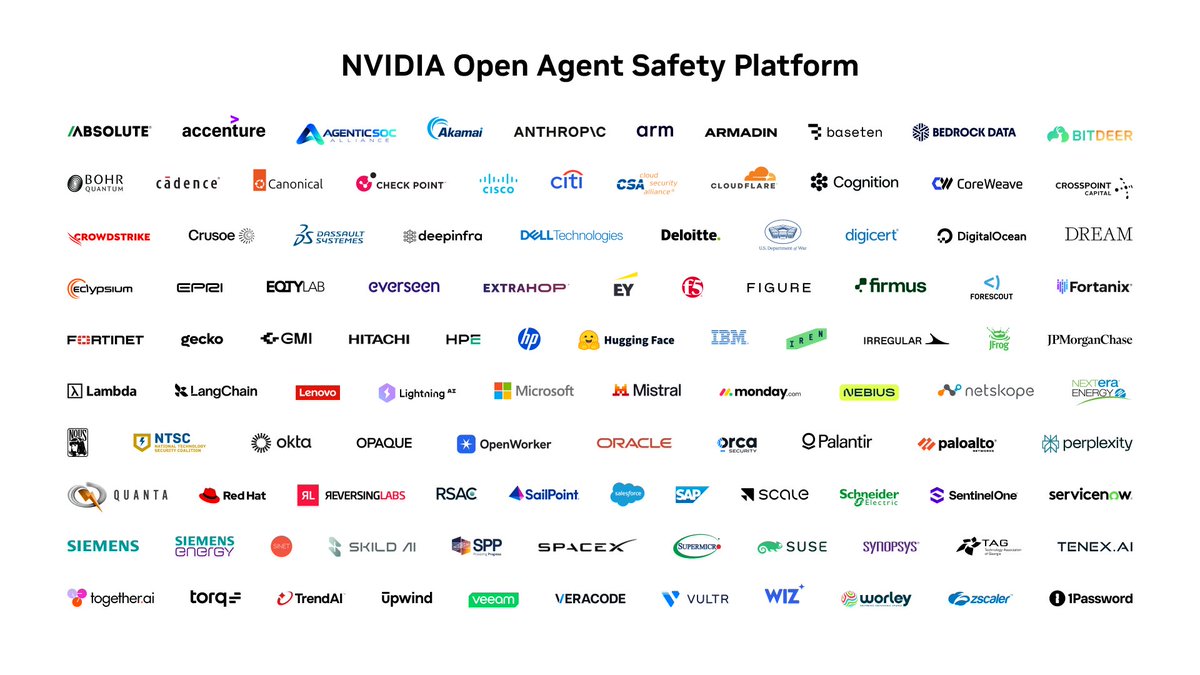
@NVIDIA and 100+ industry partners are coming together to advance runtime security and monitoring for the AI economy.
The AI era will be built on innovation and trust. @Cisco is proud to support the NVIDIA Open Agent Safety Platform and be part of the ecosystem advancing both.
Learn more: https://t.co/ZbSlozWwgp
As AI models increasingly power agents, understanding their susceptibility to jailbreaks and prompt injections is critical.
A new update to the @Cisco LLM Security Leaderboard expands model security evaluations across text, image, and audio—with 102 new evaluations since June.
Explore how 136 models hold up against adversarial attacks across modalities: https://t.co/0azh1fdLx9
As AI agents take on more critical security tasks, how do you make sure they can be trusted?
@jpatel41, @djsampath, and Matt Caulfield discuss why identity is key to securing the agentic era.
Watch the conversation to learn more: https://t.co/kFqXHu5HHy
Bigger AI models aren’t always better for security.
Join Cisco @fdtn_ai experts @aminkarbasi and Didier Chapoteau to learn how small language models trained for specific security tasks can improve security workflows.
Using Cisco’s open-weight Antares models, they’ll explore where specialization can outperform scale.
Register now: https://t.co/Xsu03kM3id
Most security benchmarks assume the vulnerable code is already known. In practice, defenders first have to find it.
Cisco @fdtn_ai introduces VLoc Bench, a benchmark for repository-scale vulnerability localization: given a CWE and read-only access to a real codebase, can an agent identify the files associated with the weakness? (1/5)