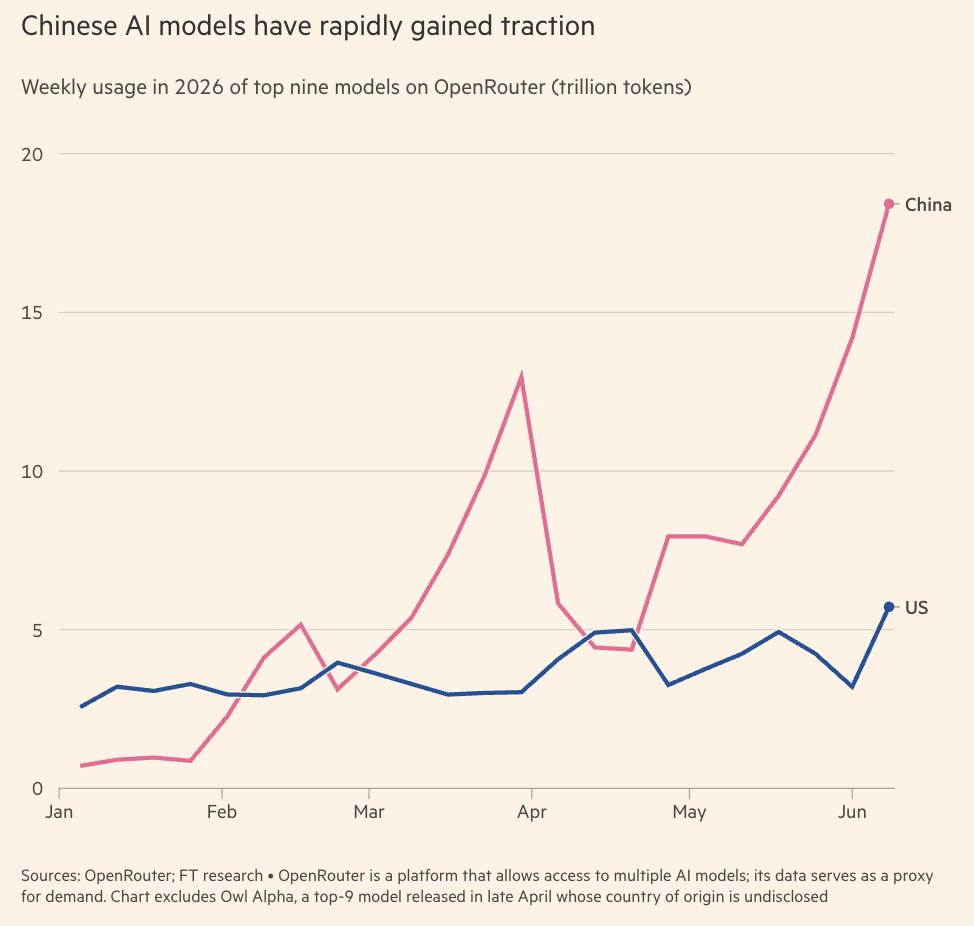
FT: "Goldman Sachs analysts last month predicted that use of AI agents would result in a 24-fold increase in token consumption by 2030 and that the huge rise in demand would exacerbate a shortage of chips over the next 12 to 18 months. While token usage and AI spending by businesses continue to grow, efforts to curb costs could weigh on the growth of the world’s largest AI labs such as Anthropic and OpenAI, which plan to go public later this year at near-trillion-dollar valuations. Since the start of the year, Chinese AI models have overtaken their US counterparts in token consumption, according to data from OpenRouter, an aggregation platform that allows users to access multiple AI models. China’s cheaper energy and more efficient models have allowed the country’s AI labs to charge less than leading US groups for tokens, giving China a new edge on the AI battleground."
Again, I believe market participants are underestimating the pricing power challenges US hyperscalers face, both due to domestic and international competition. As I wrote in my December report on "GenAI & Productivity" (https://t.co/kEx5Z4BJH7):
"While there’s a lot of speculative fear about how a single LLM could rise to dominance and what that could mean for economic, societal, and political stability, we believe the bigger concern for investors today is how relative model parity could compromise pricing power. Tech giants have thrived on monopolies and duopolies for a decade or more. Now, they’re in an LLM arms race where it’s unclear when or even if ever leadership will be sustainable. We believe competition from akin models will apply downward pressure on pricing at least for the next three years."
Learn more about Sage Road Research here: https://t.co/Wgwz2xnvR6. Interested in subscribing? Message me.
FT link: https://t.co/xssgGXkLtb
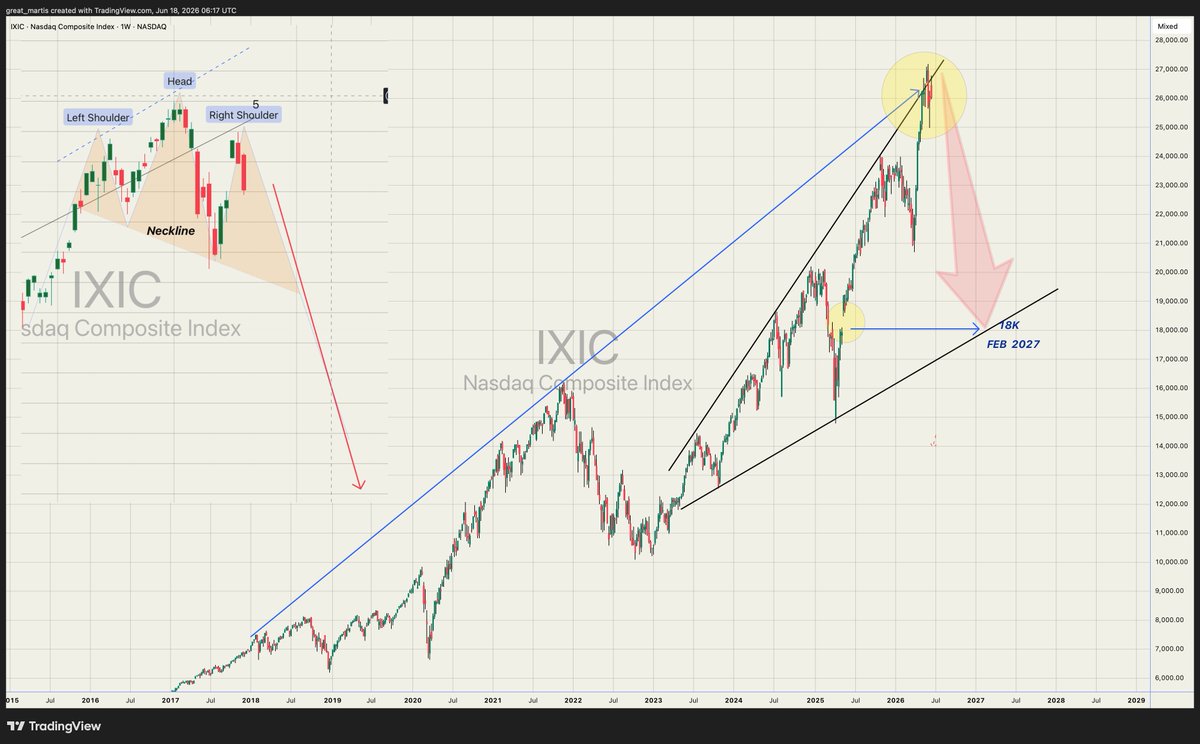
NASDAQ Composite
18k target (Gap closure)
By February 2027 at the latest.
Multiple historical levels and targets have been achieved.
Expect churn before it lets go.
Yours truly,
The Great Martis✨
She's beautiful.
Charlie Munger: “If you just get up every morning and keep plugging [away] and have some discipline and keep learning, it's amazing how it works out...”
Munger & Warren Buffett’s advice on achieving financial independence:
URGENT REALTIME STOCK MARKET FORECAST
BEARISH. CONFIRMED.
We have every single major very signal we need to make a high confidence high equity high leverage short. That means there's at least a 93% chance that we're going to dump at least 3%. I'm trading for clients at 500x leverage. So that means my clients will make 1,500% profit or 15 times their money.
We have a confirmed short-term 1 hour RSI bearish divergence, we have distribution volume increasing. And we have a bearish geometric called rising broadening wedge. Every single one of these factors alone has over a 72% likelihood. But when you multiply it against all the others, you get very close to 100% probability.
There's only one uncertainty here though. That's where the risk of liquidation comes in. Let me explain in this video...
Warren Buffett: "We assume that we'll be around forever. In our insurance business, we assume we're going to be here to pay every claim."
"There wouldn't be any sense playing games on [our] accounting because it would catch up with us later on."
"In many businesses, I don't think they have quite the same horizon on things. Many companies are thinking about what kind of little pictures they can paint for the next four quarters or so."
There are a lot of smart people at Google.
They have concluded that issuing stock at a 2.5% earnings yield is cheaper capital than issuing 30Y bonds at 5.5-6.0%.
Adjust your asset allocation accordingly.
Here is my market analysis for remainder of 2026. My base case for the second half of 2026 is relatively straightforward:
Markets chop sideways through the summer.
A meaningful low develops during September–October.
Equities rally into year-end. Beyond that, the outlook becomes significantly more cautious.
The primary reason is not earnings, politics, AI, or recession fears. It is the long-term interest rate cycle.
For 40 years, investors operated in a world where rates generally moved lower. Falling rates boosted bond prices, expanded stock valuations, reduced mortgage costs, and inflated real estate values. Most active investors today have never experienced a sustained secular rising-rate environment.
That era appears over.
The current rising-rate regime began roughly six years ago. If history is any guide, the implications for stocks, bonds, housing, and valuation multiples may only be beginning.
Why things will eventually fall apart:
1. Everybody, even Google, seems to be treating AI as if it were some kind of winner take all competition like web search was, in which Google taking over 95%
2. But everybody is building essentially the same technical solution with essentially the same data, so there is no moat.
3. If there is no moat, nobody is going to take 90% of the market.
4. With no clear winners, nobody can charge monopoly prices; instead, you get price wars and commodity pricing.
5. Which means everybody will wind up overpaying compared to the modest profits they will be able to make in an intensely competitive regime.
Am I missing something?
Paul Tudor Jones predicted the 1987 crash, made $100 million, then spent years trying to destroy this footage
you will watch him lose $6 million in one afternoon, sit in his chair and say "total devastation" then make it all back with 100% interest
This documentary will change how you think about risk forever
Bookmark & watch it. Then read the post below - $90 billion from being right just 54% of the time↓