Community-acquired respiratory virus infections in patients with haematological malignancies or undergoing haematopoietic cell transplantation: updated recommendations from the 10th ECIL-Guidelines- The Lancet Infectious Diseases https://t.co/RDJDcHk1NK
#weekend_review#AML#leusm
🧵 Optimizing Venetoclax Duration in AML (Ven + HMA)
Key observations from available data:
🔹 VIALE-A established efficacy (CR/CRi 66%, median OS 14.7 mo), not necessarily the ideal duration for every patient; Persistent cytopenias and infectious complications remain major barriers to prolonged exposure.
🔹 Karrar et al. (Mayo) suggest shorter durations (14 vs 21 vs 28 days) may be feasible in selected patients, but shorter duration should NOT be assumed to be intrinsically less myelosuppressive (AJH)
🔹 Prospective evidence does NOT currently support routine universal 7–14 day induction Venetoclax.
🔹 7+7 French study showed comparable response after 2nd cycle but toxicity was similar to 28 day venetoclax.
🔹 FILO data raise an important concept: treatment-free remission may be feasible after prolonged MRD-negative remission in favorable-risk disease (ELN2024), highlighting the importance of biology rather than fixed duration.
🔹 Metronomic/weekly Dec+Ven approaches and ongoing randomized studies (Opti-AML/Beat AML) may further redefine exposure strategies.
Current practice increasingly individualizes Venetoclax duration based on:
✓ Age/frailty
✓ Comorbidities
✓ Molecular profile/genomics
✓ Disease burden and response kinetics
✓ MRD status
✓ Cytopenias/infection risk
✓ Tolerability and treatment goals
The question may no longer be:
“How long should Venetoclax be given?”
Instead:
“For which patient, at what disease state, and for how long?”
Right patient. Right biology. Right duration.
#AML #leusm #Venetoclax
New issue of Blood Neoplasia out now! Featuring Predictors of sensitivity to immune therapies in classic Hodgkin lymphoma, Pharmacological boosting of azacitidine/venetoclax in acute myeloid leukemia, and more. Explore here: https://t.co/o6JAbGeOEh
For patients with AML treated with LIT, ELN 2024 and Beat AML 2024 best identify a favorable group. Allogeneic stem cell transplant improves survival, but patients classified as adverse risk by any system still have poor outcomes. Read in Blood Neoplasia: https://t.co/x7SeoRcNQx
Les invitamos cordialmente a reservar la fecha para las V Jornadas Catalanas, que se realizarán los días 04 y 05 de septiembre de 2026 en la ciudad de Asunción🇵🇾🩸🇪🇸
🏢 Centro de Convenciones Paseo La Galería.
🚨 Modalidad: presencial.
📍 Asunción, Paraguay
#VJornadasCatalanas
💡How can we prevent infections in adult patients receiving bispecifics for lymphoma or myeloma?
Pleased to share our new How I Treat article, just published in @BloodPortfolio 👇
Great experience writing this with @RahulBanerjeeMD and @JoshuaHillMD !
https://t.co/C08M8ZvwE7
Pre-transplant therapy for MDS to improve and "down-stage" it before allogeneic stem cell transplant does not improve outcomes
If anything, non-relapse mortality is higher for patients who get pre-transplant therapy, compared to those who undergo upfront transplant https://t.co/4lNmTGvrwj
@aamdsif
IRON OVERLOAD AFTER ALLOSCT
MYTHS vs TRUTHS 🩸🧲
❌ Ferritin = iron overload
❌ Ferritin >1000 = automatic phlebotomy
❌ Every allo patient needs MRI
❌ Ferritin must be <150
✅ Ferritin is a TREND, not a diagnosis
✅ TSAT + organ assessment matter
✅ MRI should answer a clinical question
✅ Overtreatment has consequences too
“Biochemical iron excess and clinically meaningful iron toxicity are not the same thing.”
#BMTSM #BMT #Hemetwitter
🩸 Myelofibrosis: When Should You Refer for Allogeneic HSCT?
🎤 Based on the 2024 transplant recommendations by Nicolaus Kröger
📍 15th Annual Conference of the Saudi Society of Blood and Marrow Transplantation (#SSBMT2026)
⸻
⚖️ The Core Principle
The transplant decision in myelofibrosis balances:
🧬 Disease risk
⚠️ Transplant-related risk
🗣️ Patient values and preferences
⸻
🎯 Simple Rule to Remember
📌 If expected survival with non-transplant therapy is < 5 years, the patient should be considered for allogeneic HSCT.
This remains the only potentially curative treatment.
⸻
🧬 Factors Favoring Transplant
High-Risk Disease Features
DIPSS/DIPSS-Plus high risk
MIPSS70 high or very high risk
GIPSS high risk
Circulating blasts ≥2–5%
Unfavorable cytogenetics
High-risk mutations:
ASXL1
SRSF2
EZH2
IDH1/2
U2AF1 Q157
Clinical Features
Transfusion dependence
Progressive splenomegaly
Constitutional symptoms
Accelerated phase disease
⸻
⚠️ Factors Against Immediate Transplant
Major comorbidities
Poor performance status
Uncontrolled infection
Severe frailty
Patient preference against HSCT
⸻
💊 Role of JAK Inhibitors Before HSCT
JAK inhibitors (especially Jakafi® / ruxolitinib) are commonly used to:
Reduce spleen size
Improve symptoms
Optimize performance status
Bridge to transplant
⸻
🧠 Clinical Pearl
The decision is not:
“Can this patient undergo transplant?”
It is:
“Does the risk of the disease exceed the risk of transplant?”
⸻
❓ Board-Style MCQ
Which patient with myelofibrosis should be strongly considered for allogeneic HSCT?
A. Low-risk disease, asymptomatic
B. Expected survival >10 years on medical therapy
C. High-risk disease with projected survival <5 years
D. Mild splenomegaly only
✅ Answer: C. High-risk disease with projected survival <5 years
⸻
📚 References
Lancet Haematology – Kröger et al. 2024 Recommendations
EBMT
NCCN Guidelines for Myeloproliferative Neoplasms
#Myelofibrosis #AllogeneicHSCT #BoneMarrowTransplant #MPN #Ruxolitinib #EBMT #SSBMT2026 #Hematology #KFSHRC
@Giguere_P@Papa_Heme Correct.. I would move more towards the 30% side though if fav risk is taken out of the equation but ok say 40%
So if a patient is told there is about a 4/10 chance they got cured from chemo alone and they wish not to proceed to BMT that is of course ok as long as they understand
When can we say a cancer is curable?
We want to cure all cancers. Some cancers are curable. Some are not. As oncologists, we all have individual patients with cancer who are cured. Even those considered incurable! Anecdotes abound. But when can we say a cancer is curable compared to saying an individual patient is cured. There is a critical difference.
Let’s take myeloma, a form of blood cancer. With recent advances, some patients with myeloma are likely cured. But can we call myeloma a curable cancer? I am still reluctant. I still cannot look a young newly diagnosed patient in the eye and say that we are dealing with a curable cancer. I still cannot assure them like I do with diffuse large cell lymphoma or Hodgkins.
Cure is a straightforward concept:
-You need to be able to eradicate the disease.
-You need to be able to stop all therapy.
-You need to have a high probability that after a period of time of being disease free after stopping all therapy that patients have a very low risk (usually less than 5%) of recurrence.
Some cancers are clearly curable, eg. many localized solid organ tumors.
Some cancers are curable even in advanced stages. Eg., Hodgkins, acute leukemias, testicular cancer, diffuse large cell lymphoma. No one doubts that these cancers are curable. We confidently tell patients that.
For some cancers, like myeloma we are now at the threshold of cure. We are debating whether it’s curable or not. (The fact we are wondering whether we can cure myeloma is in and of itself a monumental advance and reflects the fact that many patients can live 10-15 years or longer after diagnosis.)
At present I am still not confident that we can call myeloma a curable disease because:
1) Most studies that show excellent disease free survival are in the context of continuous suppressive anti-myeloma therapy. Unlike curable cancers like diffuse large cell lymphoma, we don’t have studies that show a clear plateau in the disease free survival curve after stopping all therapy: the gold standard visual of a curable cancer.
2) The long overall survival we now see in myeloma reflects outcomes not just with frontline therapy but successful therapy of relapse with with sequential therapy of multiple relapses. The disease course of myeloma is still one of multiple remissions and relapses.
3) We don’t have sufficient follow up in patients with highly effective modern therapy. I’m hoping for example with ciltacel CART we can finally get there. Time will tell if we can fulfill requirement #1 above.
But we are very hopeful.
We want to cure both newly diagnosed and relapsed myeloma. We may already be achieving this, and all we need is time to demonstrate it.
Addition of ASCT to an ibrutinib-containing first-line treatment in patients aged 18–65 years with mantle cell lymphoma (TRIANGLE): 4·5-year follow-up of a 3-arm, randomised, open-label, phase 3 superiority trial of the European MCL Network - The Lancet https://t.co/7Hypd9VG5A
X
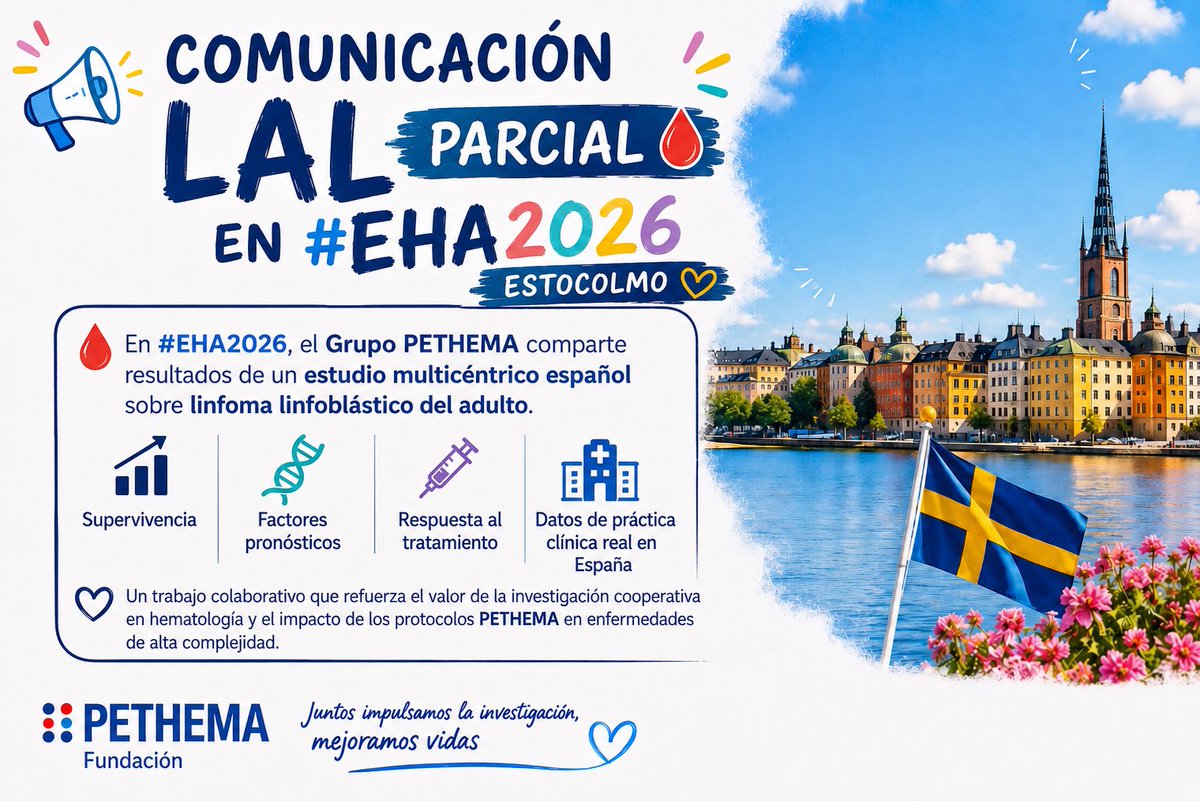
#EHA2026 | PETHEMA presenta un estudio multicéntrico sobre linfoma linfoblástico del adulto en España: respuesta al tratamiento, supervivencia y factores pronósticos en práctica clínica real. Investigación cooperativa para seguir mejorando el abordaje de las hemopatías malignas
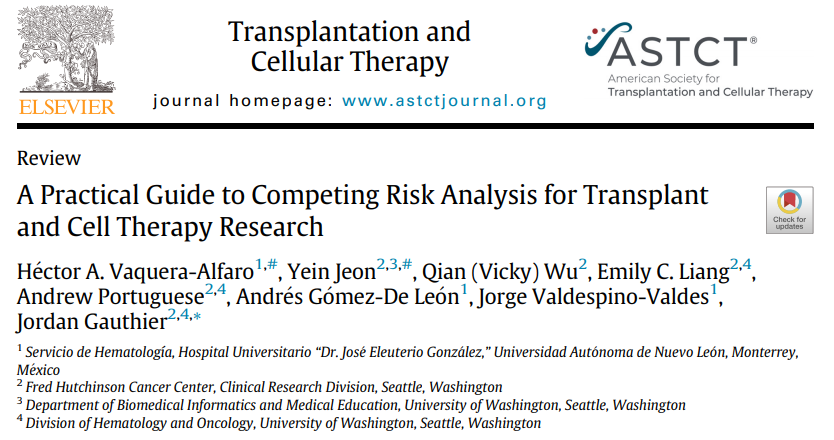
Competing risk analyses in #HCT and IEC research are frequently misconstrued. This practical guide outlines correct interpretation of competing risk methods and provides a step-by-step R tutorial for publication-ready analyses figures and tables. https://t.co/tCO8kCBbUH
Impact of CD34+ Graft Cell Dose on Outcomes After Haploidentical Bone Marrow Transplantation with Post-Transplant Cyclophosphamide-Based GVHD Prophylaxis
https://t.co/HD1EL70hv2
🎉 Happy to share our recent publication, a network meta-analysis of prospective trials evaluating GVHD ppx in the MSD setting 🙌🏽
Huge shout-out to my dear friends and co-authors, @GonzaloBentoli1 and @NicoGagelmann 💪🏽