A lawyer built an offline AI server from eight used V100s and runs DeepSeek V4.1 Flash at up to 215 tok/s, so case files never leave the office.
The trick isn't the GPUs. It's keeping the heavy work inside each NVLink board.
What the build gets right: https://t.co/5eEkaSL2RL
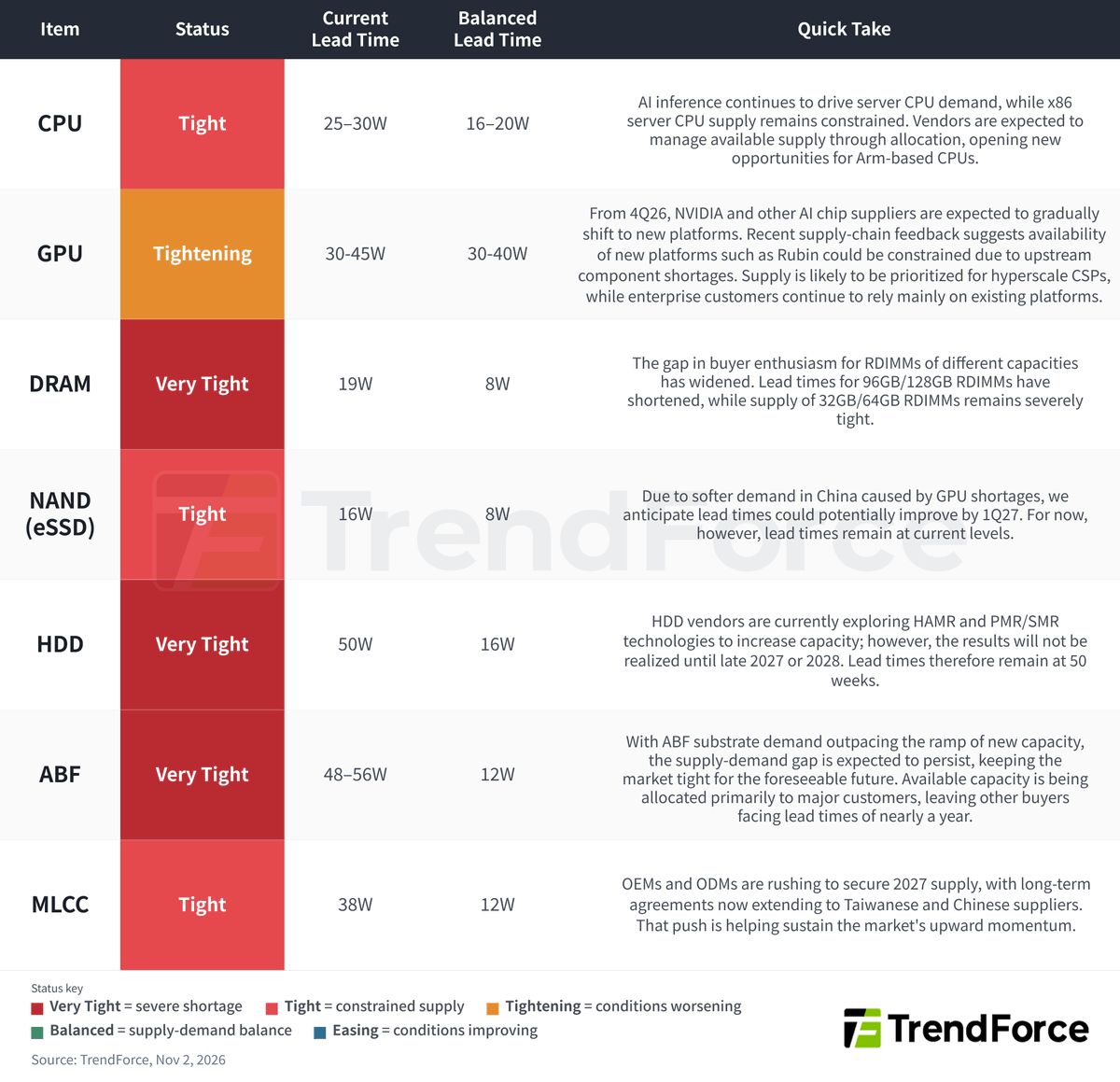
GPU lead times are 30 to 45 weeks per TrendForce, and the top end moved 5 weeks in a single week. Hardware that's already built isn't in that line: tested A100 40GB nodes ship now, each with its own burn in results. https://t.co/m1OE73VCL0
TrendForce:
GPU lead times are 30–45 weeks, with the upper end of the range up 5 weeks from the previous week.
DRAM lead times have shortened to 19 weeks, down 1 week from the previous week.
MLCC lead times have extended to 38 weeks, up 3 weeks from the previous week.
If inference is most of the demand ahead, a lot of it doesn't need the newest chip. One tuned A100 40GB node serves 250 chat users at once on a 27B model, and tuning alone took it from 0.53 to 1.04 tokens per joule. https://t.co/CXPJbx2tZM
I think AI compute cost-per-watt prices are going to stay elevated a lot longer than many people expect.
Less than 5% of U.S. consumers even pay a subscription for an AI product, with some putting the estimate <2%. People are clearly finding Grok Bot to be very useful because @SpaceX just had to significantly cut back usage capacity due to overwhelming demand. But we're still so early in the AI adoption curve.
Existing users are going to eat up significantly more compute as models get better and agents start handling increasingly complex tasks and jobs. Inference will increasingly become a larger and larger share of compute capacity.
People are seriously underestimating how much demand is still ahead of us and how long it'll take supply to catch up. I think this is partly why Elon thinks SpaceX could exit 2027 with an annual recurring revenue rate of $500 billion to $1 trillion. They can deploy the compute faster than anyone else, and the demand for that compute is insatiable, and likely will be for a long time to come.
Revolut says moving about 2,000 engineers off metered APIs onto self hosted GLM cut its coding bill 90%. Their own estimate, on B200s.
GLM's smaller Flash model runs on older cards too. One A100 40GB node with 4 bit weights did 899 tok/s tuned, 100 for a single user.
Jump has a desk writing puts on GPU rent now, so a neocloud can hedge the hourly rate falling, per the WSJ. Rent is becoming something you trade.
The old cards are on that curve too. As of Oct 19 an A100 rented 9% above a straight six year depreciation line.
Most data halls running today were built for air cooled racks at a fraction of 285 kW. That's where the installed base lives: one A100 40GB node averaged 5,148 W at full GPU load, measured at the BMC, on the floor that's already there. https://t.co/4FonLumdoe
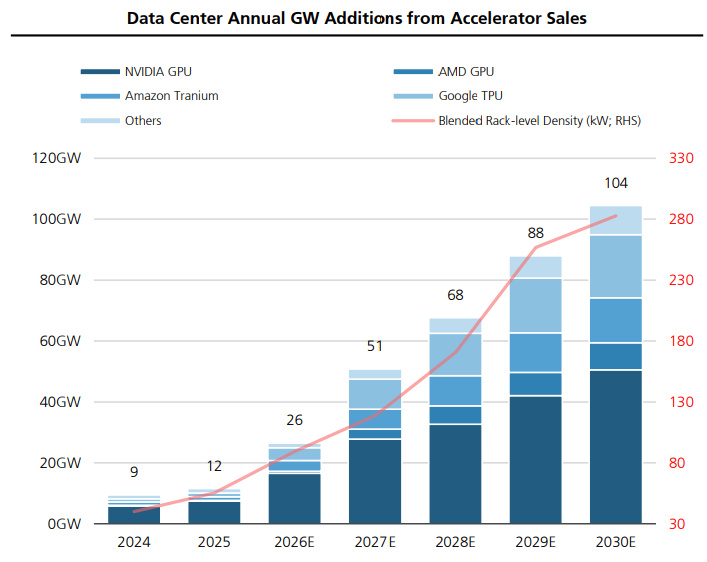
Annual AI data center capacity additions are projected to quadruple to 104GW by 2030:
• $NVDA GPUs ~50GW
• $GOOGL TPUs ~21GW
• $AMZN Trainium ~15GW
• $AMD GPUs ~9GW
What's even more interesting is that rack density is projected to more than triple to ~285kW by 2030 forcing a major shift toward liquid cooling and redesigned power distribution that could make infrastructure readiness a massive gating factor for how fast AI can scale:
• $CLS builds high-density racks & is engineering for 500kW designs
• $VRT coolant distribution units, liquid cooling & fluid services plus factory-built systems like SmartIT
• $GEV high-voltage gear & transformers through Prolec GE plus its Trench deal
• $FPS switchgear, transformers, power distribution units & eHouses needed to bring new capacity online
• $ON silicon carbide for 800V DC plus reported Ferric acquisition talks for power at the chip
• $NVTS gallium nitride & silicon carbide for 800V DC racks
Long context is where people assume a 40GB card runs out of room. So we ran coding agent traffic on one A100 40GB node: 32k tokens in, 1k out, 85% of the prompt reused like a real agent loop.
1,006 tok/s stock, 1,718 tuned. Software only.
Token prices down 67%, token spend up over 120%. Past a certain bill, owning the hardware is the cheaper way to buy tokens.
A tuned A100 40GB node handles about 250 chat users at once on a 27B model, and it doesn't bill per token. https://t.co/1oIxVAtdu2
Cheaper tokens don't mean cheaper bills
Since May:
- Average token prices are down 67%
- Token spend is up more than 120%
Charts of the Week: https://t.co/VOYp2wQyoZ
Question for teams whose token bill is now bigger than payroll: at what monthly spend did you start pricing out your own GPUs?
For scale, one tuned A100 40GB node serves about 250 chat users at once on a 27B model.
Per Korean press, SK hynix customers are asking for twice the HBM it can make, and some are cutting stacks per chip to stretch it.
Every A100 40GB that's already built has its 40 GB of HBM on the package. Tuned, one 8 GPU node serves 250 chat users at once on a 27B model.
Same A100 40GB node, software only: 2,182 to 4,235 tok/s on a 27B model.
With GPU rent up and token prices down 58% since mid July, tokens per GPU is the one part of that spread an operator still controls. https://t.co/DdLlq5BErt