Mosquito-borne diseases are breaking records as climate change and other human influences allow the insects to expand their range
https://t.co/V6i6pEbvc5
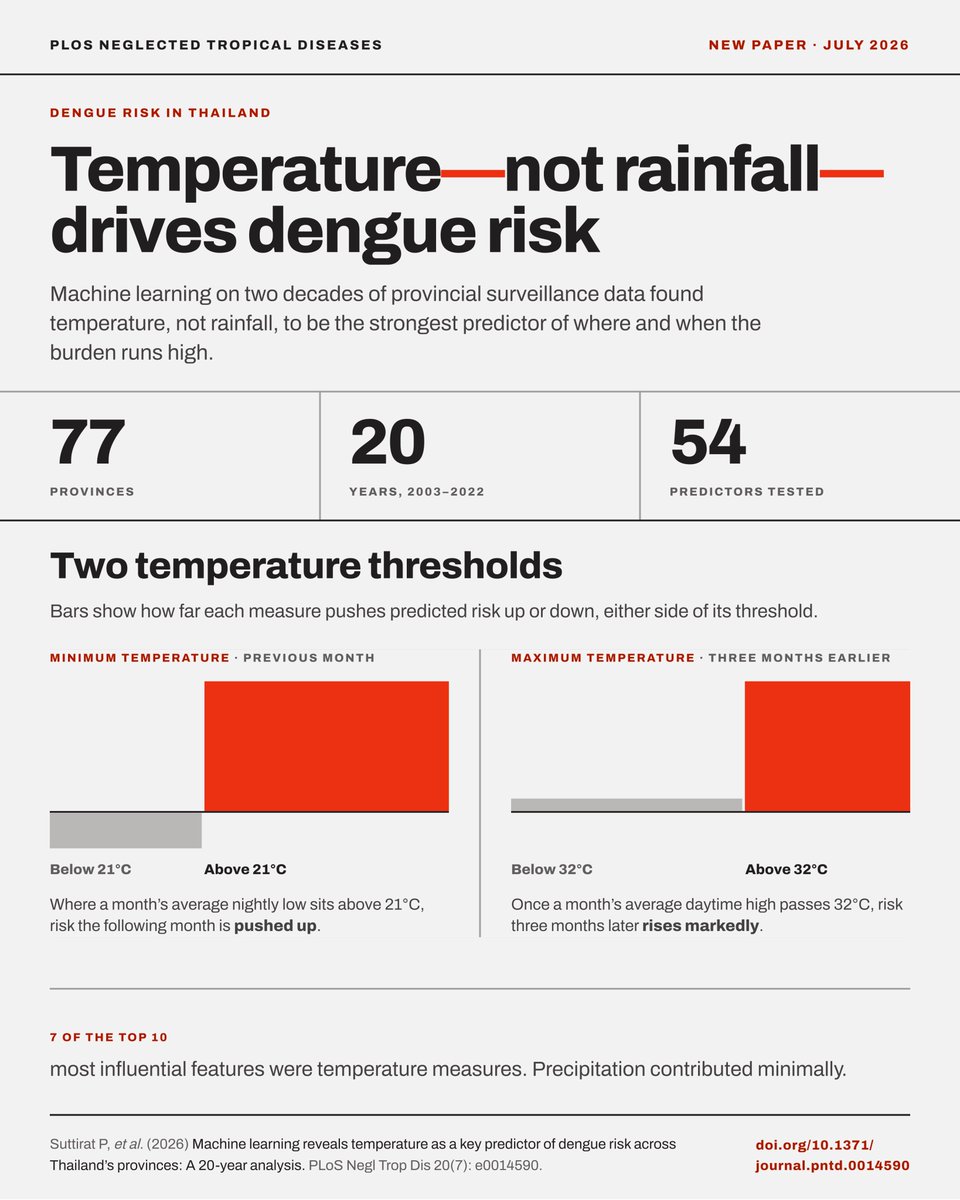
We published a new study on the dengue risk in Thailand.
Using machine learning to analyze 20 years of outbreak data, we found that temperature is the leading indicator of dengue risk, not rainfall.
https://t.co/j4PFXAEeQJ
We published a new study on the dengue risk in Thailand.
Using machine learning to analyze 20 years of outbreak data, we found that temperature is the leading indicator of dengue risk, not rainfall.
https://t.co/j4PFXAEeQJ
#Dengue is no longer a sporadic threat confined to the tropics. More than half the world's population live in areas at risk.
Reversing this trend demands urgent and coordinated action. That means:
- stronger surveillance for early detection;
- investing in innovative vector control strategies;
- equitable access to vaccines and care.
@WHO is committed to supporting countries reduce the risk posed by dengue.
#Hantavirus The @WHO update timeline on the MV Hondius #HantavirusAndes cluster: 8 cases total, 6 confirmed Andes virus, 2 probable, and 3 deaths. The vessel will arrive in Tenerife, Canary Islands, Spain, in the early morning of 10 May.
🟥 Case 1 – index, probable, fatal
A Dutch adult man with prior travel in Argentina/Chile/Uruguay boarded on 1 Apr, became ill on 6 Apr, and died on board on 11 Apr. No lab tests were done; the WHO considers the infection most likely acquired in Argentina before embarkation. According to the press, he was a famous Dutch #ornithologist (bird scientist).
🟥 Case 2 – confirmed, fatal
A Dutch adult woman and close contact (wife) of Case 1 disembarked at Saint Helena on 24 Apr with GI symptoms, deteriorated during transfer, and died in Johannesburg on 26 Apr. PCR confirmed Andes virus on 4 May.
🟪 Case 3 – confirmed, ICU
A British adult man with symptom onset on 24 Apr was medically evacuated from Ascension to the ICU in Johannesburg on 27 Apr. He was PCR-positive on 2 May and sequenced as Andes virus; remains in intensive care.
🟥 Case 4 – confirmed, fatal
A German adult woman with onset on 28 Apr (fever, malaise, then pneumonia) died on 2 May. Post-mortem testing confirmed the Andes virus.
🟩 Case 5 – confirmed, ship doctor
Adult male ship doctor; onset on 30 Apr with fever, fatigue, myalgia, and mild respiratory symptoms. PCR-positive for Andes virus on 6 May; medically evacuated to the Netherlands and stable in isolation.
🟩 Case 6 – confirmed, trip guide
A British adult male expedition guide; onset on 27 Apr with mild respiratory and GI symptoms. PCR-positive for Andes virus on 6 May; medically evacuated to the Netherlands and stable in isolation.
🟩 Case 7 – confirmed, ICU
A Swiss adult male passenger who disembarked at Saint Helena and returned to Switzerland via South Africa and Qatar on 27–28 Apr. Symptoms began on 1 May; PCR-positive for Andes virus on 5 May; hospitalized in isolation in Zurich. (This case was originally case 8 in the previous WHO DON.)
🟧 Case 8 – probable, hospitalized
A British(?) adult male who disembarked at Tristan da Cunha on 14 Apr. Developed diarrhea on 28 Apr and fever two days later; currently stable in isolation and classified by WHO as a probable case.
⚠️ WHO also notes that one previously suspected patient transferred to Germany (originally Case 7) tested negative by PCR and serology, so that person is no longer counted as a case. (but still monitored until the end of incubation)
⚠️ Contact tracing of passengers who disembarked in St. Helena is ongoing; Cases #2, #7, and #8(?) might have had close contacts on the flight due to commercial flight travel in the potential infectious period, but the WHO addresses that contacts were notified and managed by each country's authority and the WHO.
⚠️ WHO currently assesses the public health risk related to the cruise ship as moderate and, at the global level, as low. The main reason for low public risk is that the Andes virus has demonstrated limited human-to-human transmission in previous outbreaks, typically occurring among close contacts and within household settings, generally requiring prolonged close exposure.
⚠️ Investigations on the travel history and potential exposures of the first case in the Southern Cone subregion of the Americas are ongoing and suggest possible exposure to rodents during bird-watching activities. (The index case was an ornithologist, a bird scientist.) Viral sequencing analyses are also ongoing and will compare the ANDV strain associated with this outbreak with strains circulating in Argentina, Chile, and Uruguay, where the disease is enzootic.
⚠️ Full Genome Sequenced by Swiss Experts and Virus Linked to South American Rodent Reservoir: suggesting a spillover event, likely transmission from the known reservoir system in Argentina and Chile.
🔗 https://t.co/qgjjZXtgl1
In this perspective we discuss how the suspected Andes virus associated #hantavirus cluster on the expedition cruise ship MV #Hondius illustrates a critical preparedness gap in managing rare zoonotic infections in mobile, closed, and medically constrained settings. Focusing on the reported multi-country cluster involving severe hantavirus cardiopulmonary syndrome, deaths, and international passenger dispersal, it highlights the associated diagnostic, clinical, and epidemiological challenges. The perspective also explains why #Andes virus is distinct among hantaviruses, including its documented potential for limited person-to-person transmission during close and prolonged contact, with insights into the virology and pathogenesis of Andes virus. https://t.co/yMTrCkqueh
Welcome home Reid, Victor, Christina, and Jeremy! 🫶
The Artemis II astronauts have splashed down at 8:07pm ET (0007 UTC April 11), bringing their historic 10-day mission around the Moon to an end.
🚀 As Artemis II astronauts journey around the Moon right now, our new paper asks a critical question:
What if a respiratory virus spreads inside a spacecraft?
📄 https://t.co/xmstawULPR
#ArtemisII#NASA
🚀 As Artemis II astronauts journey around the Moon right now, our new paper asks a critical question:
What if a respiratory virus spreads inside a spacecraft?
📄 https://t.co/xmstawULPR
#ArtemisII#NASA