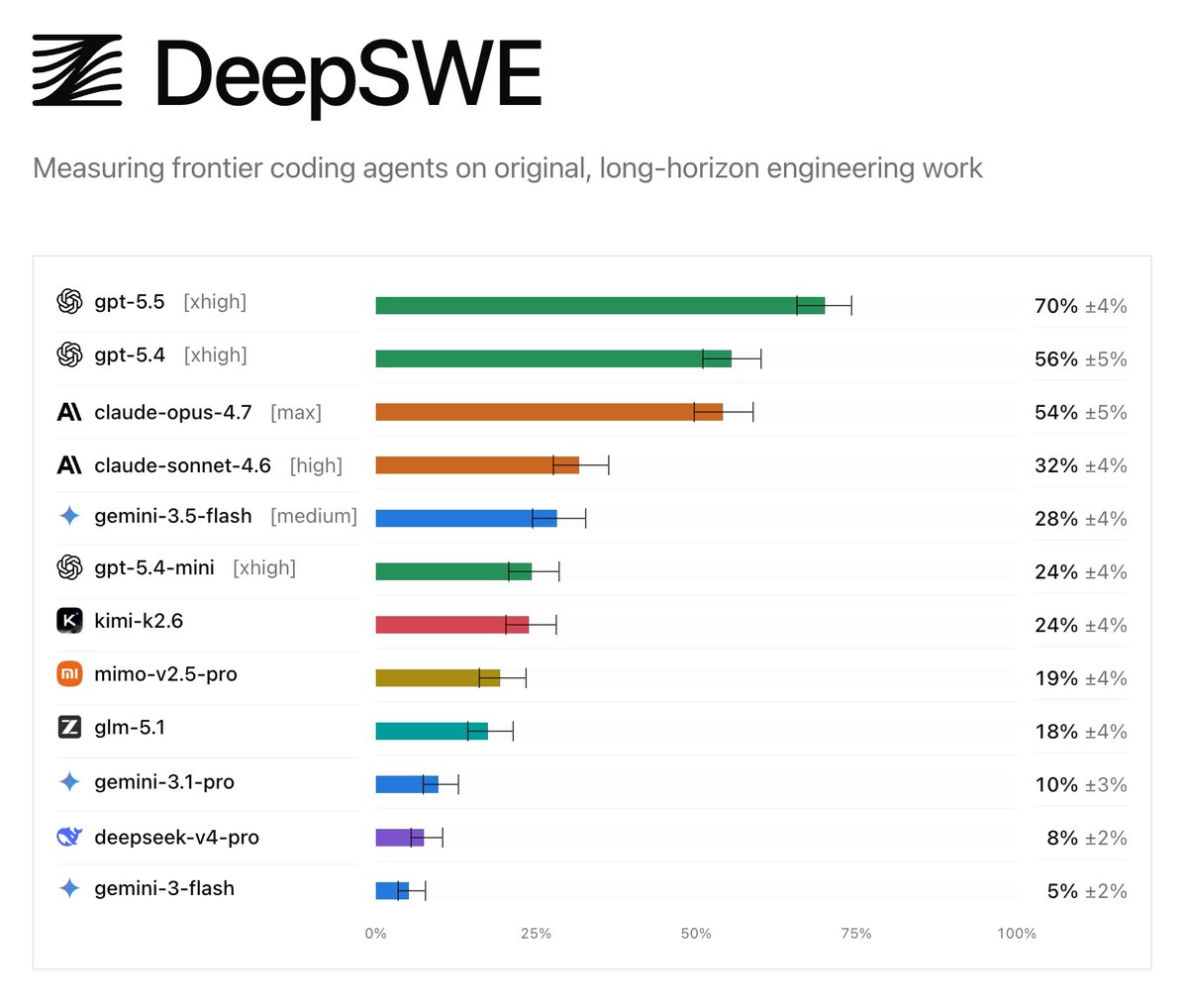
We think it’s great that lots of people are reviewing and scrutinizing DeepSWE. It being our first benchmark, we wanted to invite public collaboration and discourse, which is why we shared all our tasks and grading results in the open.
Since then, we've made lots of improvements in our methods internally and I'm very excited about the problems we’re better able to solve as a result. Notably, we’re at a point again where no benchmarks accurately reflect the capabilities of current models, and our upcoming work will be addressing this.
Introducing Benchmark Reviews: our new initiative to audit AI benchmarks. We are launching with 15 benchmarks: 4 Verified, 9 Flawed, and 2 with not enough information for a review.
Been seeing some pretty impressive improvements over the last few gemini model versions. Can definitely see a use for this now, especially given the cost and speed.
Gemini 3.7 Flash debuts at 65.5% on DeepSWE.
It delivers substantial improvements over 3.6 Flash, scoring +18.8% higher while costing less than half as much per task.
GLM 5.2 is now on DeepSWE as the top open-source model on our leaderboard.
With a pass@1 score of 44% at max effort, GLM 5.2 is indisputable #1 open-source model besting Kimi K2.7 Code by 17%.
We've updated the Artificial Analysis Coding Agent Index, replacing SWE-Bench Pro with Datacurve's DeepSWE benchmark - the swap lifts Codex with GPT-5.5 (xhigh) above Claude Code with Opus 4.8 (max), while the newly released Claude Fable 5 (max) in Claude Code debuts at the top
DeepSWE, built by @datacurve, writes its tasks from scratch rather than adapting them from public GitHub issues or pull requests, so no model has seen the solutions during training. That matters because SWE-Bench Pro, the benchmark it replaces in our Coding Agent Index, had grown gameable, with some models recovering the fix from the repository's commit history instead of solving the task.
The swap reorders the index: Codex with GPT-5.5 (xhigh) rises from 65 to 76, overtaking Claude Code with Opus 4.8 (max) at 73. Claude Code with Fable 5 (max), which enters directly on the refreshed index, leads at 77. SWE-Bench Pro had been flattering some combinations and penalizing others.
More below.
Today we’re releasing DeepSWE, a new standard for agentic coding benchmarks.
On public leaderboards, top models often look relatively close in capability. DeepSWE shows where they actually diverge, reflecting the realistic experience of developers in their day-to-day work.
So many coding agent interfaces treat great code review UX as an afterthought (understandable for CLIs, but even GUIs??) when it’s such a critical part of the process
Congrats to @datacurve on their $15M Series A!
Datacurve provides frontier training data to the world’s leading foundation-model labs, helping to push the boundaries of what AI can do.
https://t.co/8SCyvZ6OEt
Today we’re announcing we’ve raised $17.5 million in funding across a $15M Series A led by Chemistry and a $2.7M Seed to accelerate foundation model progress through providing frontier training data for LLMs.
When we first started Datacurve, it came from a simple realization: foundation model progress is limited not just by compute, but by data quality and complexity.
The right data unlocks new capabilities, especially in coding, where accuracy and reasoning matter most.
We’re now proud to partner with the world’s leading foundation-model labs, providing them with high-quality, complex training data that helps push the boundaries of what AI can do.
This is still just the start. Come build the future of technology with us in San Francisco: https://t.co/6vVsjUmj4t
Huge thanks to our incredible team and investors who’ve believed in us since day one and beyond: @garrytan at @ycombinator, @1vnzh from @cohere , @Mark_Goldberg_ from @chemistry_fund, @TheDerrickLi from @AforeVC, @forwarddeploy, @SoheilK, and @shyamalanadkat.