📢Meet Qwen3.8-Max — our most capable model to date.
Next week, the open weights of Qwen3.8-Max will be released, and Qwen3.8-27B is also going open-weights to meet you all!🎉
Qwen3.8-Max, a new bar for coding and cowork at 2.4T parameters:
- Autonomous coding: 10+ days of self-evolving development, from empty folder to production without hand-holding, complete project trace in the GitHub:https://t.co/iVHZWQoeSo
- Real work, real results: Production-quality deliverables across hundreds of professions.
- Long-horizon mastery: System-level autonomous planning with closed-loop adaptive learning, driving 500+ turns of chip design optimization and 365 days of e-commerce strategy.
- Native multimodal intelligence: Vision isn't just input — it's a continuous feedback loop for planning, execution, and self-correction.
💰Pricing:
Input: $2.0 / M tokens
Output: $6.0 / M tokens
Implicit Caching: $0.25 / M tokens
Start building with Qwen3.8-Max! 🚀
📖 Blog: https://t.co/iwjmQxLBof
✅ Qwen Studio: https://t.co/4V2pFvDovG
⚡ API: https://t.co/gAGqaLQGbN
EL CUARTETO DE LA FELICIDAD🧠
DOPAMINA
Duerme 7 a 9 horas.
Celebra logros diarios.
Haz ejercicio diario.
OXITOCINA
Medita cada mañana.
Dale un abrazo a alguien.
Haz un acto de generosidad.
ENDORFINA
Practica hobbies.
Ríe con seres queridos.
Baila, canta.
SEROTONINA
Agradece todos los días.
Disfruta de la naturaleza.
Recuerda momentos importantes.
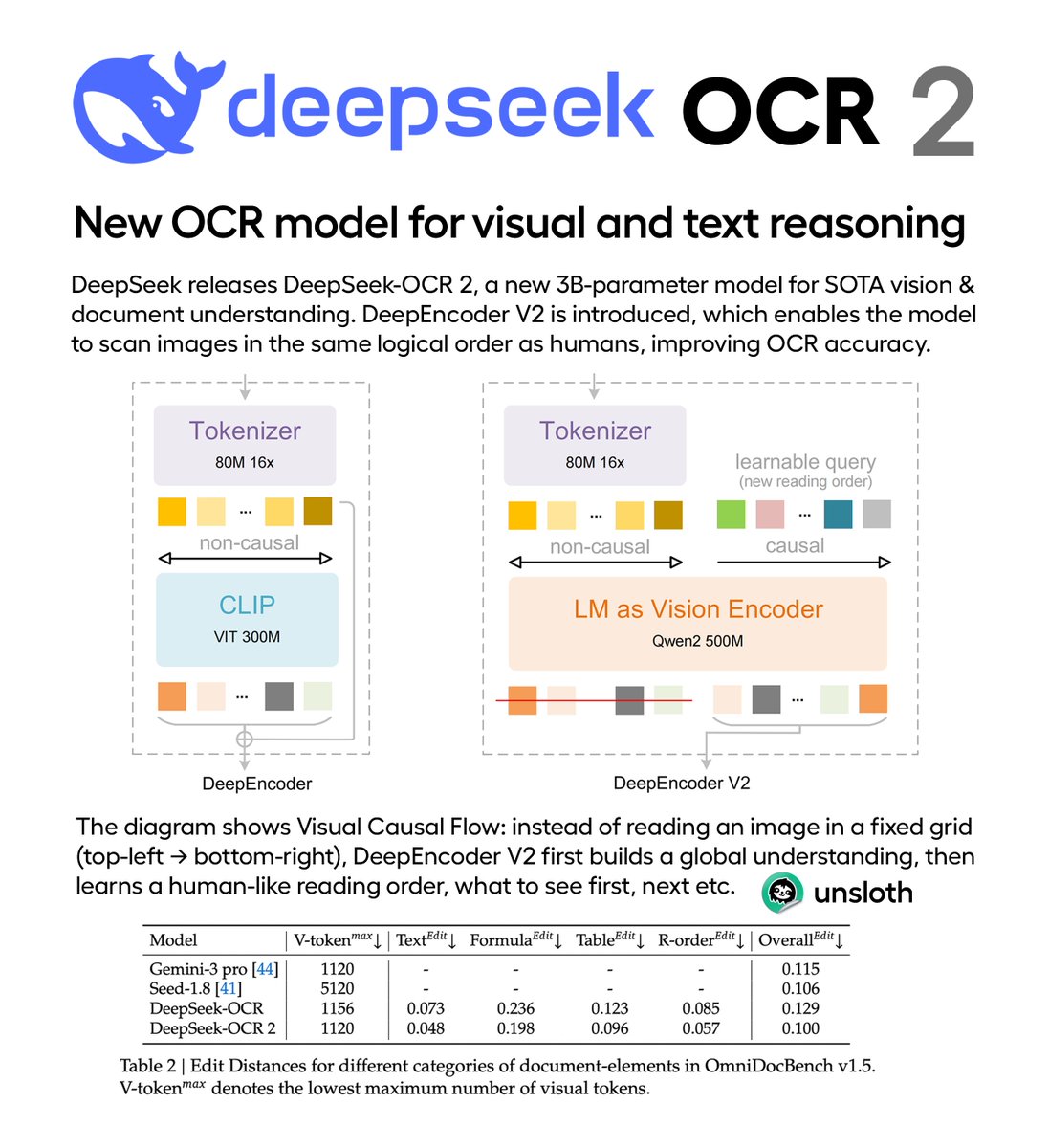
DeepSeek releases DeepSeek-OCR 2. 🐋
The new 3B model achieves SOTA visual, document and OCR understanding.
DeepEncoder V2 is introduced which enables the model scan images in same logical order as humans, boosting OCR accuracy.
Instead of traditional vision LLMs which read an image in a fixed grid (top-left → bottom-right), DeepEncoder V2 first builds a global understanding, then learns a human-like reading order - what to attend to first, next, and so on.
This improves OCR on complex layouts helping it follow columns, link labels to values, read tables coherently, and handle mixed text + structure more reliably.
DeepSeek-OCR 2 outperforms Gemini 3 Pro on benchmarks and is >4% improvement over the previous DeepSeek-OCR.
You can now run and fine-tune DeepSeek-OCR 2 with Unsloth and our guide.
Guide: https://t.co/z5Hu7J7KkW
Model: https://t.co/OuVLY7SvhP
We’ve acquired Torch, a healthcare startup that unifies lab results, medications, and visit recordings. Bringing this together with ChatGPT Health opens up a new way to understand and manage your health.
We're excited to welcome the Torch team to OpenAI @IlyaAbyzov, @elh_online, @jfhamlin, and Ryan Oman.
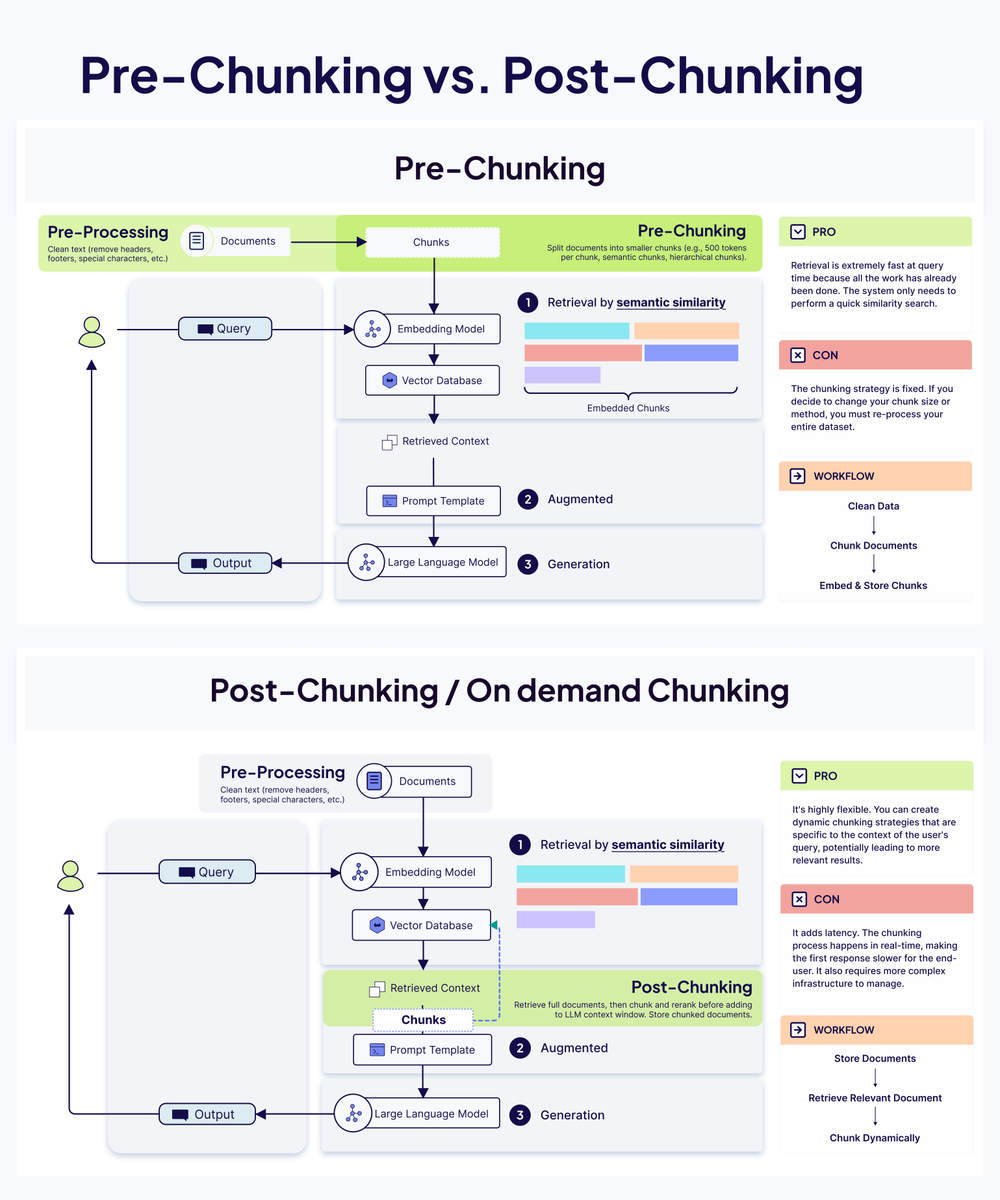
Good context engineering isn’t just 𝘩𝘰𝘸 you chunk.
It’s 𝘸𝘩𝘦𝘯 you chunk.
And that timing choice creates two completely different architectures.
𝗣𝗿𝗲-𝗖𝗵𝘂𝗻𝗸𝗶𝗻𝗴: (the classic way)
Everything happens offline before a user ever sends a query.
𝗪𝗼𝗿𝗸𝗳𝗹𝗼𝘄: clean → chunk → embed → store → fast retrieval
𝗣𝗿𝗼𝘀:
✓ Lightning-fast retrieval
✓ Simple, stable architecture
✓ Predictable performance
𝗖𝗼𝗻𝘀:
���️ Locked into your chunking strategy
⚠️ Costly to change chunk sizes
⚠️ Not adaptive to query context
𝗣𝗼𝘀𝘁-𝗖𝗵𝘂𝗻𝗸𝗶𝗻𝗴: (the advanced approach)
Instead of chunking upfront, you chunk after retrieval, based on the actual query.
𝗪𝗼𝗿𝗸𝗳𝗹𝗼𝘄: retrieve doc → chunk dynamically → rerank → send to LLM
𝗣𝗿𝗼𝘀:
✓ Query-aware chunking
✓ More relevant results
✓ Adapts to diverse question types
𝗖𝗼𝗻𝘀:
⚠️ Higher latency
⚠️ More infrastructure
⚠️ More compute per query
𝗪𝗵𝗶𝗰𝗵 𝘀𝗵𝗼𝘂𝗹𝗱 𝘆𝗼𝘂 𝗰𝗵𝗼𝗼𝘀𝗲?
• 𝗣𝗿𝗲-𝗰𝗵𝘂𝗻𝗸𝗶𝗻𝗴 → you need speed + simplicity
• 𝗣𝗼𝘀𝘁-𝗰𝗵𝘂𝗻𝗸𝗶𝗻𝗴 → you need flexibility + relevance
Want to go deeper? The free guide about chunking strategies for context engineering breaks it down 🧡
https://t.co/tIKNrsbWy1
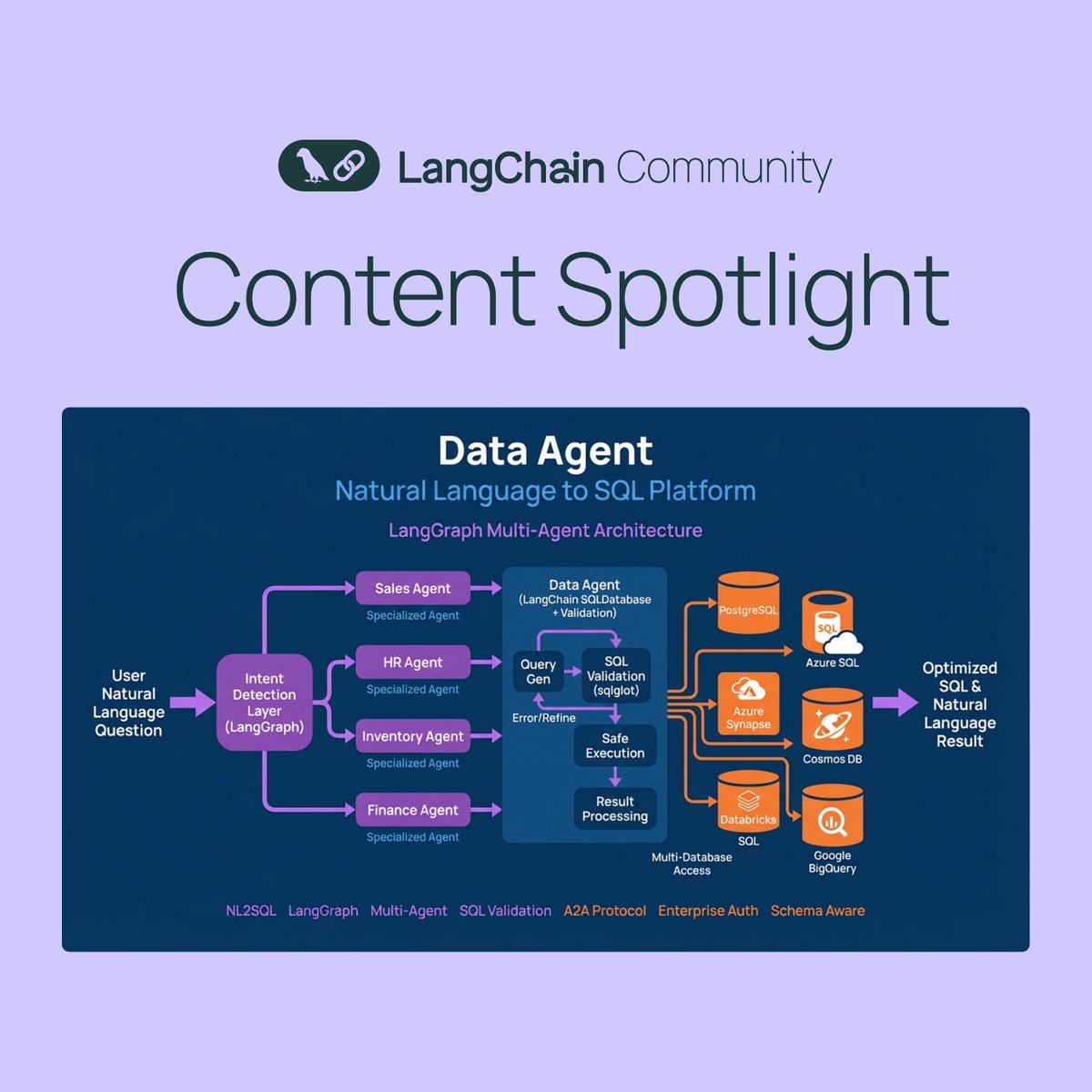
🗣️💾 Data Agent
Made by the LangChain Community
An open-source NL2SQL platform that converts natural language to SQL across 6 databases. Built with LangChain SQLDatabase and LangGraph multi-agent architecture for routing, generation, and validation.
Check it out: https://t.co/1TVD2kjoQd