A late announcement but here it is!
I have published my first poetry book titled, "But what is Grief? If not Love and Food." is live on Amazon.
https://t.co/PRRDBFAMCe
There are many ways to read a city. Here’s a postcard mapping Mumbai through women’s writing (fiction) — stories that take us across trains, apartments, overbridges, memory, intimacy, labour, migration, ambition, and everyday life. 1.
The book invites a kind of intimate witnessing that can only come from scholarship premised on altogether different terms than those usually used to engage collaborators,...richly textured with scenes of struggle and triumph.—Antipode https://t.co/nL1risbU9r
@mediaiou@Harvard
Lila Abu-Lughod shows Why Those Who Claim To Save Muslim Women Don’t Care About Them at All.
Important reading of her book Do Muslim Women need Saving? (2013)
@project_polis
https://t.co/eRJc2xh9HW
"#Qualitative Research: Prioritizing Participant’s Individuality" - Ethically & in the interest of quality research, researchers owe it to their participants to consider each one as a unique individual with distinctive contributions to make to the study https://t.co/Ea90HgjDxy
Every year after Diwali, I pay for the manmade calamity in Delhi. The whole nexus of over medicating (by steroids) by doctors, reducing 'patient opinions', pressure to invest in purifiers and staying indoors despite work is frustrating as an individual with Chronic Illness.
So-called objective metrics in academia disadvantage women. Letters of reference for women tend to have less stand-out adjectives. Women's papers are cited less, their grants are smaller on avg & their papers have a harder time getting past reviewers.
https://t.co/CSwmxsx9yt
In 'Someone Else's Problem: Waste and labour in urban South Asia,’ I write for @thecaravanindia’s July 2025 Issue on questions of labour and waste in urban South Asia, across Delhi, Lahore, and Guangzhou.
https://t.co/q2PPvghoWM
Have read Shahu Patole's Dalit Kitchens of Marathwada and Anoothi Vishal's Stories about Kayasth Food and Culture. The differences in the two food cultures (read castes) are striking. Food remains a critical lens to study society.
It’’s May 1st. Labour Day in India.
The house help came. The cook showed up. The apartment security gaurd & housekeeping staff is on duty. Only me and my laptop class friends taking a break to “celebrate labour.”
Irony is now a public holiday.
It was great to be at @iitdelhi to give a talk on ‘Stratification Economics and Conspicuous Consumption’ to PhD students. Thanks @ishanjsr for the invitation!
📣 New BJPIR article out now!
'Vulnerable research: Reflexivity, decolonisation, and climate politics' by Charlotte Weatherill
Find the full article in #OpenAccess here: https://t.co/rqtRJeQx9X
@PolStudiesAssoc
Reflexivity isn't enough, decolonisation isn't enough, decarbonisation isn't enough: you need all three.
Vulnerable research means asking whether you are the right person to do the research, or whether you are just the one who can afford to do it.
https://t.co/VlMJGuM7CM
A fantastic group of people is organizing an equally fantastic Monsoon School on Digitalisation and Contested Modernities at IIIT Hyderabad. Do consider applying!
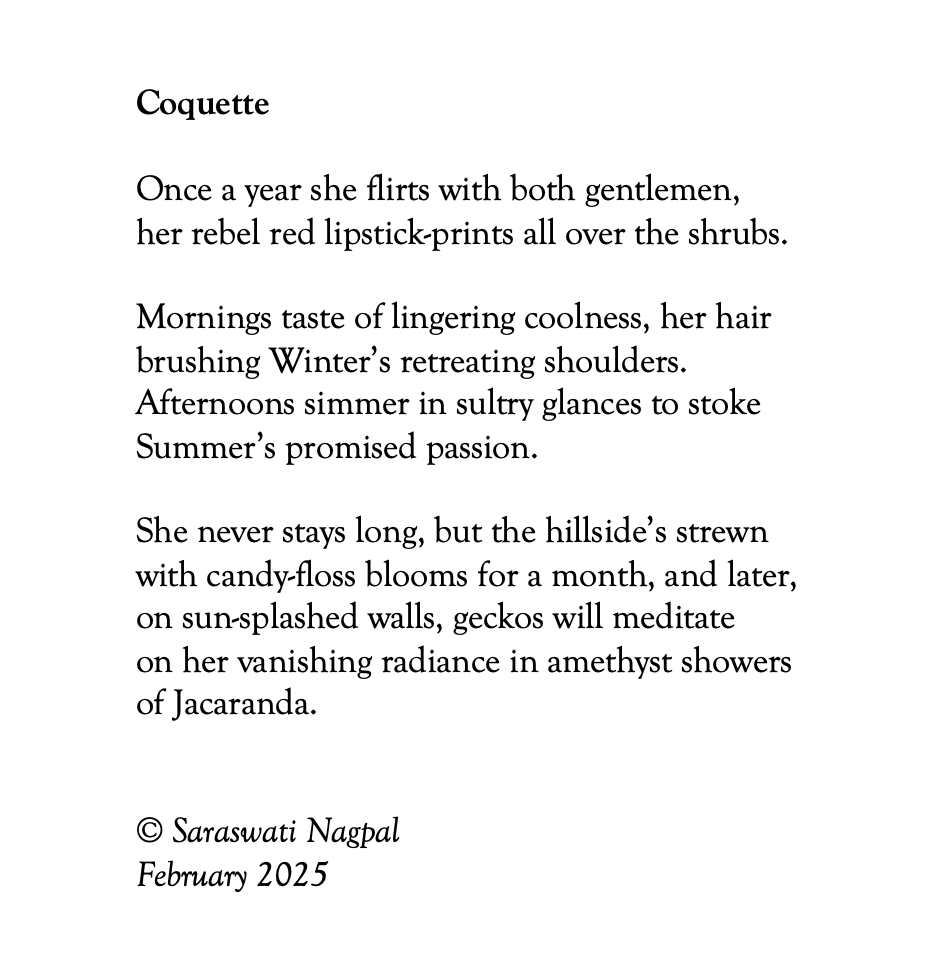
"Blink-and-you-miss-it" Spring in rural south India. For "Spring" @TopTweetTuesday and talented host @aperrincycling here's my <80 words. I've spectacularly failed to break out of my style; on the upside, no banned words have been used. Thank you for reading!
Submissions are open for our next anthology, the theme is GRIEF. Please read the guidelines carefully. We are looking forward to reading your work! Photo by Karly Santiago via Unsplash. #Poetry#Anthology#Grief#Submissions
https://t.co/KGxcjulDa6