Depression care in youth is mostly reactive. Our new comment in Nature Mental Health makes the case that wearables, smartphone data, and ML may help us detect risk earlier. ⌚️📱https://t.co/mukMLiN2PO
Excited to soon share the empirical work we've been working on in this area!
@JamieLarsH Thank you for sharing! Thrilled to have been a part of such great work led by @chase_antonacci
Highlighting that we found a threat-primed neuroendocrine maturation profile where cumulative trauma tracked with earlier puberty, higher cortisol & BMI, and elevated mtDNA
Excited to share my first paper since starting my PhD at @Stanford. We found that affective, cognitive, and behavioral difficulties peak from early to mid-adolescence, and blunted reward-network connectivity in childhood predicts more severe dysfunction during that period👧🏽🧠
Now out in @PsychiatryRes: though structural disadvantage is a major risk factor for internalizing disorders, youth from lower opportunity neighborhoods achieve comparable outcomes to more advantaged peers when provided access to high-quality, evidence-based psychotherapy!
.@russpoldrack and I are hiring a full-time, in-person/hybrid research coordinator to work with us on cognitive control, response inhibition, and dense MRI scanning. The position is designed for folks looking to start a Ph.D in 2-3 years. Please retweet. https://t.co/WpNnhYomwp
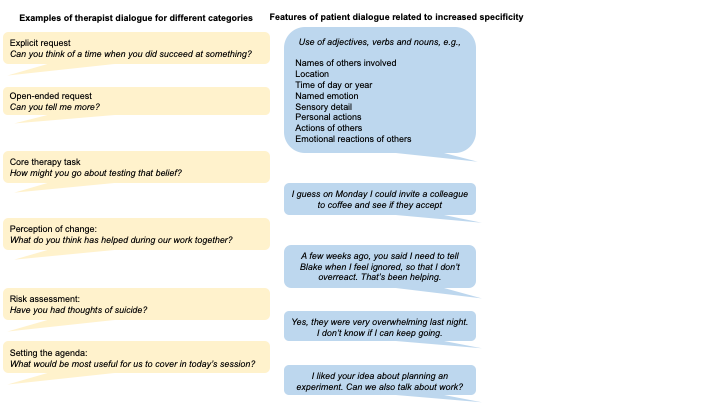
Use of more specific, concrete detail when completing core Cognitive Behavioural Therapy tasks is associated with better treatment outcomes.
We applied deep learning to 353,614 internet-enabled CBT sessions delivered by Ieso Health for the UK NHS.
https://t.co/AXafPejTyB
HUGE congratulations to @naim_reut@k_domb@Siramar143@Simona_Paulina Katharina Kircanski & @MelissaBrotman for the FIRST published trial of exposure-based CBT for youth w/ severe irritability 🤩 2nd trial currently ongoing in our lab; stay tuned! https://t.co/uO07cxJAEi #CBT
Check out our meta-analysis on resting state fMRI in anxiety disorders. With @AZugman, Laura Jett, @AndersonWinkler, and Danny Pine. TLDR: hypoconnectivity b/w amyg and ACC, MFG, & CG — though findings not robust to potential publication bias!!
The UCLA Psych Clinic is once again offering FREE therapy to BIPOC youth age 5-24 thanks to a generous grant from the Nicholas Endowment and we have open spots RIGHT NOW! Must be located in California. Not a study, no session limits, just evidence-based therapy.
🧵/ SNAAP is doing some restructuring currently (including our website), but we're happy to say we're still taking interested mentees. Fill out our interest form here if you're applying to neuro grad programs & you're looking for some help: https://t.co/hbvD1q8WJ0
@ScientificRuvvy@NIH Totally agree. I think for many students, challenges like these can unfortunately be a real deterrent to pursing an academic career.
The fact that postdocs @NIH are not eligible for retirement benefits is actually insane. I struggle to think of other career choices in which individuals have comparable levels of training and expertise and are not eligible for basic benefits.
It’s postdoc appreciation week, and I’d personally appreciate if postdocs were considered employees rather than ‘fellows’ so that we’d be eligible for retirement benefits. Bc we’re so underpaid, many of us don’t have disposable income to make significant contributions on our own
We'll be recruiting an RA & postdoc on this project, which is a collab with UK-based @toby_wise@AliciaJ_Smith, and Orygen @MarioAlvarezJi1@PatMcGorry + others.
Interested in computational factor modelling and/or using science to improve treatment selection? Get in touch!
My latest in the WSJ , a new study by Katie McLaughlin and colleagues in Nature Communications demonstrating that policies like child tax credits and expanded medicaid can really improve prospects for kids from low-income families .
https://t.co/kH3DVigtCi
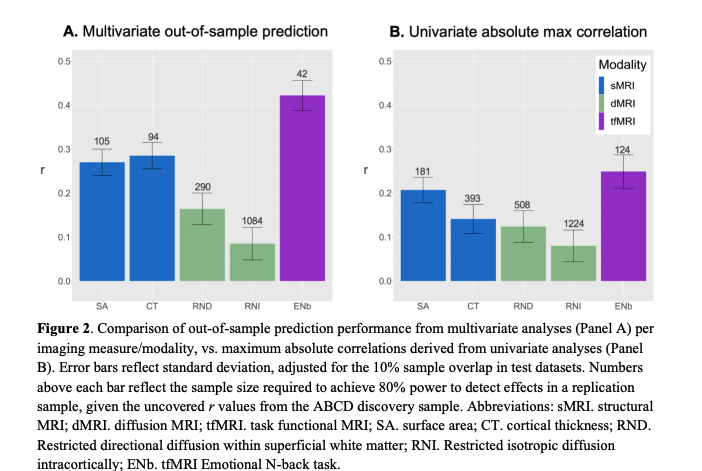
"reproducible brain-behavior associations can be obtained with dozens, rather than thousands, of individuals.."
Reports of the death of brain-behavior associations have been greatly exaggerated | bioRxiv https://t.co/iv6pVnWXOf
🚨new publication alert!! 🚨 in our paper just published in @PNASNexus, @JamieLarsH@kellybarrypsych and I asked, does positive parenting buffer against the deleterious association btw childhood stress and corticolimbic structure in kiddos?
https://t.co/FM6OTU1EEE
Our BIG research paper from the groundbreaking Bucharest Early Intervention Project is out in the American Journal of Psychiatry (https://t.co/C1FGVY7fVC). We provide the most robust evidence yet that children exposed to early deprivation benefit from family-based care.