Netlify now runs Edge Functions on Unikraft. They moved from V8 isolates to microVMs on our platform and published the numbers. Median warm invocation went from 25 to 40ms down to **~5 to 6ms**. p99 is 47.4% faster. Log delivery is 5x faster. Availability sits at 99.998%. All of that across about **a billion Edge Functions a day**.
To boot, all of this with (1) the same pricing (2) no migration for their customers and (3) now running on strongly-isolated microVMs, not isolates.
All numbers are Netlify's own, from their engineering writeup.
🔗 Full story: https://t.co/bdY3qV0Aps
I have asked my clanker to send some PRs for the Elixir one. Please ask your clanker to verify them and tell your clanker we are allowed to deviate from the Rails version in the same way Express/Go/Rust/ do (it was objecting to that in other PRs)!
The clanker says there is more work to be done but I don't have infinite tokens, so it would be nice to see those merged first.
It takes less effort that you’d think. Simply tell the model what to do. Most people’s problem is either they assume the limitations of the model or just didn’t ask it the right question. I told ai agents I wanted enough money to buy a house in a year. Gave it access to my brokerage. Poof 700k.
Before that I said I wanted a new Tesla before December 2025, it had 3 months to do it in. I rolled the car off the lot in November, cash.
There’s huge potential in these models. Many just haven’t realized their role is to extract it, not bend it to their will.
with all the dunking on @elixirlang, a quick note from someone who bet on it.
phoenix liveview is processes all the way down. that is what lets us build interactive ui without the overhead and indirection of client side state management. we ship and test interfaces insanely fast and nothing else has come close.
and that is just liveview. @elixirphoenix is one of the most productive web stacks i have tried.
the erlang runtime is the other half. agents can attach to it in dev and in prod and see the process tree, memory and cpu, not just symbols. it is a system you can interrogate.
we have not used everything it can do because we have not needed it yet. when something does need to be fast we can drop into a nif and write that part in rust, and so far that has barely come up. we optimized for feeling productive so we could get the business off the ground. @marekfort and i say the same thing every time. best decision we made, and even better with agents.
Rails founders code has perf issues 😂 I halved median response time in 5mins
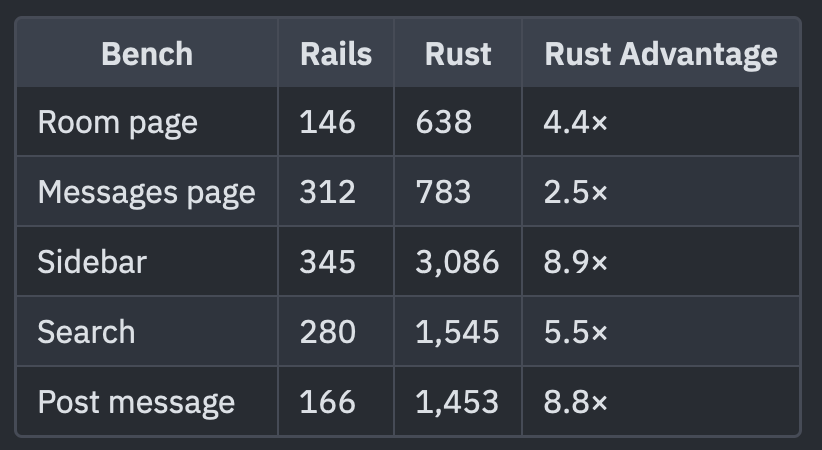
AI Go & Rust ports fix slow code written by Rails founders
Rails uses Redis over TCP Go/Rust ports use in proc cache
I’ve spent more time in the code than them. I give up. Code & benchmarks are trash
Very exciting feature coming to LiveView: subscribe to a PubSub topic from any LiveView (or LiveComponent!!!) and LiveView will automatically manage the subscription for you. Simply:
subscribe(socket, "user.updates", &handle_user_updates/2)
PR: https://t.co/wX0sWMqfzB
This is exactly what happens when nobody reads or writes the code. The Rust port got hand-tuned fragment splicing, cached digests and compiled templates. The Go port re-hashes and re-copies the whole page every request. You're not benchmarking languages, you're benchmarking how much attention each port got.
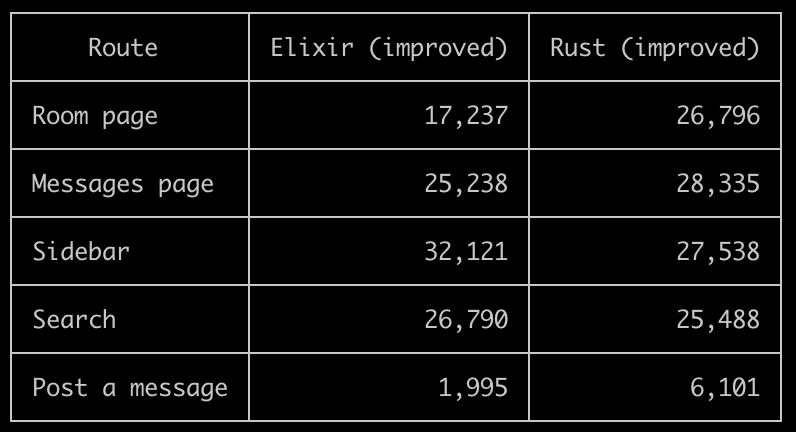
I took a stab at improving the performance of Elixir. I used the PR for Elixir that @ZachSDaniel1 posted and worked some more on it. In the benchmark Elixir is now faster than Rust (ccece30 newest commit) for the Sidebar and Search benchmark.
Oh FFS. It turns out the req/s in the initial vibed Rust version is within the same order of magnitude as the initial vibed Elixir/Go versions, and even performs worse in some of them.
The history is in the repository! The Rust version only got faster with a bunch of additional work. The initial Elixir/Go versions presented in the tweet below saw none of this additional work. It was comparing a 300 commits Rust version with a 2-3 commits Elixir/Go version.
Source: https://t.co/0kuvLVU4iw
I rarely use monitoring/tracing provider dashboards and UIs anymore
Only to get graphs to post on here
Everything is connected to my agent via MCP, it's so good
I'd possibly even go as far as to say all these providers could delete most of their UI and just go agent-native
Lumis now lets you choose which languages to load in your package. Need only Elixir and Rust? That's only 2mb vs ~130mb of the full bundle. Just add:
{:lumis_wasm_elixir, "~> 0.26"}
That also applies to MDEx and MDEx Native. See https://t.co/HMI2Oho8zH
https://t.co/iopvqBHnQl
The future of programming seems certainly to be systems where change is constant and ongoing via agents, everywhere, and communicating all the time. And we happen to have a runtime perfectly suited to that. Lets go!
🥳 Excited to start revealing what we've been working on in the last few months. First, we decided to reinvent Kubernetes for agentic workloads with statefulness and fast resumption. Secondly, we are building an agentic orchestrator that will be Google's open agentic orchestrator and runtime. https://t.co/XCrdAVvDAe
I made a DuckDB extension where you can use @typesafeai 's Jev to do quick classification of rows in any csv/parquet file or duckdb table
about 10sec for 1k rows ~ better than using an LLM, way more ergonomic than a classifier
game-changing for data analysis!