Here's what i think is true. Jesus was fully God and fully man, and fully man Jesus worshipped fully God Jesus . He was Creator and created. There was no blending.
@away14375 There's dumb and there dumber. Dumb : she legit smiles at you and you take it as an invitation to interrupt her workout; and dumber : she looks at you with the expression this woman has in this photo and you do the same .
@AttorneyF_ Fair enough. We can both cherry pick, but let's not. Like the Bible, it's meant to be read in its entirety with attention to historical context and linguistics. And since there is no compulsion to believe any of it, we are free not to be literalists or to avoid strawman traps.
🐕Choe de 3 años se perdió durante un paseo familiar y la buscaron por varios días sin tener éxito al ser un bosque muy amplio, denso y con abundante fauna nativa.
Su familia perdió la esperanza y después de 2 años fue captada por una cámara trampa con su nueva familia 🐺
@redeemed_zoomer@ryanburge@WheatonBGC@CTmagazine They say it! They will correct you if you ask if they are Protestant . Almost every time, they say. " No, I'm Christian. " The question is part of my mental health evaluation so I have asked many hundreds of people.
@AttorneyF_ What do you make of this, then?
"There shall be no compulsion in religion. The right course has become clear from the wrong."
— Quran 2:256
@OrevaZSN Perhaps less ambitious but also important, stop labeling any unexpected activation of your sympathetic nervous system as 'anxiety'. Expand your vocabulary
Imma keep repeating important lines, regardless of how sick everyone gets of them.
“A cursed fact of the world is that the most important life lessons you learn are the hardest to communicate to others because they always sound like clichés.” — Nabeel Qureshi
“The more we say thanks, the more we find to be thankful for. And the more we find to be thankful for, the happier we become.
We don't give thanks because we're happy.
We are happy because we give thanks.”
―Douglas Wood
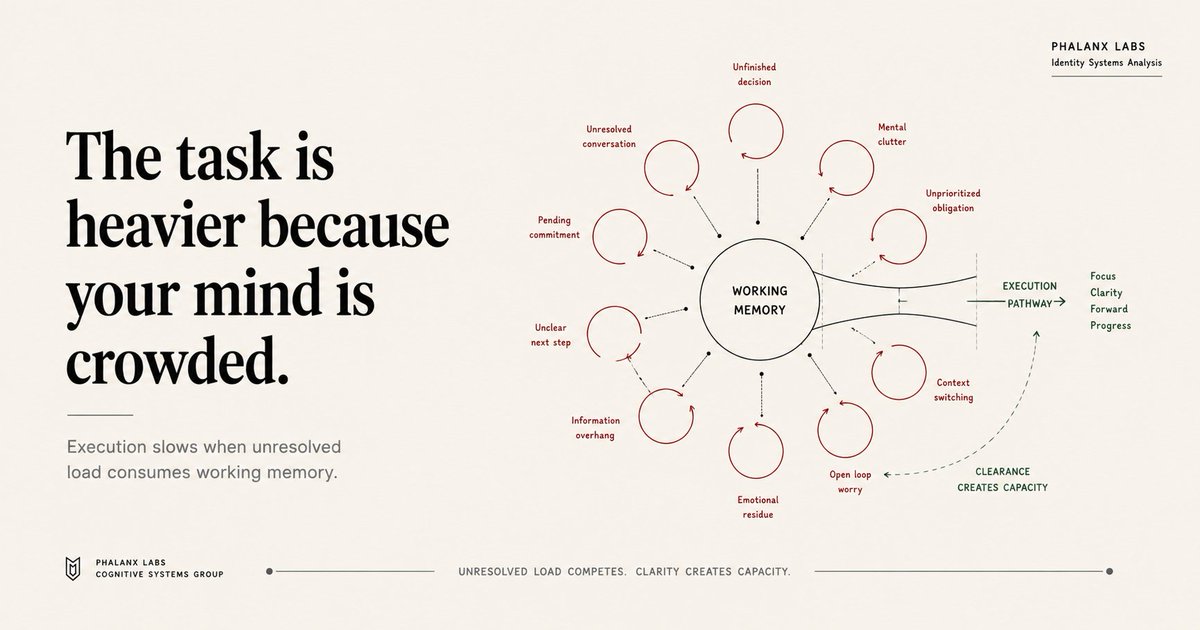
You think you need more discipline. Reality is, you need less internal noise.
When your mind is crowded enough, even obvious action starts feeling heavy.
Think about this.. Most actions are not complex,,
But you perceive them so..
Because your nervous system is already carrying too many open loops.
Unfinished decisions.
Unanswered messages.
Background stress.
Things you need to say.
Things you need to end.
Things you are pretending are not draining you.
This is why high performers sometimes stall on moves that should take five minutes.
The task is not the task anymore. It is the task + everything else your brain is holding at the same time.
That is the hidden tax.
People call this procrastination.
But often it is just cognitive overcrowding.
Just too much shit in there, most unresolved, almost all taking up more space than it deserves
Execution reliability improves the moment your inner world becomes less congested. You need fewer unresolved things competing for working memory.
Sometimes the fastest way forward is not pushing harder.
It is clearing enough internal space for the obvious move to finally feel light again.
A vague deadline is an invitation for your brain to manufacture drama. Give a task three weeks and it will find a way to fill three weeks. Give it one clean afternoon and the mind starts cutting what was never necessary. Time expands around uncertainty.
Game theory explains why people become more honest as their options increase. Most honesty is tested under scarcity. When someone has no alternatives, they are incentivized to manipulate, exaggerate, and conceal. Abundance removes survival pressure. The person with options can afford the truth because the cost of losing any single outcome is lower.
A Chicago philosopher wrote one book in 1940 proving that 95% of the books you have read in your life, you didn't actually read, and Charlie Munger has been telling people to read it for 50 years.
His name was Mortimer Adler.
He spent 40 years at the University of Chicago, ran the editorial board of the Encyclopædia Britannica, and built his entire career on one uncomfortable observation about the people around him.
Most adults who called themselves well-read had not actually read a book in the real sense even once. They had run their eyes over the pages, registered the words, formed a vague impression, and put it back on the shelf.
The book had passed through them without ever entering them.
In 1940 he wrote How to Read a Book. It has stayed in print for 86 years.
Charlie Munger recommends it. Naval Ravikant recommends it. Fareed Zakaria recommends it.
Every serious thinker who builds a career on absorbing information eventually finds their way to this book, and the reason is that Adler had isolated something nobody else was naming clearly.
There are four levels of reading. Almost everyone is stuck on the second one. The fourth level is so different from what most people call reading that you have probably never done it in your entire life.
Level one is elementary.
You learn it as a child. You decode the letters into words and the words into sentences. You finish the sentence and understand roughly what it said. This is reading the way a 7-year-old reads, and almost every adult on earth has stopped developing past this point in some quiet way.
Level two is inspectional.
This is skimming. You move through a book quickly to figure out what it is broadly about. You read the back cover, scan the table of contents, glance at a few paragraphs, and form an opinion. Most adults who claim to have read 50 books a year are actually doing this. They are inspecting books, not reading them. They walk away with a vague sense of the argument and almost none of the evidence that supports it.
Level three is analytical.
This is the level Adler said most people have never properly experienced. You take one book and you wrestle with it for as long as it takes. You identify the question the author is trying to answer. You map their argument from front to back. You write your disagreements in the margins. You force yourself to articulate, in your own words, what the author is claiming and why. The point is not to finish the book. The point is to argue with it as if the author were sitting across the table from you. Most people never do this once in their life, because it is exhausting and slow and feels nothing like the reading they were taught as children.
Level four is the one almost nobody knows exists. Adler called it syntopical reading. The word means "across topics," and the technique is something closer to running a small private research lab in your own head.
You pick a single question that actually matters to you. How does power corrupt people. Why do civilizations collapse. What makes a marriage last. How does a person change their own mind. Then you assemble five or ten or twenty books from different authors, different centuries, different traditions, all of them taking a swing at the same question.
You do not read any of them cover to cover. You move between them. You find the chapter in book three that addresses the same question as the chapter in book seven. You force those two authors to argue with each other inside your own head.
The book stops being the unit of reading. The question becomes the unit. And the authors become voices in a conversation you are now hosting.
This is the level where reading stops being consumption and starts being construction.
You are no longer absorbing what someone else thinks. You are building a position of your own out of the friction between people who disagreed.
Adler argued that this is the only level of reading where you stop being a passive receiver of other people's ideas and start being someone who can produce ideas of their own.
The reason Charlie Munger has been recommending this book for 50 years is that this is exactly how Munger has always thought. He calls it building a latticework of mental models. The technique he is describing is just syntopical reading applied for a lifetime.
You take the strongest insight from psychology, the strongest insight from biology, the strongest insight from economics, and you stack them against the same problem until something new falls out the bottom.
The reason most people never reach level four is not that it is intellectually difficult. It is that it is logistically uncomfortable. It requires you to keep multiple books open at once.
It requires you to take notes that nobody is going to grade. It requires you to abandon the goal of finishing books and replace it with the goal of answering questions.
This is also why AI just changed everything Adler was teaching.
NotebookLM, Claude, and tools like them let you do syntopical reading at a speed that would have looked like magic to a Chicago philosopher in 1940.
You upload 10 books on the same question. You ask the AI to surface every place those authors agree and every place they contradict each other.
The technique Adler said almost nobody on earth had reached can now be run on a Sunday afternoon by anyone with a laptop and one good question.
The technique was always the unlock. The bottleneck used to be time. The bottleneck is now curiosity.
Most people will keep reading the way they always have. A book at a time. Eyes over the pages. No question driving it. No other authors in the room. Adler called that level two for a reason.
You are not behind on your reading list.
You are behind on the level you are reading at.