67. My life is the experiment. Lifestyle + ancient wisdom — breathwork, fasting, movement & more. I share what actually works for a stronger brain and body.
Type 2 Diabetes the bad news that became a blessing for me.
“I am afraid I have some bad news for you, Ranjit.”
It was late August 2020 when my GP spoke those words. Ireland had endured a severe lockdown. The gyms were closed, and life had slowly contracted to the four walls of my home office.
I had plenty of work, and when the working day ended, another kind of work began: studying for my postgraduate degree in coaching. My mind was constantly occupied, but my body had become almost still.
Month by month, without my paying enough attention, my weight climbed from 85 kg to 98 kg.
My blood-test results suggested type 2 diabetes. My GP ordered a second test, hoping perhaps that the first had been wrong.
One week later, I sat opposite him again.
“I am sorry, Ranjit. It has been confirmed. You have type 2 diabetes.”
There are moments when a single sentence divides life into a before and an after. Yet, to his surprise I answered:
“You know, this is a blessing. for me”
During that uncertain week between the two tests, I had immersed myself in the subject. I studied information from diabetes organisations in the United States, Germany, Ireland, Spain and the United Kingdom. I also read two books, including one by Dr Jason Fung.
The more I learned, the more clearly I understood what had happened. The diagnosis had not appeared out of nowhere. My lifestyle had changed, my weight had risen, and my body was warning me that I could no longer continue along the same road.
My GP offered me metformin. I asked him instead for three months—three months in which to change my lifestyle and see what might be possible.
“What are you planning to do?” he asked.
“Change my nutrition and begin intermittent fasting.”
He advised me against fasting. So did the doctors in my Indian family and my wife’s family. They were worried, and I understood why. But I decided to proceed carefully and gradually.
I began with 16 hours, skipping dinner. After two weeks, I increased the fast to 17 hours. Two weeks later, I reached 18.
There was no miracle and no secret shortcut—only a succession of daily choices.
Three months later, I returned to my GP. My weight had fallen from 98 kg to 85 kg. When he saw my blood results, he could hardly believe the change.
My type 2 diabetes was in remission.
Six months later, my results remained outside the diabetic range without medication.
Today, at 67, I feel fitter and healthier than ever before. Looking back, I remain strangely grateful for that diagnosis. It arrived disguised as bad news, but it became the wake-up call I needed. It asked me a simple but life-changing question:
If you continue living this way, where will this road eventually take you?
I chose a different road.
Better nutrition, intermittent fasting, strength training and regular movement became part of my new life. But the deepest change was not simply what I ate or how often I exercised. It was the decision to take responsibility for my health—one choice and one day at a time.
This is my personal story, not medical advice. Fasting may be dangerous for some people, particularly those taking glucose-lowering medication. Always consult a qualified healthcare professional before making similar changes, because every person—and every body—is different.
What Is “Normal” in a Blood Test?
“Normal” blood test ranges are generally based on reference ranges derived from populations. For my key health markers, I prefer to aim for evidence-based optimal targets.
Optimal is my goal. Normal is my safety net.
@dr_ericberg That is essentially what Muslims practise during Ramadan: fasting from both food and water from dawn until sunset, then eating and drinking again overnight.
Interesting finding, but we should be careful about generalising it. Zinc, folate and vitamin D levels in older vegetarians could vary considerably between countries and populations. Diet, supplementation, food fortification, sunlight, lifestyle, health and many other factors can influence the results. One population does not necessarily represent all vegetarians.
@AlpacaAurelius The bliss of not constantly following the news is quite remarkable. Your mind does not get hijacked by an endless stream of negativity and urgency. And when something truly important happens, chances are your family or friends will let you know.
I have been fasting since the 1990s, so I havee had many years to observe how my body responds. For me, a 72-hour fast combined with training is not only a physical challenge — it strengthens my mind tremendously.
I believe that repeatedly challenging myself and learning to remain calm under discomfort helped me during the earthquake in Cali, when I was on the 6th floor. Despite such a dramatic situation, I was able to stay remarkably calm and focused.
Sometimes what sounds questionable in theory can feel very different in practice, because every body responds differently. I am not advising anyone else to do this — it’s simply what works for me.
@Tim_Denning We should all be equal under the law. Beyond that, we should recognise and respect that every person is different — with different strengths, weaknesses, experiences and potential. Equality should never require uniformity.
@licmartinduraes@Helios_Movement Sarcasm aside, I have done this often and feel very well, more energized then before. Everybody is different and reacts differently. If I would feel that it is harming my health I would not do it. Appreciate your comment!
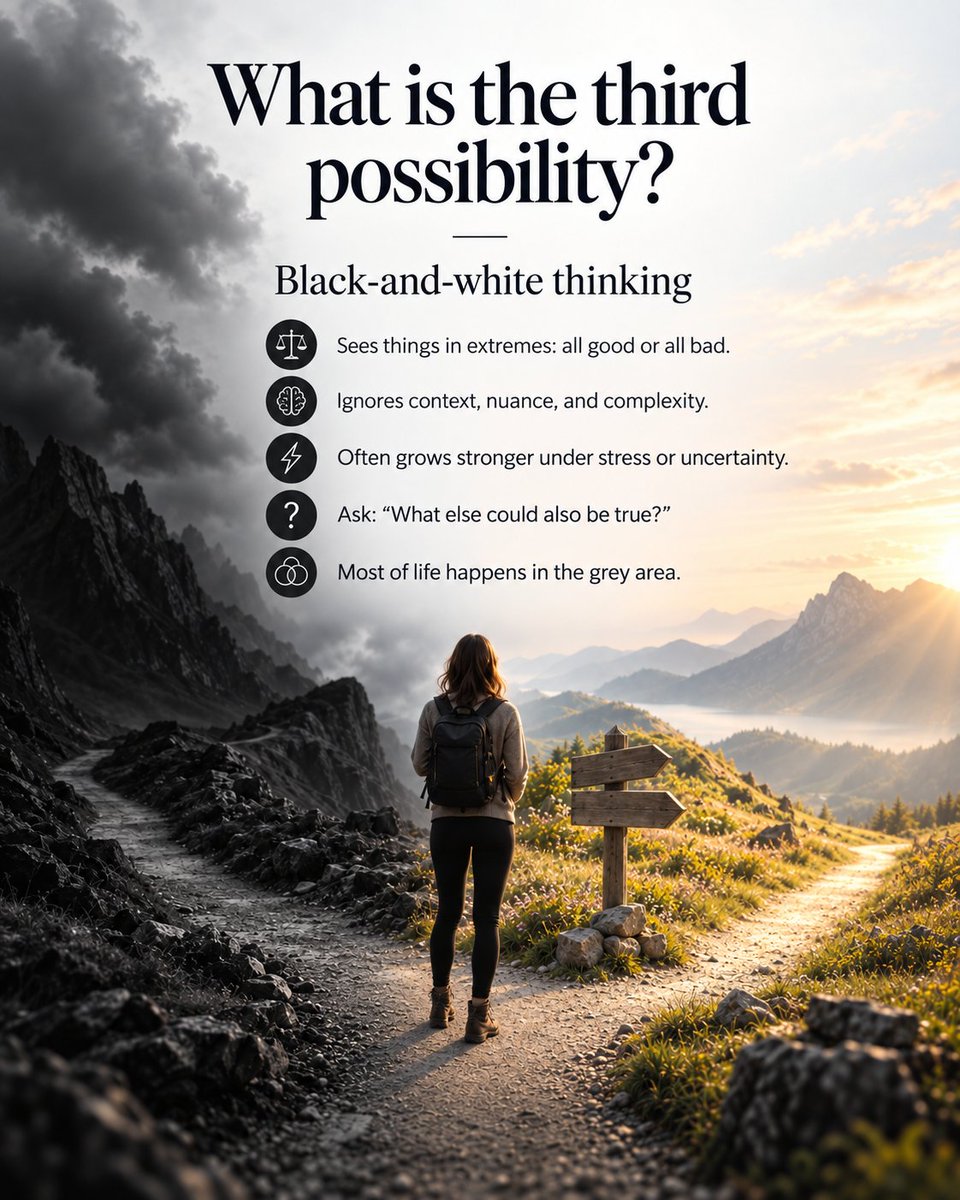
Why do we so often see events as black or white?
Because our brain likes simplicity. It is easier to label something as good or bad, right or wrong, success or failure than to process uncertainty and complexity.
But reality usually lives somewhere in between.
@DeepPsycho_HQ How cultures conceptualize the stages and purpose of life:
Hindu: Learn-Build-Give back-Let go
Japanese: Learn-Contribute-Master-Continue with purpose
Modern Western Model: Learn-Work-Accumulate-Retire
That is exactly the point: it is still a hypothesis, because many factors influence why people in one society commit more crime than in another.
The study should be replicated across different continents and social environments. Finland may be useful, but it is probably not the strongest basis for a global comparison.
Why not test the same hypothesis in countries such as Brazil, Sierra Leone, India, or South Africa?
Only then could we begin to see whether the effect is truly universal or strongly shaped by culture, inequality, institutions, and environment.
@Thedrivenman Over communicating is not necessarily begging. The difference is intention: are you trying to be understood, or desperately seeking validation and approval?
@Balder998 Simply put: focus kon your strengths. Develop them, sharpen them, and use them - they may be one of your greatest assets in creating success.
Interesting comparison, but it does not always apply. From your list, my highest score is with Spielberg.
A real example from my IT sales years: at GITEX in Dubai, we generated 162 leads. Six months later, none had turned into significant business — only a few small deals.
Then I attended a three-day IT fair in Madrid. We came back with just six leads. My manager immediately said, “We won’t participate in this fair again.”
But one of those six leads became an important customer: the Ministry of Defence.
That experience reinforced something I have always believed: numbers can look impressive, but quality matters far more than quantity.
Dr Berg, I have a question. I start my mornings with a glass of lukewarm water, the juice of half a small lemon, turmeric, and a little black pepper. On weekends, when I have breakfast, I also add a shot of apple cider vinegar.
From your point of view, would this mixture still provide the same benefits as drinking just lemon water, or could combining these ingredients reduce or change the effect?
To deny something simply because science cannot yet prove it may be another form of intellectual neglect.
Dick Swaab argues that we are our brains — and neuroscience gives us powerful reasons to take that seriously. But consciousness, meaning, intuition, and the deeper question of existence are far from fully explained.
Not everything unproven is false. Sometimes it is simply not understood yet.
What do you think about it?
Very true, with some slight nuances to differentiate. The brain can activate many of the same neural pathways during vivid imagination as during a real experience, but the response is not identical. Imagined signals are generally weaker, and the intensity of physiological and neurochemical responses can differ significantly.
Interesting study on this:
https://t.co/ebWLn5pm6H