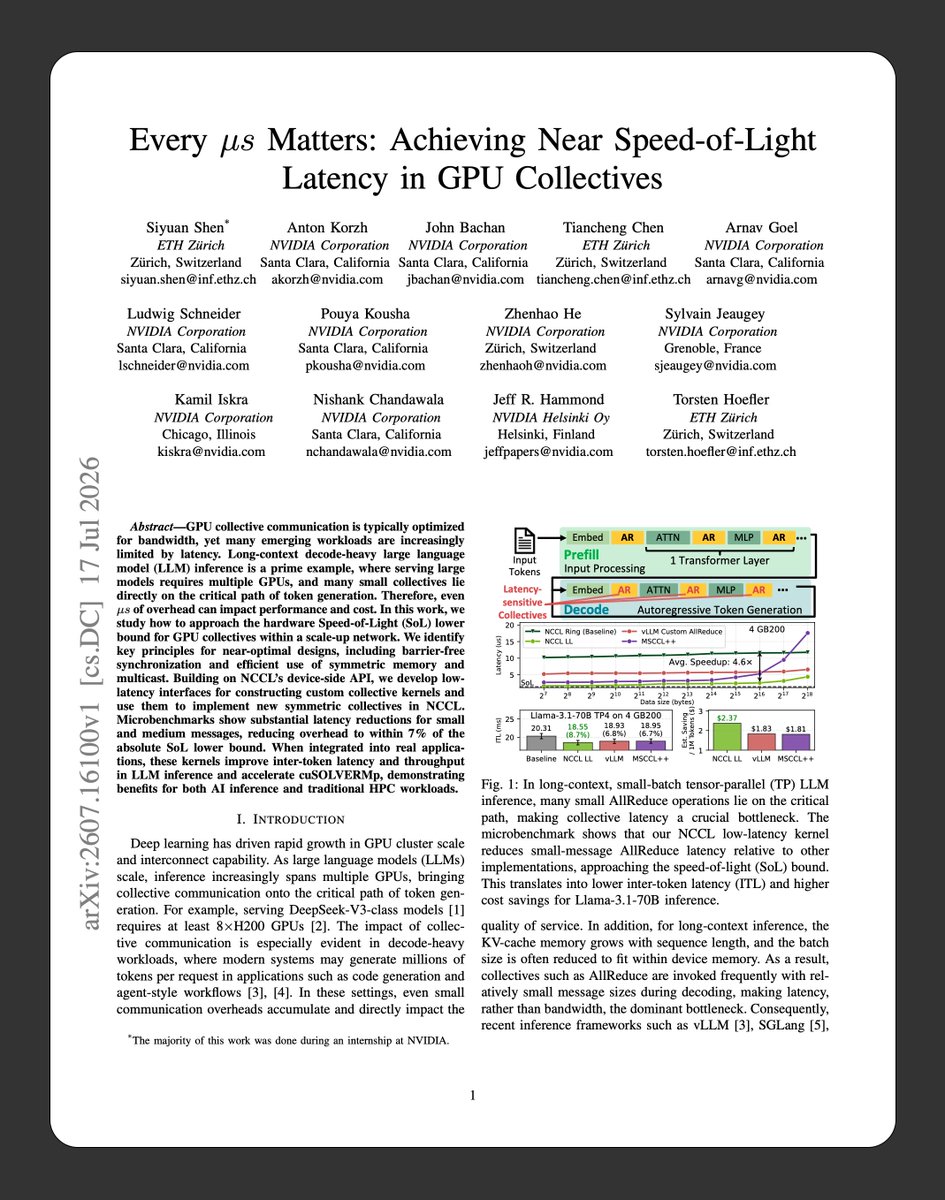
🚀 v3 is out!
We’ve just updated 《The Principles of Diffusion Models》 on arXiv, ahead of its @mitpress MIT Press publication in 2027.
What’s new:
✨ A new “Road Ahead” chapter on discrete diffusion
🛠️ Major restructuring, including diffusion solvers chapter
🧭 Reader guides for each chapter
With continuous diffusion for language making a comeback, many of the same principles in the book can carry over.
Check out the new version (link in thread)!
w/ @DrYangSong, @gimdong58085414, @mittu1204, @StefanoErmon
At 250 billion DNS cache entries, one wasted byte costs 250 GB of RAM.
Five Rust optimizations later: 100 TB freed, inserts 43% faster, lookups 19% faster.
We didn't trade speed for space. https://t.co/mMyOYnj0mQ
Of course, we are not the first to identify this gap. In fact, many hyperscalers already have such a powerful primitive internally for building their systems (e.g., https://t.co/Nw9vsZUvXs).
@richardartoul Neon has a service called Safekeeper. Postgres streams WAL to a quorum of Safekeepers, and the write can be ACK’d once the WAL is durable there, before it reaches S3
https://t.co/g9FRF2Wh8n
Qwen3.8-Flash can now be run locally! 🔥
The 125B MoE model outperforms Claude-Opus-4.6 (Max).
Run on 75GB RAM via Unsloth GGUFs.
Qwen3.8-Flash-Next enables CPU RAM / unified mem setups to deliver near VRAM speeds.
Guide: https://t.co/LLMclyJTeL
GGUF: https://t.co/vXkjO3W0fj
every chinese frontier model now uses linear attention (except deepseek)
they all use (except kimi) sparse attention with similar indexer/compression designs to maximize efficiency
they all use "fancy" residuals (mHC, attention residual, gated residual) to maximize signal propagation
they all use Muon
very exciting time for frontier (and efficient) oss models, the beauty of open research :)
Now we know: The popular Ox Alpha LLM was GLM-5.3-Flash...
Compared to GLM-5.2, this new GLM-5.3-Flash model uses:
- a Kimi Linear-style 3:1 (super*) hybrid attention pattern with 34 Kimi Delta Attention layers (KDA) and 11 Multi-heat Latent Attention (MLA) / DeepSeek Sparse Attention (DSA) layers;
- a scaled-down GLM-5.2-style sparse MoE backbone, going from 744B-A40B to 320B-A18B;
- a DeepSeek V4-style mHC residual path with four parallel streams;
- plus a native vision encoder (not shown).
* "Super hybrid" because both KDA and MLA/DSA are "efficient" components. E.g., Kimi only uses KDA + full attention GQA, DeepSeek V3.2 uses DSA + full attention MLA.
PS: Sry for the excessive tech jargon. Explainers on all these components (MLA, DSA, KDA, mhC, etc.) in my LLM Architecture Gallery
PPS: Haha, maybe justification for getting that pricey Mac Studio M5 Ultra 256 GB / 512 GB to run this locally...
Everybody is building their write-ahead log on S3 now. Turbopuffer, Chroma, and WarpStream are all doing versions of the same trick. Here's what they are doing and how...
The old assumption was that a WAL needs a local disk followed by a replication across nodes for prevention against data loss. The WAL + S3 pattern flips it.
A write only counts as committed once it lands in S3, not before. So nodes stay stateless; they only cache in NVMe or RAM, and any node can serve any namespace/data since nothing durable lives on it and everything is on S3.
Two S3 properties make this work: strong read-after-write consistency, and conditional writes (If-None-Match). That second one lets multiple writers coordinate an ordered log without a leader election protocol like Raft sitting in front of it.
The cost is latency.
A single object storage round trip is tens of milliseconds, so nobody writes one record per S3 call. Everyone batches writes and flushes on a timer, and accepts commit latency in the range of 100 to 200ms.
This is why it matters - we need not worry about replication topology, not about leader failover, not about disks to provision ahead of load; nothing.
S3 storage becomes the thing you trust; everything else is just a stateless cache in front of it.
Hope this helps.
This from the OpenAI talk at Hot Chips where it fascinating how a lot of what you see in asic design today, is the technical bet being made on what is the right approach.
"In agentic inference, the largest and fastest-growing data structure is the KV cache, and we do not believe that the long-term solution involves moving large KV states. Disaggregated prefill is a solution for GPUs because GPUs need to build a large batch to make sampling efficient."
We built Jetstream, a new approach to database accelerators inspired by Tailwind/BRAD. It generates UDFs/UDAs that run directly inside the database—with full update support.
On DuckDB: 300–800× TPC-H speedups, nearly 10× beyond GenDB/Bespoke.
https://t.co/W4CWXX3YR5
Scaling Postgres has been attempted by many engineering teams.
Each pushed Postgres scalability forward. Each came with compromises.
Neki is built to address these shortcomings. Learn how we got here in this brief history of Postgres sharding:
https://t.co/fENuark19m
I've been leaning into fundamentals of computer systems. I read a fantastic write-up on the early, early boot process of Linux by @jespinog.
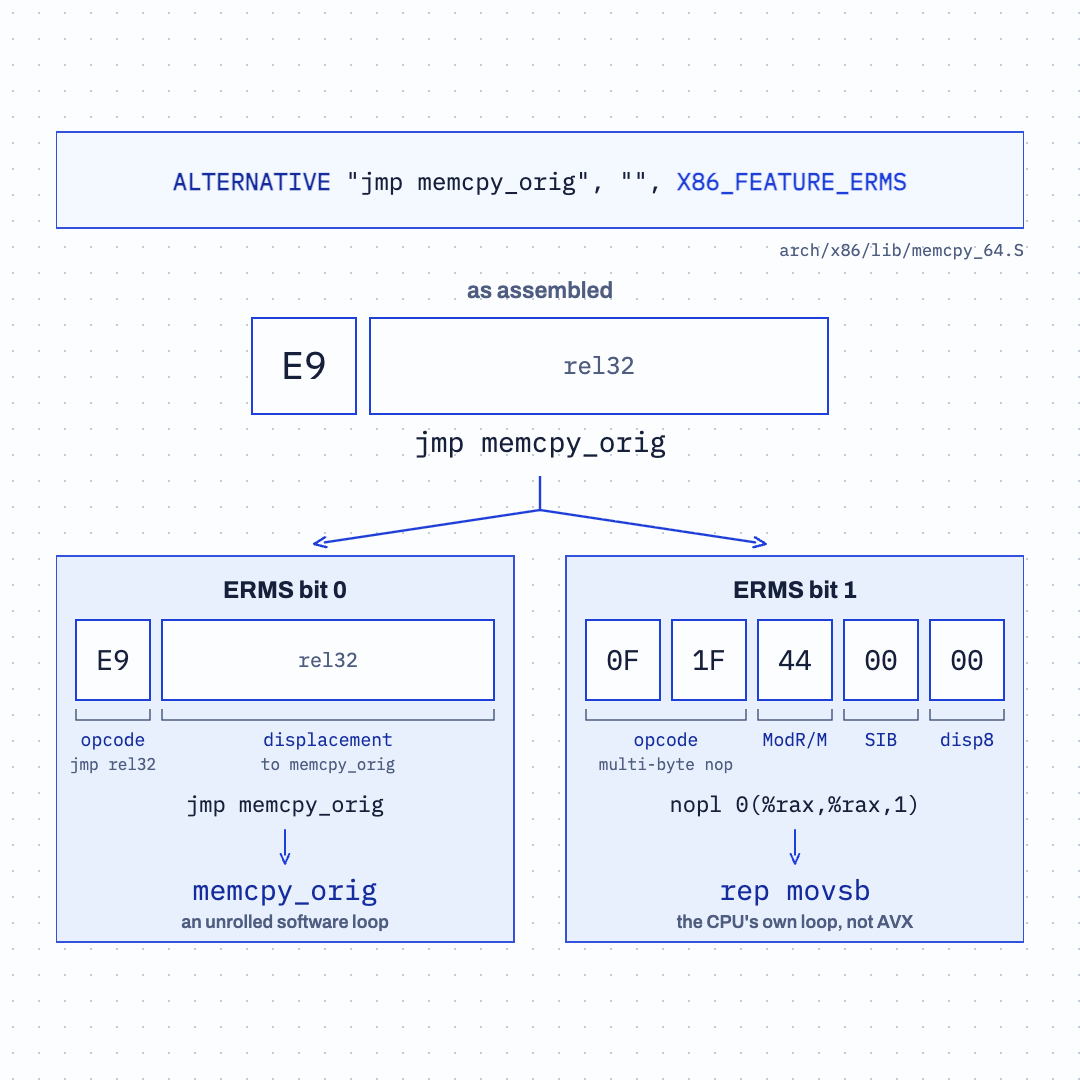
The kernel is truly unhinged. After CPU discovery, it hot-patches itself at specific sites marked ALTERNATIVE so that based on your hardware, it can take advantage of specialized features for maximal performance. The fact this works and powers the entire internet is short of a wonder of the world.
In the graphic, the kernel detects if the CPU supports ERMS, a feature that makes string instructions fast for copying or filling memory. If it supports it, it will literally patch the JMP execution code to direct to the specialized "rep movsb" instruction rather than jump. This insanity is unheard of in userspace. Kernelspace is indeed the Wild West.