https://t.co/kAMABqhkiV
A demonstration of 4 different ways to glue an octagon into a genus-2 Riemann surface. This is an exercise to "mod" out hyperbolic translations, necessary to draw the tilings in the previous post.
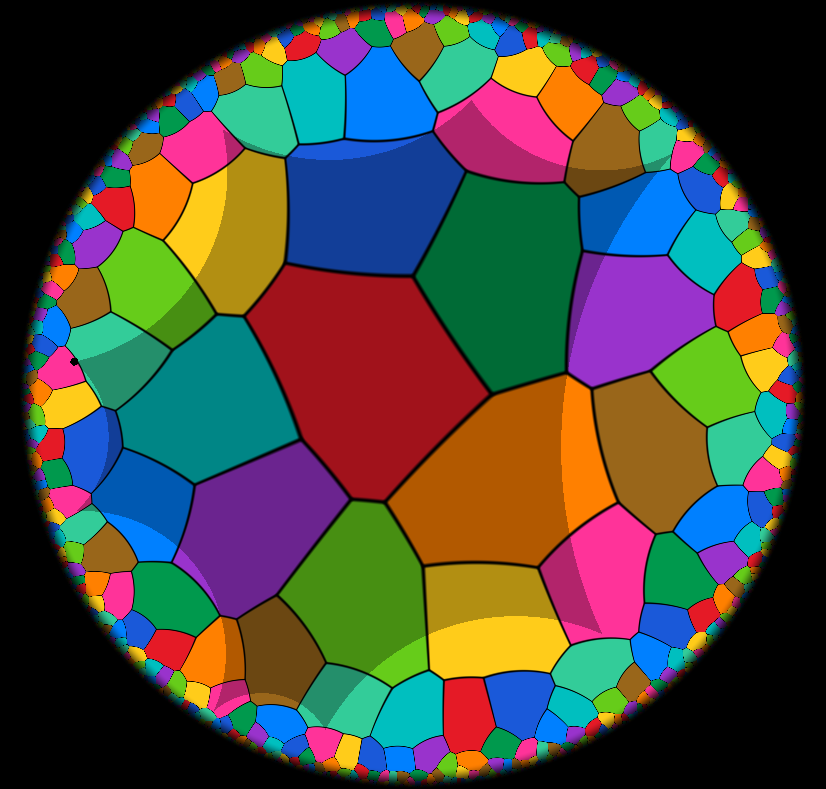
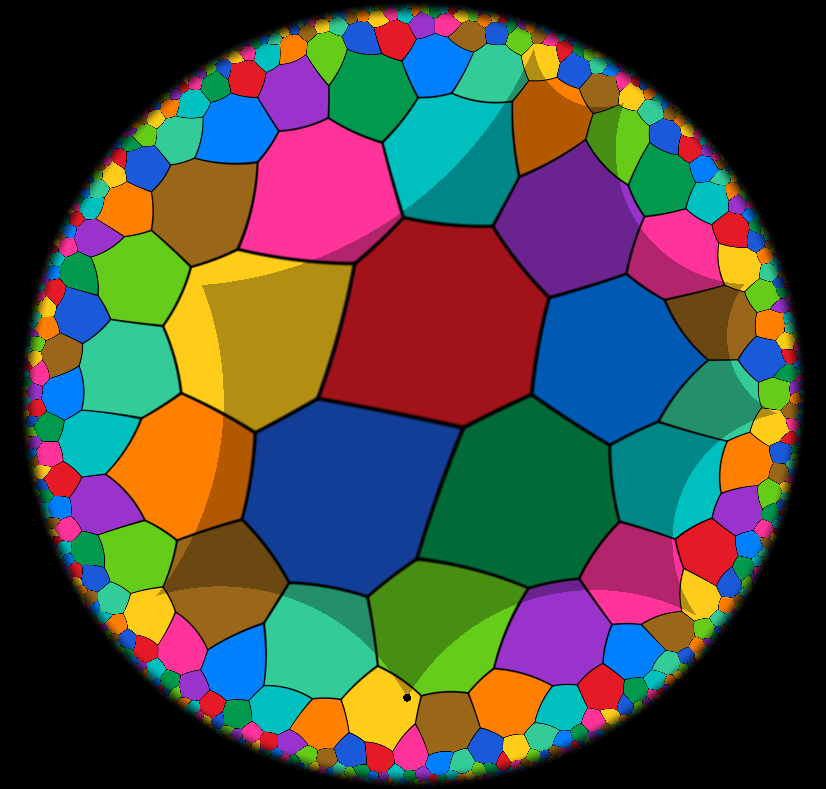
Three monohedral tilings of genus-2 Riemann surface by heptagons, obtained by the group of WANG Erxiao from Zhejiang Normal University. Code is available at https://t.co/OssxztseCf and also on Shadertoy (links in the GitHub repository).
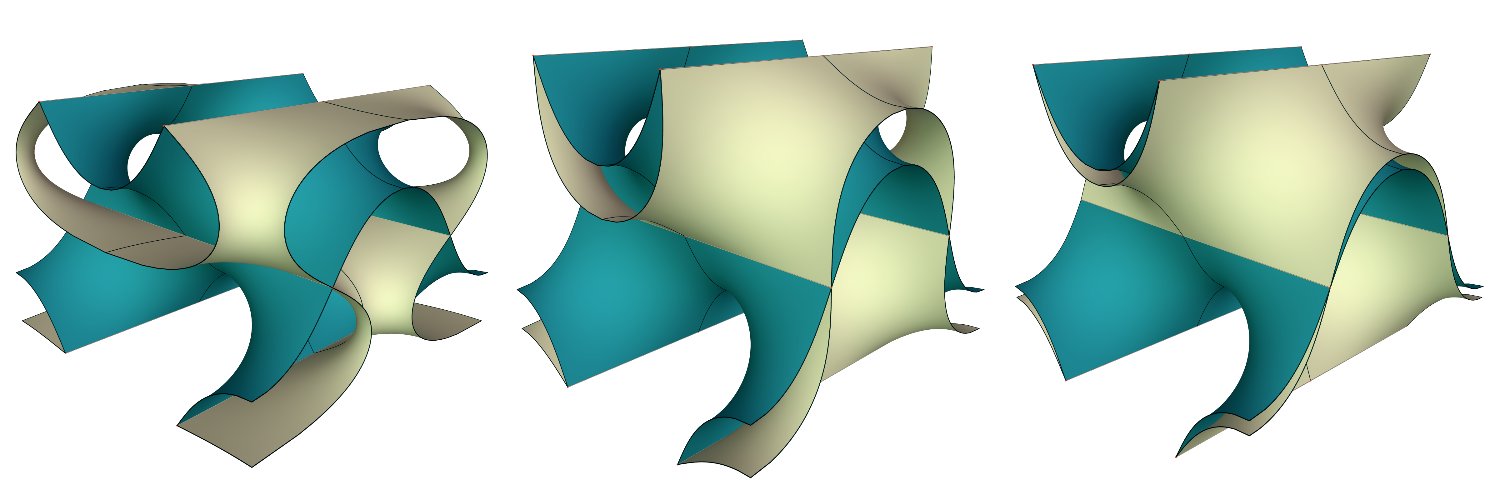
First time to leave Euclidean space 😅. Here are Lorentzian CHM surfaces (maxfaces). Right-hand side are the zoom-ins of the singularity at the bottom of the left-hand side. They seem cone-like but actually not.
Finally published! Helicoids and vortices | Proceedings of the Royal Society A: Mathematical, Physical and Engineering Sciences https://t.co/QJyII23RIS
@graveolens@AlexKontorovich@Albertotufaile@monsoon0@sigfpe @lenfuchs @alytile@soma_arc Just seen this. The code specified harmonic oscillations, so elliptic orbits are no surprise. The surprise lies in the lack of collision. It is some kind of "dynamic circle packing" achieved by some kind of optimization. Now we need to study how and why it worked, mathematically.
I simply can not take responsibility to any paper that comes out from such a team. And I read many engineering papers who made similar mistakes. So, if you see this thread, and you are working on TPMSs or periodic bicontinuous structures, please be careful in your work. /11-end
So all their data becomes questionable, and all my previous effort comes in vain. They explained that it is hard to impose periodic boundary condition because the structure is not periodic. COME ON! The "P" in TPMS means PERIODIC! /8
I have to set up some bottom lines: Quantities must be dimensionless, independent of unit cell choice, and periodic boundary condition must be imposed in simulations. But then I ask myself: What if there are other mistakes in the computation that I can not possibly check? /10
But then, another problem pops out today. It turns out that their simulation on single unit cells did not employ periodic boundary condition. Even worse, they just randomly chose boundary conditions, fixed for some TPMSs, free for the others, just whichever convenient. /7
First, it turns out some team members do not understand dimension analysis. I asked if their quantity is dimensionless, they said no. Then I asked their reason to choose a particular cell size, and there is none. I explained that this is bad, they said everyone does this. /4