SpecPilot is out 🚀
we gave coding agents GPUs and one rule: stay lossless. with one request, they more than doubled every released speculative decoding system we tested.
DFlash2: 4.46× → 10.87× over AR. no training. plus a lossless 12-bit format whose GEMM beats cuBLAS.
Is model scaling the only source of agent improvement?
We @henryqin1997@YaxinLu1997@VITAGroupUT@VictorKaiWang1 are glad to share our work: We reach 95.3% Raw Accuracy, or a $15 Frontier Run (88.8% with DeepSeek-v4-Flash, matching GPT-5.6 Sol Max), on Terminal-Bench 2.1 via Harness Scaling.
Human effort -> Non scalable ❌
Agent direction? Local optimization ❌
Human direction + agent action = better workflow control✅
StateM:
1. Open-source model + StateM -> Close-source frontier, everyone can try!
2. Training free, significantly improve frontier agents.
3. Zero-transfer-cost on same family of agents. [1/8]🧵
📄https://t.co/GjM1VOzWUN
🌐 https://t.co/KapEB3kjXr
@seunggeun_kr We will update our reference to Prism in the next version, as it is indeed very relevant to our research. Thank you again for bringing this to our attention.
Excited to introduce our latest work, DMax! DMax is a new dLLM paradigm that unlocks aggressive parallel decoding while preserving accuracy.
Our paper, code, models, and dataset are all available now!
Paper: https://t.co/WoJJAgfQkH
Code: https://t.co/hN2HByCtmB
@seunggeun_kr Prism gets token quality through a quality head and then unmasks low-quality tokens from the clean token pool, while DMax aims to learn a token-to-token distribution, allowing DLLM to directly decode correct tokens from incorrect tokens.
@seunggeun_kr Hi @seunggeun_kr , I just saw your message. Prism is a great and insightful work. I think both DMax and Prism aim to teach DLLM to self-correct, but their core principles are different.
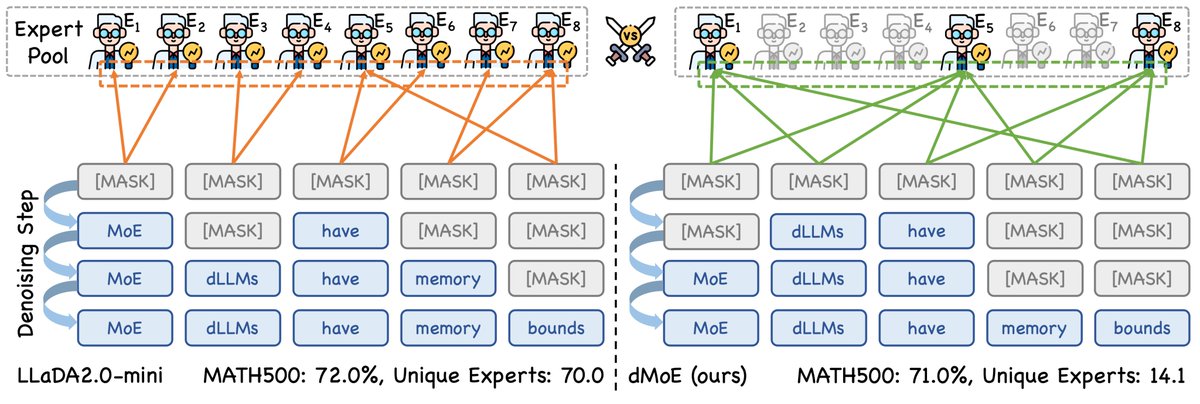
[arXiv 2026] dMoE: dLLMs with Learnable Block Experts
https://t.co/a2yozYn4Ea
Overview of dMoE. We introduce block-level Mixture-of-Experts routing into diffusion large language models (dLLMs), enabling the model to adaptively select computation paths during diffusion-based generation. Built on top of LLaDA-2.0-mini, dMoE achieves an improved efficiency-accuracy trade-off without architectural changes to the base model.
DMax: Aggressive Parallel Decoding for Diffusion LLMs
Solves error accumulation in parallel dLLM decoding to achieve 6.0 tokens-per-step on math and code benchmarks while preserving accuracy through progressive self-refinement from mask embeddings to token embeddings.
Wow, really fast!
Researchers at the National University of Singapore present DMax!
This new paradigm for diffusion language models (dLLMs) enables aggressive parallel decoding.
It cleverly mitigates error accumulation by reforming decoding as a progressive self-refinement process, allowing the model to correct its own erroneous predictions during generation.
DMax significantly outperforms LLaDA-2.0-mini, boosting TPF on GSM8K from 2.04 to 5.47 and on MBPP from 2.71 to 5.86, all while preserving accuracy. It achieves an impressive 1,338 Tokens Per Second on H200 GPUs.
Thanks @_akhaliq for sharing our work! Our paper, code ,models and datasets are all available now!
Paper: https://t.co/WoJJAgfQkH
Code: https://t.co/hN2HByCtmB
🚀ViFeEdit: A Video-Free Tuner of Your Video Diffusion Transformer
🚀 https://t.co/dwXUYC7B6z
🎬 The first method that adapts T2V DiTs to diverse video editing tasks in video-free scheme.
😊 Easy Training: Solely 100-250 image paired data and minimal training cost (< 20 epochs).
🎥 Visuals as control
Can we guide video generation by drawing on the frame?
In-Video Instructions embeds intent (arrows, text) into pixels for precise control.
Project Page: https://t.co/rTGKmLzoIa
#VideoGeneration#GenAI
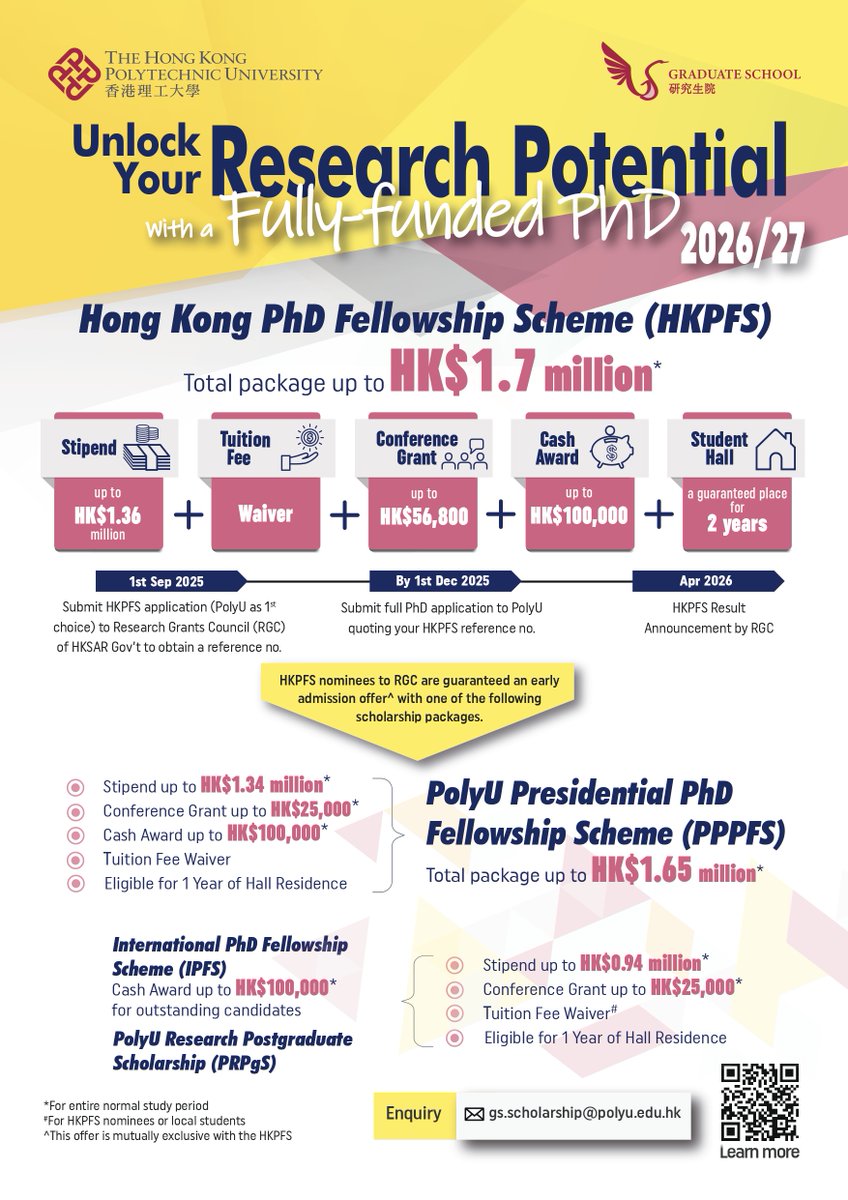
I’m accepting applications for fully-funded PhD positions starting Sept 2026 at PolyU.
Love Generative Models and Computer Vision? Apply via HKPFS and Join us!
⏳ Deadline: Dec 1, 2025
https://t.co/Fvz7PaHdSx
#HKPFS#PhD#AI#ComputerVision#GenerativeAI
Artificial Hippocampus Networks for Efficient Long-Context Modeling
TL;DR: Inspired by the Multi-Store Model in cognitive science, Artificial Hippocampus Networks (AHNs) transform the Transformer’s KV cache into compact long-term memory, achieving 74% KV cache reduction and 41% FLOPs savings on 3B model with 128K sequence length.
Paper: https://t.co/ECDiwwSQD9
Models: https://t.co/Wq9X4ZiV5V
Code: https://t.co/YjWSFlAlFj
Thanks to @_akhaliq for sharing our new work!
dParallel: a simple yet effective method that significantly reduces the decoding steps of dLLM by certainty-forcing distillation
🚀 paper: https://t.co/Lac6iLDKD1
🚀 code: https://t.co/KMLHWDFSIG