If Sullivan & Cromwell (@sullcrom) can file a motion with 40+ hallucinated citations, the rest of us probably want a safety net. Just launched https://t.co/CafvGyTuLs: a free, open source tool (yes, really) to catch AI citation hallucinations. Demo attached.
Cheng-chi (Kirin) Chang (NYU), Algorithm as Agent: AI Vendor Liability for Title VII Hiring Discrimination After Loper Bright, on SSRN. The algorithm was always the agent. Highly recommended. https://t.co/bAGshsyQmK
Courts have reached for terms of negligence when sanctioning attorneys for submitting AI-generated citations to nonexistent cases. @chengchi_chang rejects this characterization and proposes a framework for the treatment of AI hallucinations. https://t.co/CUQ2ZoDCyh
@chengchi_chang examines Mobley v. Workday, the most consequential AI discrimination case currently in litigation, and the impacts of Loper Bright on AI civil-rights litigation. https://t.co/ozrceB8mSJ
@akoustov This kinda already happened? AJPS (top-3 poli sci journal) dropped its ban on AI-drafted manuscripts on Aug 11: you can use AI for the whole writing process now, as long as you disclose and take responsibility (source: https://t.co/F5TKMH8G4m)
@danravicher People should use https://t.co/CafvGyTuLs, the completely free and open-source tool I built (yes, really!), to avoid this!
https://t.co/v0rbAXWAxN
If Sullivan & Cromwell (@sullcrom) can file a motion with 40+ hallucinated citations, the rest of us probably want a safety net. Just launched https://t.co/CafvGyTuLs: a free, open source tool (yes, really) to catch AI citation hallucinations. Demo attached.
@RobertFreundLaw People should use https://t.co/CafvGyTuLs, the completely free and open-source tool I built (yes, really!), to avoid this!
https://t.co/v0rbAXWAxN
If Sullivan & Cromwell (@sullcrom) can file a motion with 40+ hallucinated citations, the rest of us probably want a safety net. Just launched https://t.co/CafvGyTuLs: a free, open source tool (yes, really) to catch AI citation hallucinations. Demo attached.
If Sullivan & Cromwell (@sullcrom) can file a motion with 40+ hallucinated citations, the rest of us probably want a safety net. Just launched https://t.co/CafvGyTuLs: a free, open source tool (yes, really) to catch AI citation hallucinations. Demo attached.
@bnafOg@sullcrom Thanks, totally agree. I built https://t.co/CafvGyTuLs as a verification step, not a generator. It checks each citation against real legal databases before filing
@bnafOg@sullcrom Great point, and yes, I’ve seen that exact failure mode. I built https://t.co/CafvGyTuLs to cross-check case names and citation metadata (volume, reporter, page, year), so plausible but wrong citations get flagged instead of passing through.
Huge thanks to @FreeLawProject for the open legal infrastructure behind this. No idea if this reaches the people who need it most, but if it reaches you and there's a feature you want, drop it below. More replies = more motivation to keep shipping after work!
Full disclosure: this is also the practical side of a forthcoming piece. Hallucinated Authority: AI Citations as Reckless Misrepresentation, 115 @GeorgetownLJ Online (forthcoming 2026). It argues unverified AI cites can be reckless misrepresentation, not routine error.
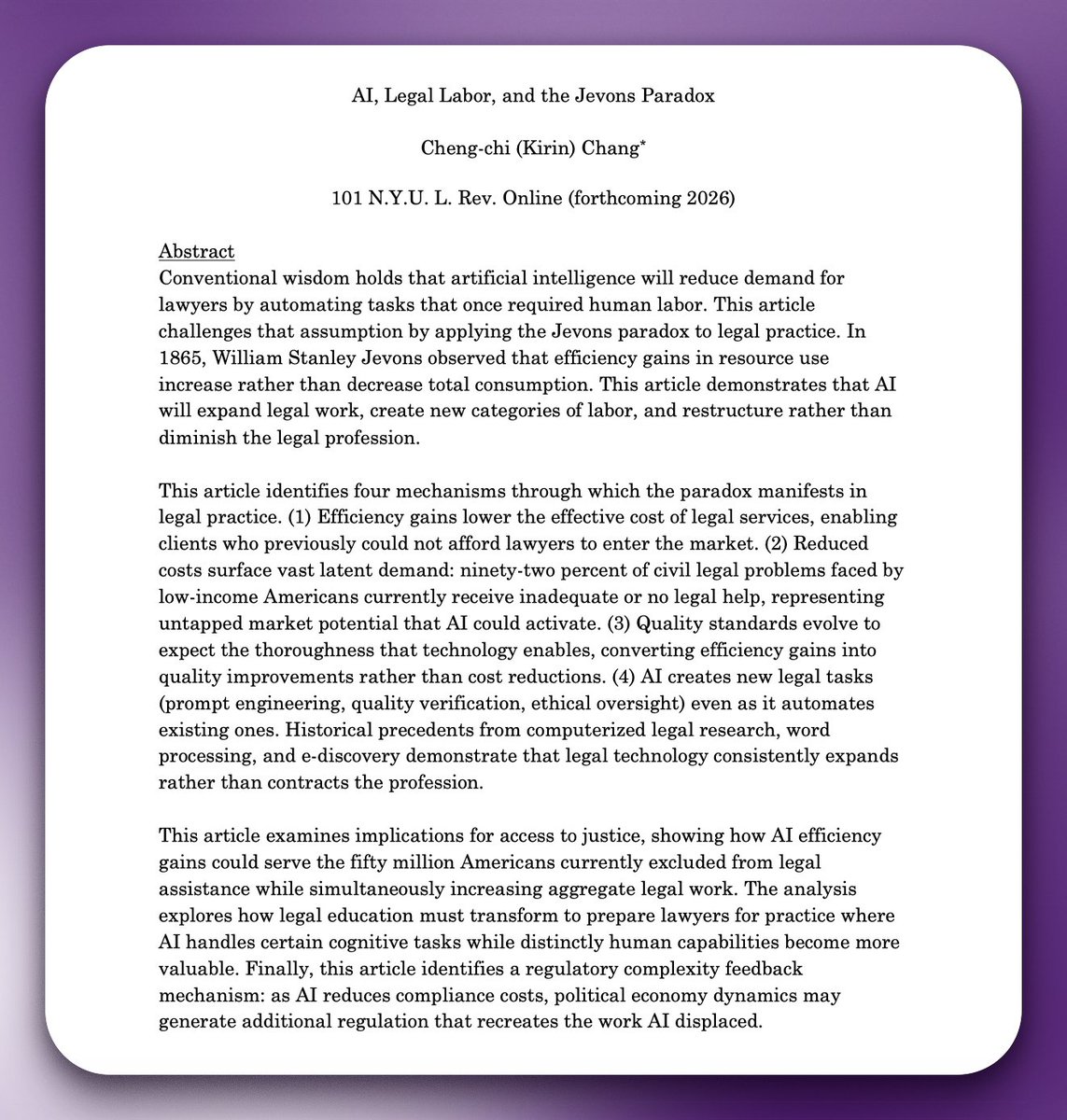
Thrilled to share "AI, Legal Labor, and the Jevons Paradox," forthcoming in @nyulawreview.
Jevons paradox: efficiency gains expand consumption. In law: cheaper AI surfaces more demand, more demand means more work. The profession expands, not shrinks.
https://t.co/rx2V77ROVc
This is a wonderful opportunity to spend a year conducting research @nyulaw while engaging with an international community of legal scholars and practitioners. If you have any questions about the program or application process, please feel free to reach out!
The U.S.-Asia Law Institute at @nyulaw is accepting applications for 2026-2027 visiting scholars. Open to legal scholars and practitioners with LLM/JD or equivalent.
Deadline: Jan 31, 2026
More info: https://t.co/U6Y9ym6LHe
ご応募お待ちしています!
New draft book chapter: "Superintelligent AI and the Right to Be Forgotten" for Research Handbook on Law in an Age of Superintelligence (@ElgarPublishing , forthcoming).
Grateful to editors Woody Barfield & Marc Blitz for the invitation.
Draft: https://t.co/jbRz6MgvYh
My article "Wires of War" is published in @UPennJIL!
Submarine cables carry 95% of global data but face hybrid warfare threats. Ukraine & Taiwan show vulnerabilities to sabotage & cyberattacks.
Solutions: treaties, cooperation & partnerships.
Read more: https://t.co/Yq9UjMK0XN
Chang on the Framework Convention on Artificial Intelligence and Human Rights, https://t.co/OlRPuPt6eW - Cheng-chi (Kirin) Chang (Emory University School of Law) has posted The First Global AI Treaty: Analyzing the Framework Convention on Artificial Intelligence and the Eu AI Act (2024 University of Illinois Law Review (Online) 86 (2024)) on SSRN.