🛡️ RobustRLlib: a one-stop library for designing and applying robust RL against shifts in applications
• 17 representative robust RL algorithms
• A wide range of tasks with deployment-time environment shifts from diverse sources and modes
We’d love your feedback!
I learned a ton from Yuxin and the other authors’ work when I first got into RL theory. A lot of their insights still help me today when working on more applied stuff. Definitely a great book. Check it out!
Excited to share our new book on reinforcement learning! It presents a self-contained treatment of state-of-the-art sample-complexity analyses for tabular RL.
Statistical Foundations of Reinforcement Learning: A Non-Asymptotic Perspective
https://t.co/BvzdasrD38
@ChenMoneyQ i usually chat with them intensively to only design the structure of a paper and where to put more emphasis. This works for me in getting an acceptable first draft
We can finally talk about it:
We found a way to extract hidden reasoning of frontier models using a vulnerability in the APIs of every frontier AI company.
We verified that our reasoning token count matches billed API thinking tokens 1:1 for most of the prompts we queried.
sf is insane
2 guys i know co-founded a company
working 140 hour weeks
both wanted to start dating but didn't have time to meet women
they made the efficient choice and just started dating each other (even though they're not gay)
other founders could learn from this level of commitment
Recursive self-improvement (RSI) is so popular. For benchmarks with clear success criteria, RSI works pretty well. But for open-ended tasks, RSI will naturally collapse as long as we do not have a perfect verifier: https://t.co/eRLP3js9Eo.
A simple thought experiment: What if we stop trying to cram intelligence into agents, and instead externalize it into a shared knowledge base?
Introducing Knowledge-centric Self-Improvement (KSI).
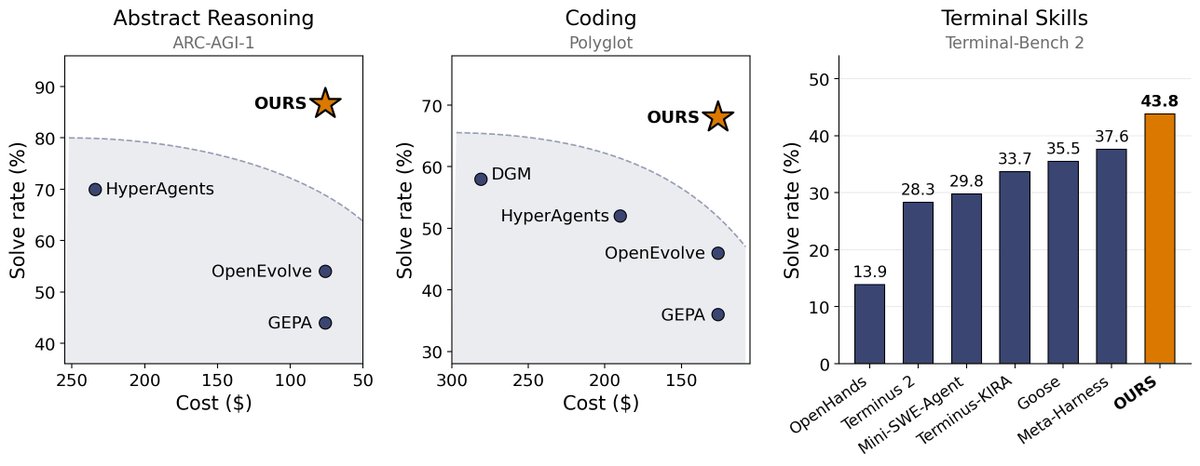
TL;DR: We show that a remarkably simple knowledge curation mechanism pushes the Pareto frontier of self-improvement agents, outperforming SOTA agent-centric approaches (e.g., harness or prompt optimization) across reasoning, coding, and terminal benchmarks at a fraction of the cost.👇
New paper accepted by ICLR 2026: Distributionally Robust Cooperative Multi-Agent Reinforcement Learning via Robust Value Factorization: https://t.co/IhcplhgYW8
Code: https://t.co/WuqOm4TDMm
(2/3) Key idea: instead of making each agent individually robust, we align all agents against a shared worst-case model implicitly during centralized training, ensuring decentralized greedy execution remains robust under environmental uncertainty.