Excited be part of the team that used LLM agents as AI researchers to find better recipes for Gemini DeepThink! Thrilled to see the intelligence level it has achieved.
Gemini 3 Deep Think is getting a significant upgrade. We’ve refined Deep Think in close partnership with scientists and researchers to tackle tough, real-world challenges.
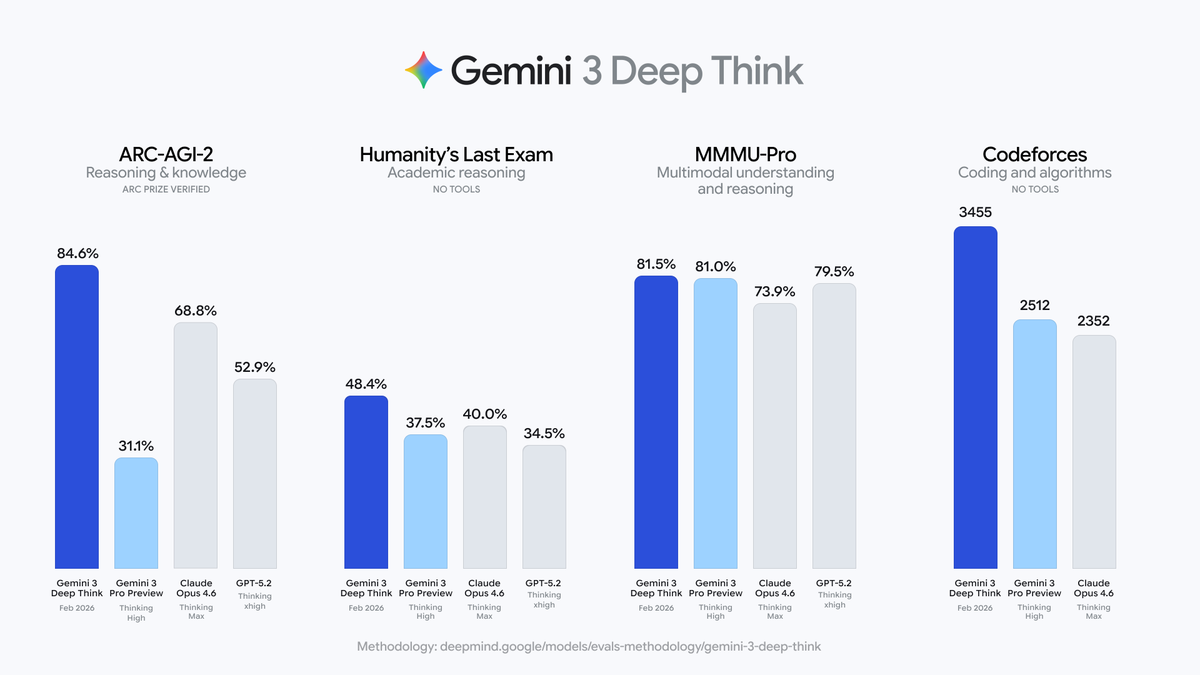
And it’s pushing the frontier across the most challenging benchmarks, achieving an unprecedented 84.6% on ARC-AGI-2. It also sets a new standard on Humanity’s Last Exam - 48.4% without tools.
We’ve updated Gemini 3 Deep Think to better tackle the complexity of real-world research, science, and engineering. ♊ 🚀
It achieves gold-medal standards on the written portions of the Physics and Chemistry Olympiads, building on gold-level performance at IMO and ICPC and has SOTA results on ARC-AGI-2, MMMU-Pro, and HLE. 🏅
From optimizing code to validating scientific data, we’re seeing it become a genuine partner in the discovery process.
Read more here: https://t.co/phbQ0jAkYd
This is Gemini 3: our most intelligent model that helps you learn, build and plan anything.
It comes with state-of-the-art reasoning capabilities, world-leading multimodal understanding, and enables new agentic coding experiences. 🧵
Veo is getting a major upgrade. 🚀
We’re rolling out Veo 3.1, our updated video generation model, alongside improved creative controls for filmmakers, storytellers, and developers - many of them with audio. 🧵
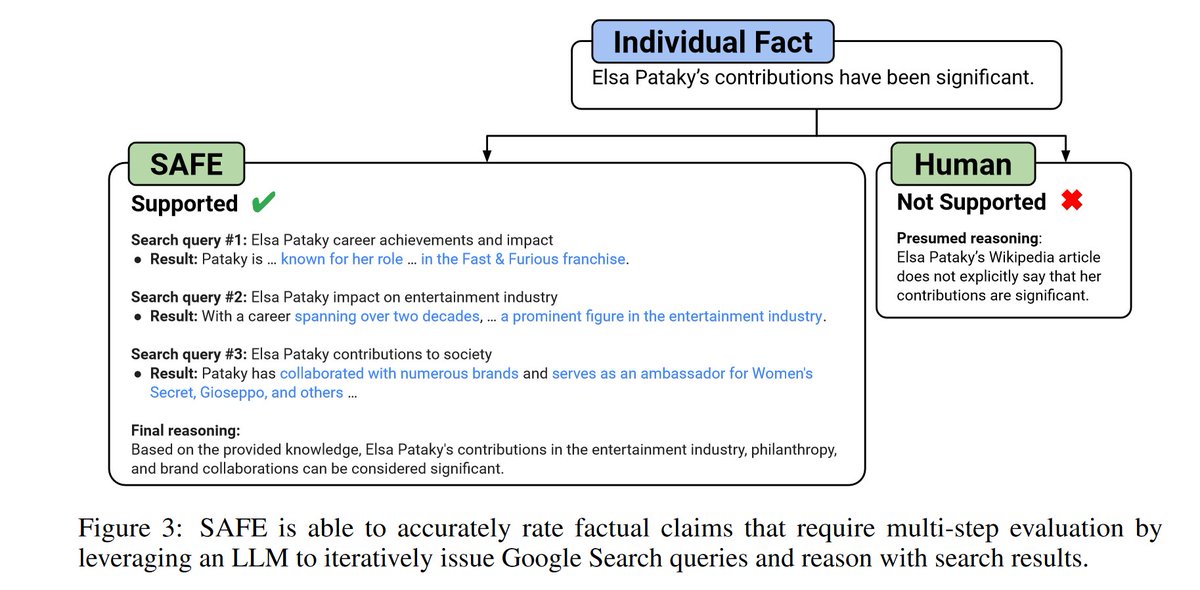
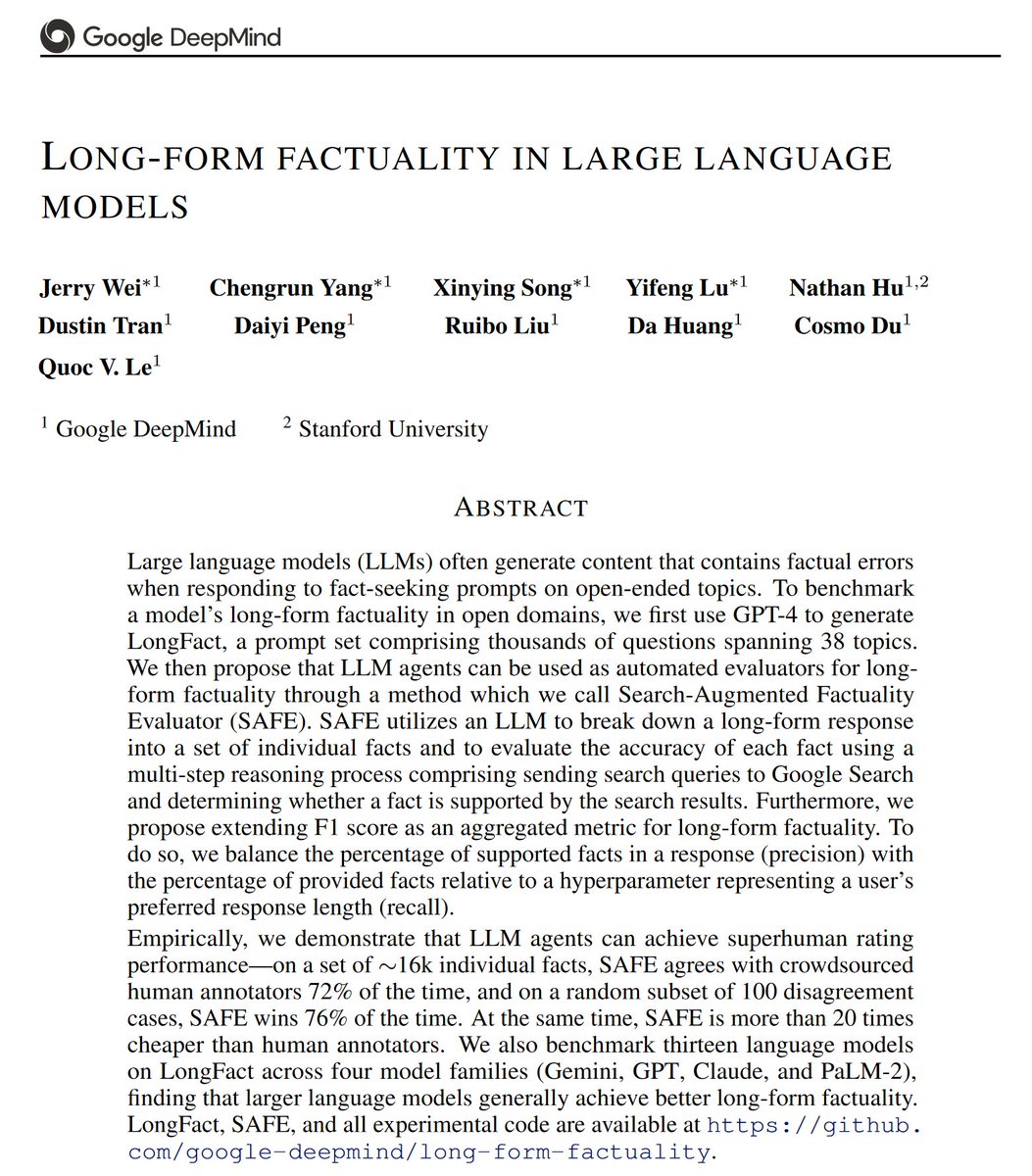
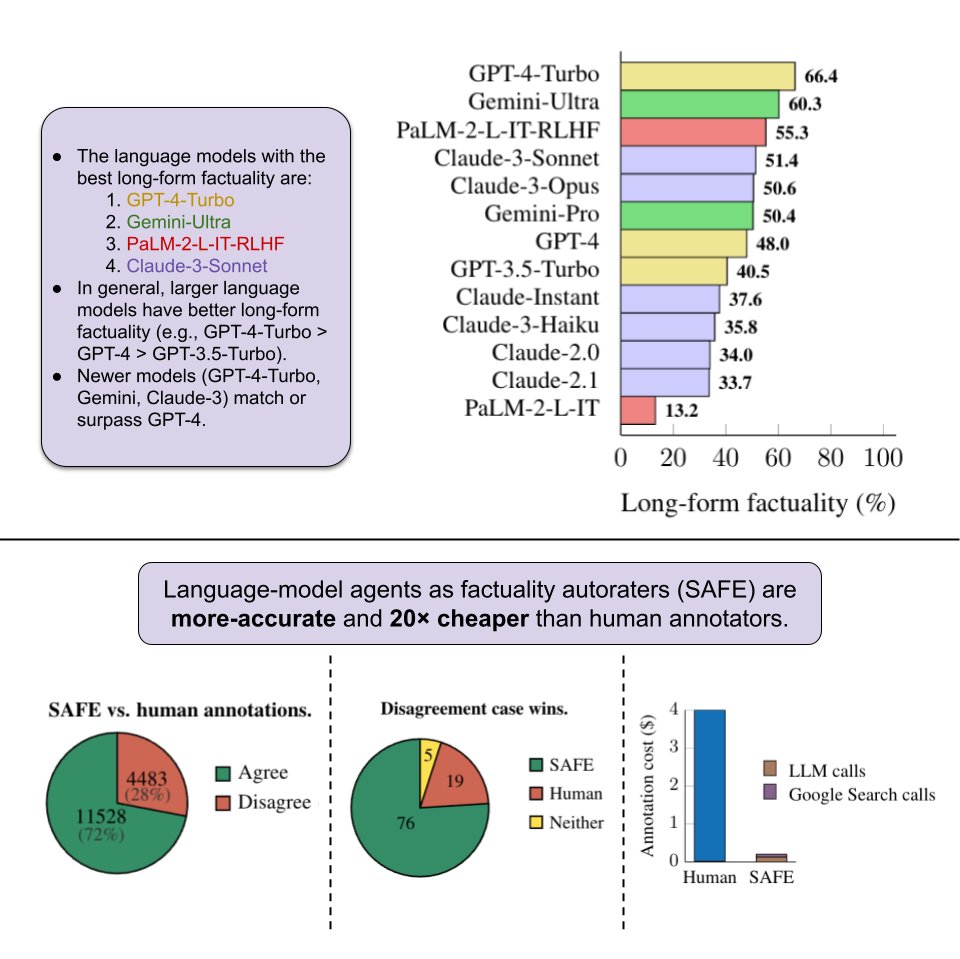
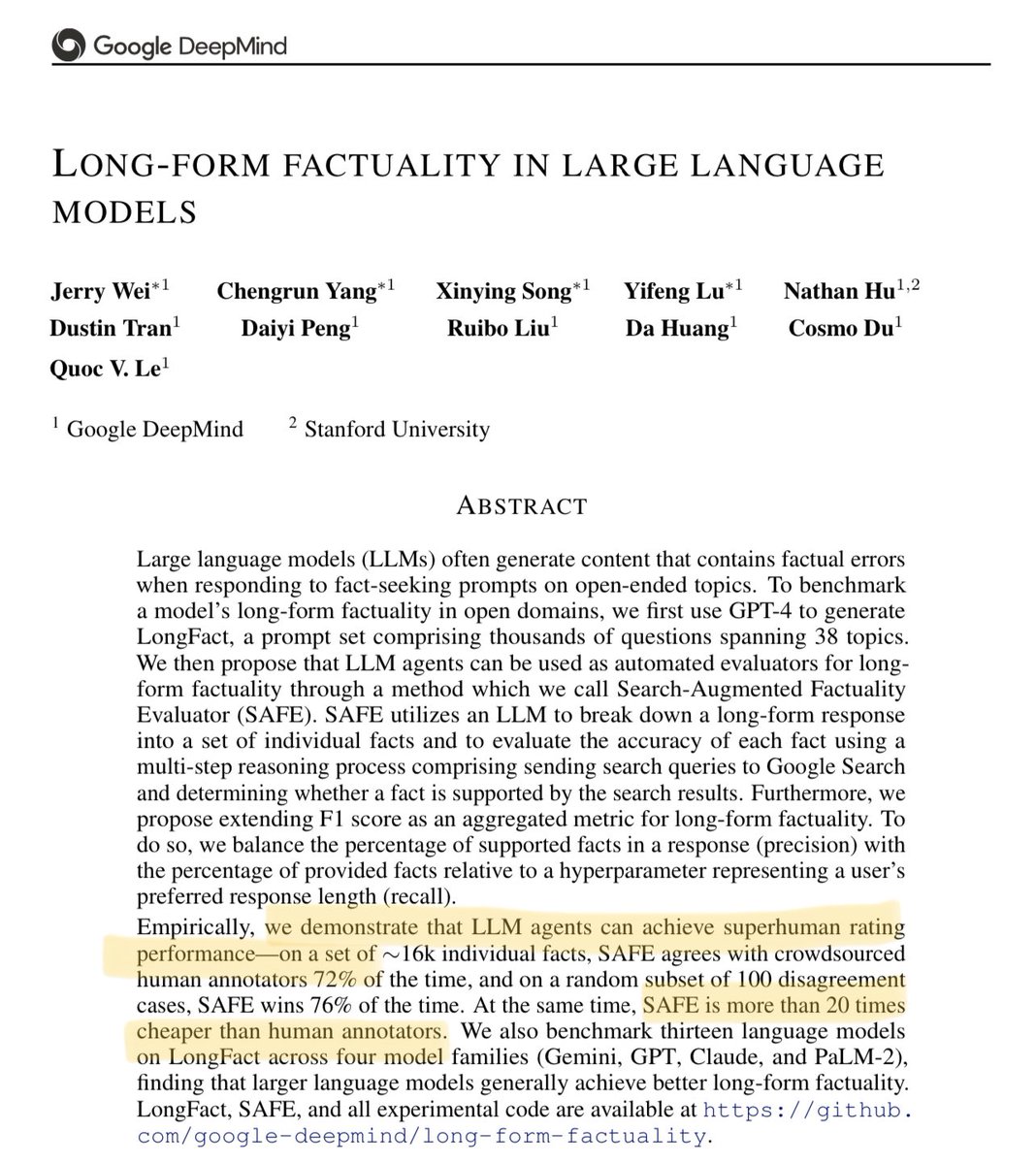
AIs have a bad reputation for truth, so three important findings in this paper:
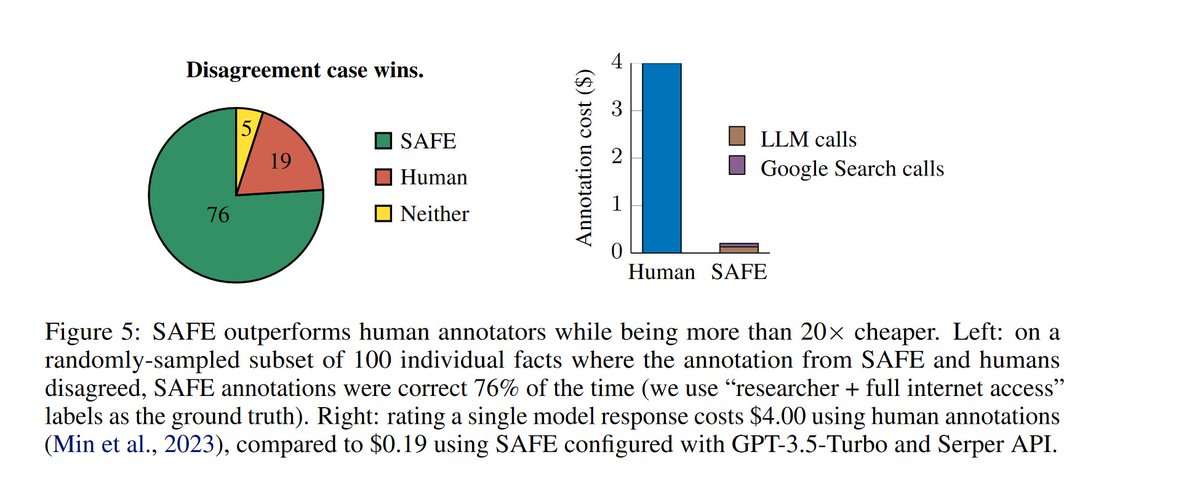
1) "LLM agents can achieve superhuman rating performance" on fact checking when given access to Google!
2) Bigger models are more factual
3) LLMs are 20x cheaper than humans
https://t.co/lSSMAjoOnF
We focus on long-form factuality in open domain, and so we show an entire evaluation pipeline with dataset + autorater + metric. The dataset was generated with LLMs and the autorater is an LLM agent with Google Search, demonstrating LLMs can rate themselves better than humans!
New @GoogleDeepMind+@Stanford paper! 📜
How can we benchmark long-form factuality in language models?
We show that LLMs can generate a large dataset and are better annotators than humans, and we use this to rank Gemini, GPT, Claude, and PaLM-2 models.
https://t.co/A3vgEjbqTV
Google announces Long-form factuality in large language models
Large language models (LLMs) often generate content that contains factual errors when responding to fact-seeking prompts on open-ended topics. To benchmark a model's long-form factuality in open domains, we first
Google presents Long-form factuality in large language models
- Proposes that LLM agents can be used as automated evaluators for longform factuality
- Shows that LLM agents can achieve superhuman rating performance
repo: https://t.co/rlAIFSqfTU
abs: https://t.co/L3CpeLaFpQ
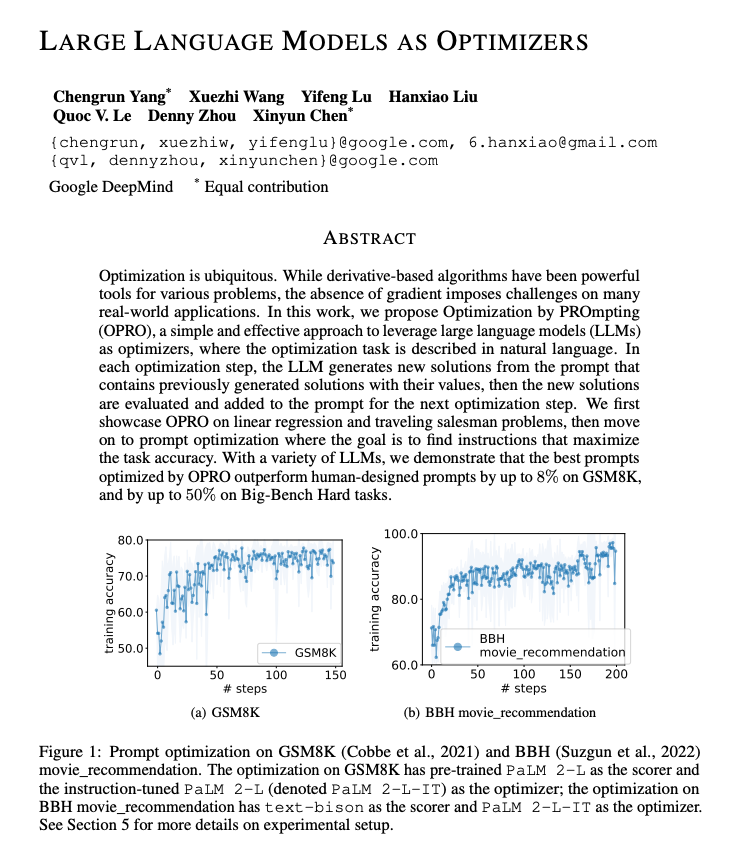
In our work https://t.co/ZZ54i5yhtY, besides prompt optimization as our primary application, we also investigate the potential of LLMs for broader optimization problems. Interestingly, LLMs can find good solutions to some small-scale classic optimization problems; e.g., TSP. This is done with a simple meta-prompt that only contains a problem description and past optimization trajectory, w/o additional training or human-designed heuristics in the prompt!
Thanks for sharing our work (https://t.co/U0NPcuNIXZ)! Besides the huge improvement with prompts optimized by LLMs, we are also amazed by the creativity of LLMs, which continually surprise us with interesting prompts tailored to the LLM in the optimization loop!
That said, there is a case you may need to worry more about overfitting: the generated instructions become even more specific to the task, or the sentence just get much longer, so that it may overfit more severely. In these cases it may still be necessary to check overfitting once in a while.
(3/3)
But indeed, the found instructions on BBH overfit more than "Let's think step by step." or "Let’s work this out in a step by step way to be sure we have the right answer.": in Table 7, the "Our Acc" column has a larger training and test difference than the other columns (although our test accuracies are still often the highest). So the takeaway might be: we still overfit, but the extent of overfitting doesn't drastically increase in most of our searches.
(2/3)