Major new report on global trends in mental health, out today from Sapien Labs. Data from 2.5 million people across 85 countries.
Some of the most important findings:
1) Young adults used to generally have good mental health, compared to older generations. But now, in ALL countries examined, they are doing badly compared to older generations in that country.
2) "Four key factors have emerged that together predict three quarters of this effect. These are diminished
family bonds, diminished spirituality, smartphones at increasingly young age, and increasing consumption of
ultra-processed food."
3) The decline of young people's mental health is "most pronounced in the wealthier and more developed countries." They note that it is in such countries that smartphones are given earliest, junk food is most heavily consumed, spirituality is most diminished, and family ties are looser and often weaker.
4) "A younger age of first smartphone ownership is associated with increased suicidal thoughts,
aggression, and other problems in adulthood."
5) Here is their summary of findings on early smartphone ownership:
"GenZ is the first generation to grow up with a smartphone. Among this group, the younger they acquired their first smartphone in childhood, the more likely they are to have struggles as adults. These struggles extend beyond sadness and anxiety to less discussed symptoms, such as a sense of being detached from reality, suicidal thoughts, and aggression towards others. The effects arise through disruption of sleep, increased risk of exposure to harmful online content, predators, and explicit material as well as increased probabilities of cyberbullying during crucial developmental years. Excessive time spent on smartphones also diminishes the development of social cognition that requires learned interpretation of facial expressions, body language, and group dynamics. The negative impacts are particularly sharp below age 13."
The report is short, accessible, and important. Read it here:
https://t.co/hFGAyoWabs
It's now happening. The existing fiat monetary order, the domestic political order, and the international geopolitical order are all breaking down, so we are at the brink of wars. It all is happening because of the Big Cycle that is driven by the five big forces I've described repeatedly and laid out in detail in my book and Youtube video titled Principles for Dealing with The Changing World Order. You can find the video linked in the comments below.
"The Monetary Order is Breaking Down"
Ray Dalio from Davos
Dalio highlights that the gold market outperformed tech and US markets recently, hitting record levels as central banks and sovereign wealth funds use it as a diversifier.
Trump is destroying the power of the USD!
He also explains that current events are analogous to historical cycles, where high debt levels and geopolitical conflicts lead even allies to prefer "hard currency" over debt assets like bonds.
For a neutral investor, Dalio suggests a diversified portfolio where gold represents 5% to 15% of the total. He personally favors tilting away from bonds and toward gold. He believes many entities are still "short" on gold relative to where they should be for proper diversification.
Despite his concerns about the monetary system, Dalio is optimistic about the technological revolution, specifically the impact of AI on company productivity.
The period of pre-AI videos was this nice golden age of evidence for things, connecting us together in a shared, objective world.
As videos become effortlessly fakable, bit puts its back into a sort of communication dark age.
I think it’s safe to say that 2025 was a very interesting year. And I think I see it very differently than most.
You probably saw a lot of headlines about AI and tech stocks. While that was a big story, I don’t think it was the most important thing.
The big story in the investment world was the depreciation of the value of fiat money and how that impacted the price of gold.
That’s how 2025 looked through my eyes, at least. I’m curious to hear if you see things the same way.
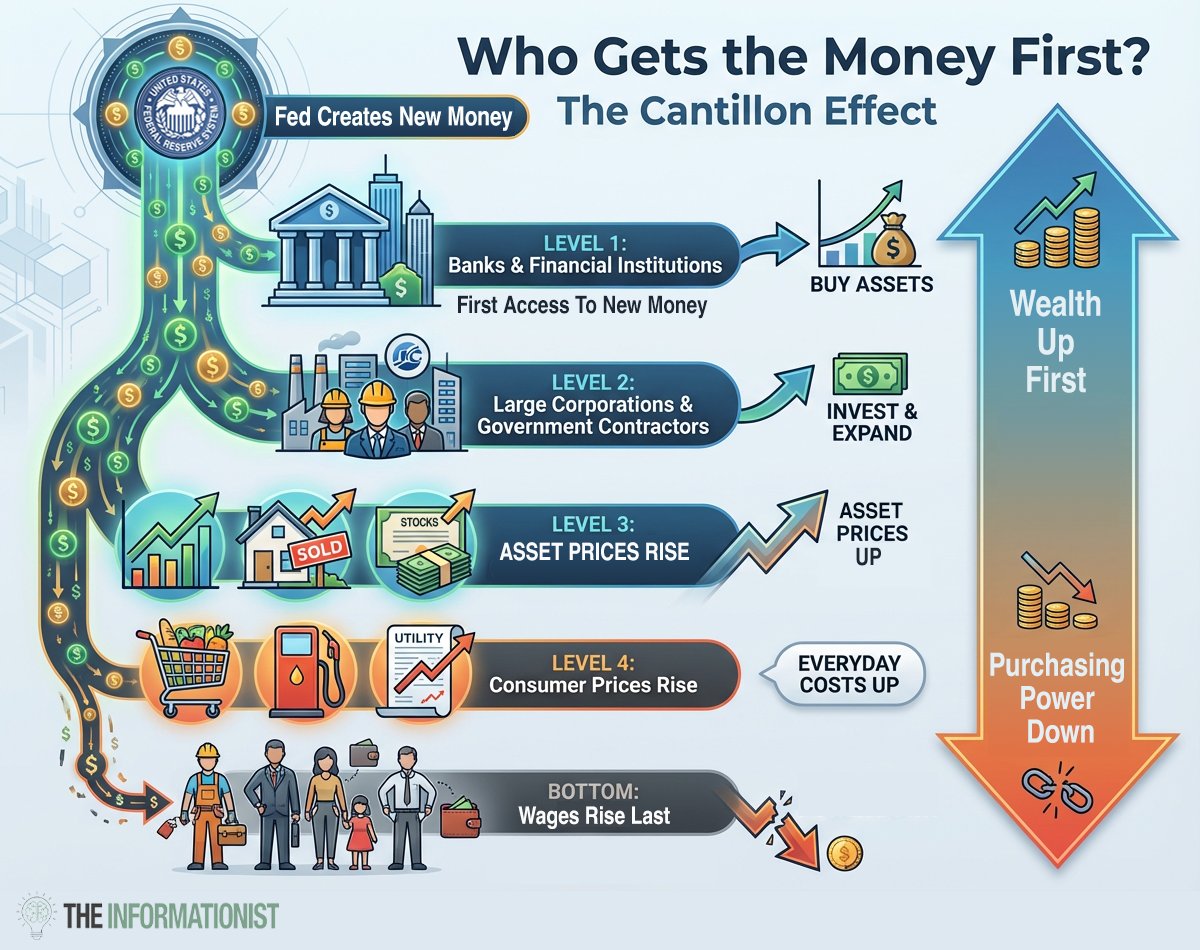
Most people have never heard of the Cantillon Effect.
But once you understand it, you’ll see the world of investing differently.
What is it?
In the early 1700s, Richard Cantillon noticed a simple pattern:
When new money enters an economy, it doesn’t reach everyone at once.
And whoever gets it first benefits the most.
Here’s how it works today:
New liquidity enters through the Fed and through bank lending.
Both follow a similar pattern:
→ Markets and large balance sheets get first access
→ Large corporations and well-connected borrowers tap cheap credit next, they invest and expand at today’s prices
→ Asset prices tend to rise as new liquidity chases finite assets
→ Consumer prices often follow
→ Wages rise last, usually after purchasing power has already declined
Fed data shows how lopsided the playing field is:
- The top 10% hold nearly 90% of equities.
- The bottom 50% holds about 1%.
It’s a simple but powerful monetary transmission.
Understanding this won’t change the system.
But it might change how you think about where to store your savings.
For those of you who don't know, I write all about topics like this every week in The Informationist. Last week, we dove deep on this one.
Link in bio if you want to read the full explanation.
@RnaudBertrand@vussyviz Exactly. China’s house price to income ratio is one of the highest in the world. I think it’s around 40 in Beijing and close to 30 in major cities. For comparison, New York City is around 10.
In two years, the level of detail you can capture in a 3D Gaussian Splat has skyrocketed. In this scene on SuperSplat, I can zoom right in on a certificate and the text is perfectly legible. Imagine where we will be in another 2 years. 🪄
We present MotionStream — real-time, long-duration video generation that you can interactively control just by dragging your mouse.
All videos here are raw, real-time screen captures without any post-processing. Model runs on a single H100 at 29 FPS and 0.4s latency.
@BankOfDevo@KobeissiLetter No. He’s been saying owning gold for years. It’s just that with gold hitting $4000, he gets a lot more coverage now. Blame the media, not Ray Dalio.
For example,
https://t.co/ZOkCL71jaq
STATISTICAL MISTAKE DU JOUR
If a portion of those with low cholesterol use statins because they are metabolically ill, then the cohort will have a higher mortality rate (but their HR would be even higher without controlling LDL).
Similar to Simpson's paradox.
h/t @drjohnm
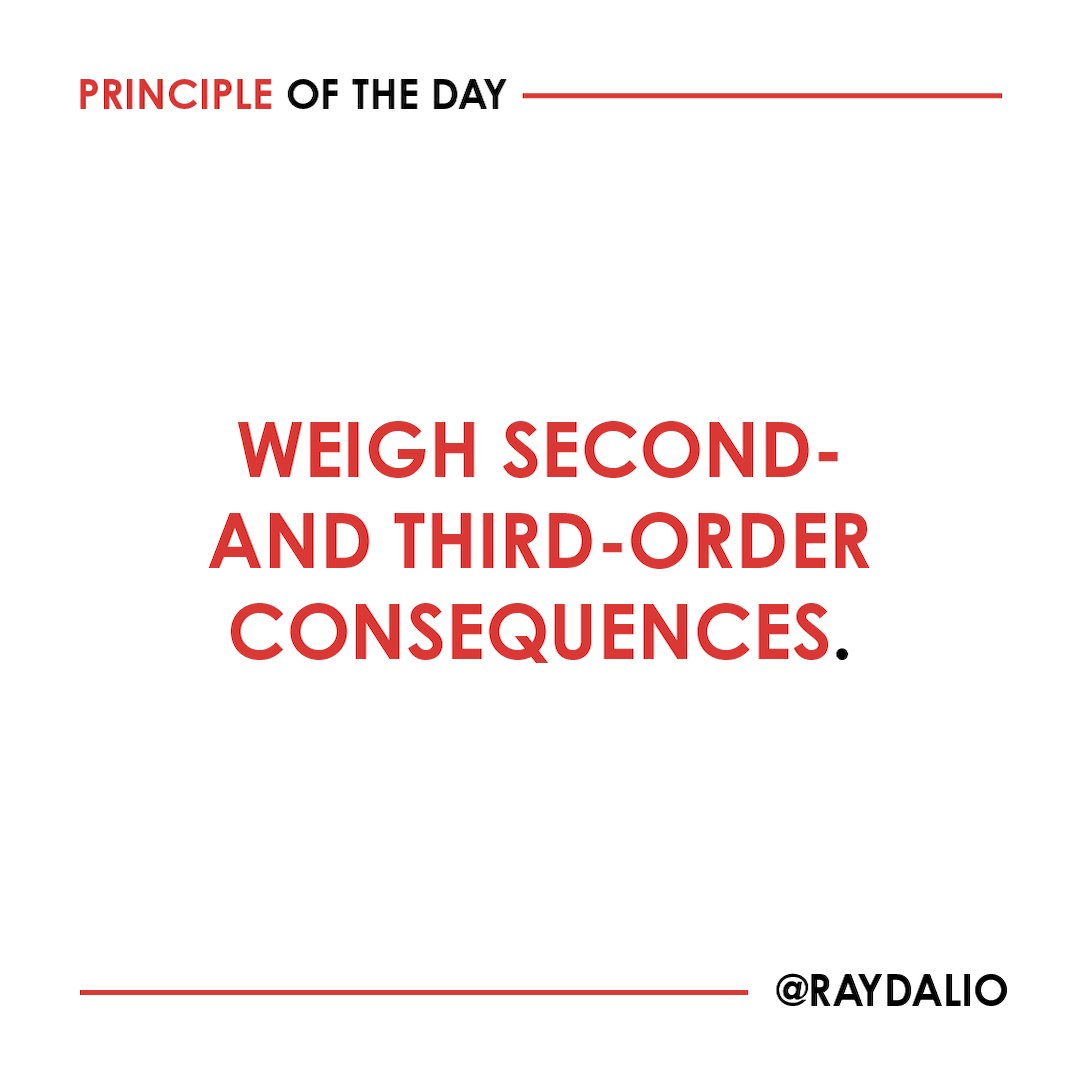
By recognizing the higher-level consequences nature optimizes for, I've come to see that people who overweigh the first-order consequences of their decisions and ignore the effects of second- and subsequent-order consequences rarely reach their goals. This is because first-order consequences often have opposite desirabilities from second-order consequences, resulting in big mistakes in decision making. For example, the first-order consequences of exercise (pain and time spent) are commonly considered undesirable, while the second-order consequences (better health and more attractive appearance) are desirable. Similarly, food that tastes good is often bad for you and vice versa.
Quite often the first-order consequences are the temptations that cost us what we really want, and sometimes they are the barriers that stand in our way. It's almost as though nature sorts us by throwing us trick choices that have both types of consequences and penalizing those who make their decisions on the basis of the first-order consequences alone.
By contrast, people who choose what they really want, and avoid the temptations and get over the pains that drive them away from what they really want, are much more likely to have successful lives. #principleoftheday
@ecommerceshares@The_Analyst_Lab Yeah no doubt. I think the entertainment industries will be impacted quite heavily by generative AI. As far as I know, VEO 3 is the only mainstream model that generates audio along with video so far.
@The_Analyst_Lab@ecommerceshares Also, VEO 3’s audio generation is very hit or miss, especially for non English dialogue. My preferred workflow on my side projects is generating the audio separately, and then lip sync. For that workflow, I would just use multiple models and pick the best result.
@The_Analyst_Lab@ecommerceshares VEO 3 is very impressive. However, it is not that far ahead of competitors like Seedance 1.0 (Bytedance) and Hailuo 2 (Minimax). I have used all 3 to generate videos. VEO’s main advantage is being able to generate audio along with video, but that does not seem insurmountable.