How should researchers select and design the most informative next experiment, given existing evidence, to predict effects at scale or in new populations?
We study this in WP with Aristotle. Updated version: https://t.co/xcwkUifVEc
R package: https://t.co/7XEqtIp3On
We've added to the website a free PDF of the Bayesian Workflow book (for non-commercial purposes, like research and exorcism). We put so much work into this book, hope you all find value in it. https://t.co/f472XjM6cf
Anthropic engineer:
"Most people will use Sonnet 5 and Fable 5 wrong. You can set them up right in one afternoon and stop overpaying every single day."
In 31 minutes he shows how to test every model against your real use case and stop overpaying for nothing.
Watch the session, then read the guide below on the Claude features 99% of users never find.
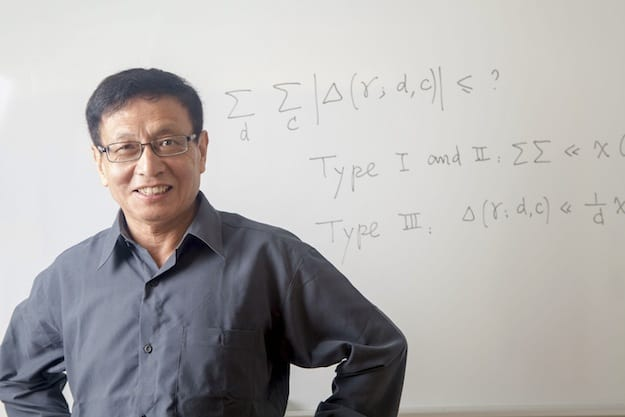
A Chinese mathematician spent 7 years making sandwiches at Subway after his PhD, and at 58 solved a 150-year-old math problem nobody thought was solvable.
His name is Yitang Zhang. The problem is called the Twin Prime Conjecture.
He was born in Shanghai in 1955 and knew he wanted to spend his life on mathematics by the time he was nine years old. That year he found his own proof of the Pythagorean theorem. Nobody taught it to him. He just worked it out.
Then the Cultural Revolution arrived and took everything.
The Chinese government closed the schools. Zhang's father had political troubles with the Communist Party, so Zhang was sent to the countryside with his mother to work in the fields. He spent 10 years as a farm laborer. No high school. No classroom. No teacher.
He read math books in the fields when he could find them.
When the revolution ended, Zhang was 23. He sat the university entrance exam and got into Peking University, one of the most competitive mathematics programs in China. He finished his bachelor's degree, then a master's. The president of Peking University personally recommended him for a full scholarship at Purdue University in the United States.
He arrived at Purdue in 1985. He earned his PhD in 1991.
Then the second wall hit.
His relationship with his doctoral advisor collapsed. The advisor did not write him letters of recommendation. Without those letters, the academic job market was closed. Zhang applied. Nothing came back. He spent the years after his PhD working as an accountant, doing delivery work, sleeping in his car during the stretches when nothing else was available.
A friend eventually opened a Subway sandwich restaurant in Kentucky and offered him a job. Zhang took it. He kept the books and made sandwiches. A man with a PhD in mathematics from Purdue, working a Subway counter because the academic world had no place for him.
He did this for seven years.
He was finally hired as a lecturer at the University of New Hampshire in 1999. Not a professor. A lecturer. The lowest rung of the academic ladder, with no research funding, no graduate students, and no institutional support. He taught calculus to undergraduates and worked on mathematics alone in whatever time was left.
Most people would have stopped believing by then.
Zhang did not stop.
The Twin Prime Conjecture is one of the oldest unsolved problems in number theory. Twin primes are pairs of prime numbers separated by exactly two: 5 and 7, 17 and 19, 41 and 43. The conjecture predicts that these pairs never stop appearing no matter how far you go along the number line. Mathematicians had believed this for over 150 years. Nobody had been able to prove it.
The deeper version of the problem asks something slightly different. Not whether twin primes are infinite, but whether there is any finite gap between prime numbers that appears infinitely often. This is called the bounded gap problem. The best mathematicians in analytic number theory had been attacking it for decades. A landmark 2005 paper by three researchers came agonizingly close and still could not close it.
Zhang worked on it alone. No collaborators. No funding. No department seminars where he could road-test his ideas. He once said he would go to a friend's house and think in the garden for hours.
In 2012, during a visit to a friend's home in Colorado, something unlocked.
He submitted his paper to the Annals of Mathematics in April 2013. The Annals is the most prestigious mathematics journal in the world. Papers sit in review for months, sometimes years. The editors read Zhang's submission and immediately knew something was different. They sent it to the leading experts in analytic number theory for review.
It was accepted in three weeks.
The paper proved that there are infinitely many pairs of prime numbers separated by a gap of less than 70 million. Not two. Not the twin prime gap specifically. But a finite gap. For the first time in history, someone had proved that prime numbers keep coming back together, that the universe of numbers never lets them drift apart forever.
Peter Sarnak, one of the most respected mathematicians at the Institute for Advanced Study, said: "He is not a fellow who had done much before. Nobody knew him. His result was spectacular."
Zhang was 58 years old.
Within a year he had the MacArthur Fellowship, the Cole Prize, the Rolf Schock Prize, and a full professorship at UC Santa Barbara. The man who spent seven years at Subway was now one of the most celebrated mathematicians alive.
He said in an interview: "I was not lucky. Maybe it is more important for a person to make himself known to the public. But that was not so easy for me."
He was not complaining. He was just being precise.
The mathematics establishment has a quiet belief that great work happens young. The Fields Medal cuts off at 40. Most mathematicians who change the field do it in their thirties. Zhang proved his most important theorem at 58, after a decade of farm labor, seven years of sandwiches, and a decade of teaching calculus to freshmen with no one watching.
He did not beat the deadline.
He proved there was no deadline to beat.
Our paper “Difference-in-Differences Designs: A Practitioner’s Guide” is now published in the Journal of Economic Literature. It took us a while but we are happy!
We put together a lot of material to make the paper useful in practice: https://t.co/30TbAgihlz
Hope you like!
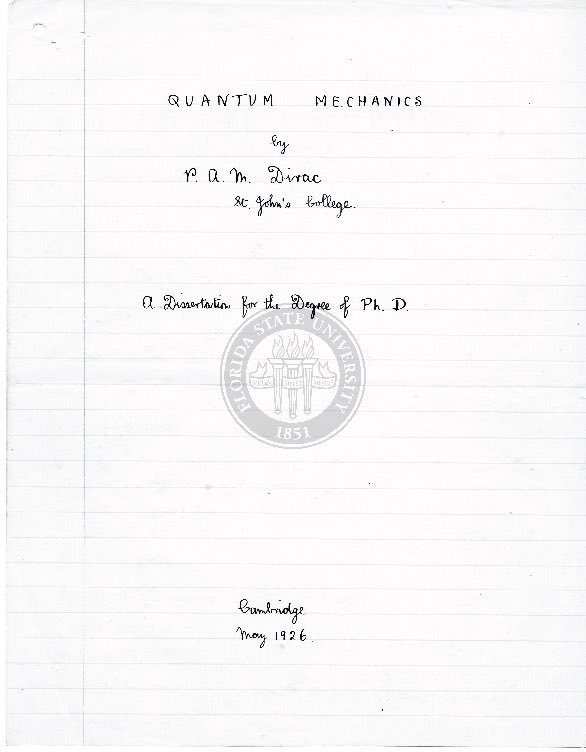
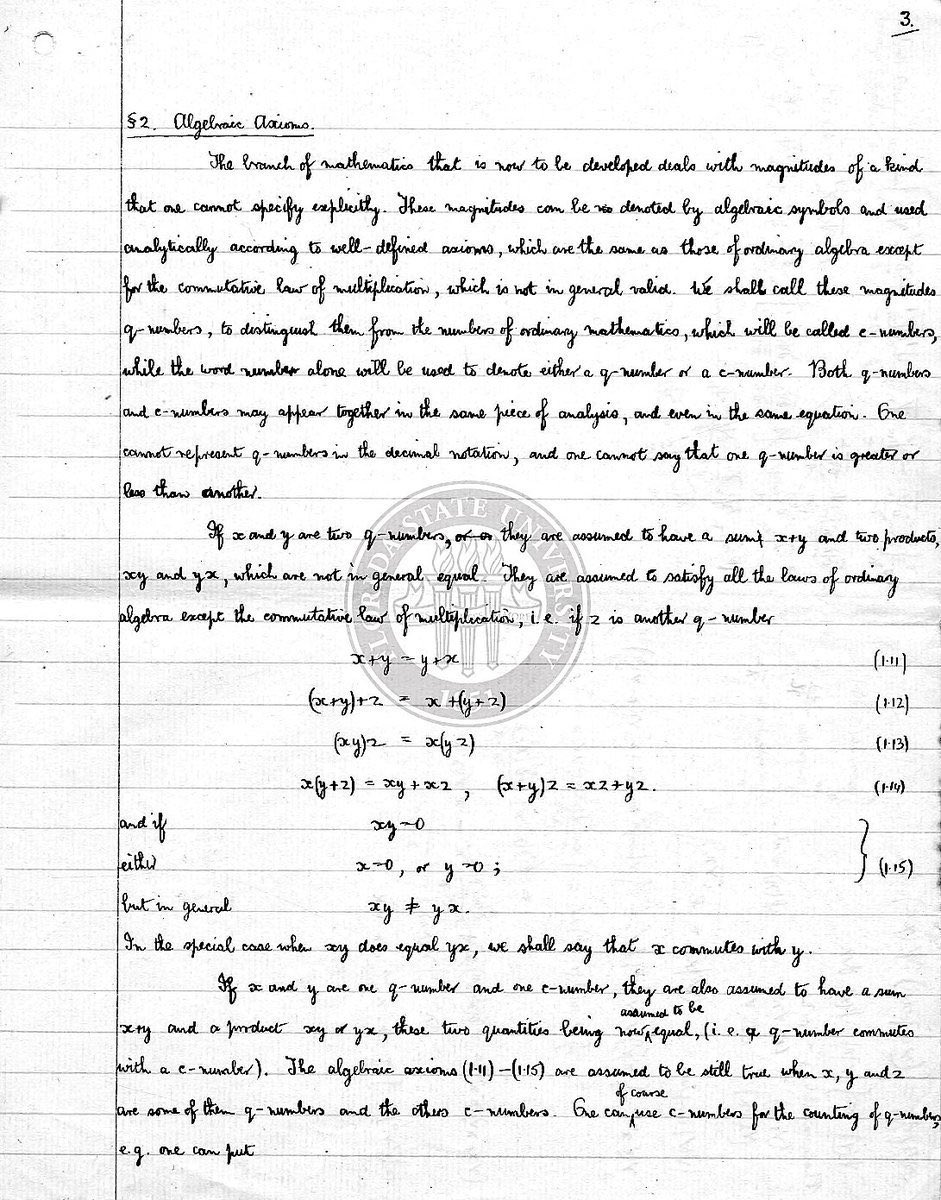
Imagine writing a PhD thesis so foundational that the title is literally just the name of the entire field of study.
Paul Dirac, 1926: "Quantum Mechanics."
This is probably the best paper I have read about causal reasoning for quite some time. Really a great weekend read!
"Causal Persuasion" (Burkovskaya & Starkov) models how much evidence you need to establish vs. rule out a causal link. The result is stark:
To prove X causes Y: 1-2 well-chosen variables often suffice.
To prove X does NOT cause Y: you must account for every possible common cause. Arbitrarily many confounders. Practically unfalsifiable.
This inverts the Humean intuition: in causal reasoning, positive claims are cheap to sell and negative ones are almost impossible to rebut.
Now think about what this means for Virtual Cell models.
Most perturbation datasets cover a thin slice of the combinatorial space — a few hundred gene knockouts, maybe a few contexts. A model trained on that data can confidently "learn" gene X drives phenotype Y. But if the true structure is X←C→Y , and C was never systematically varied — the model will never see its own confounding. It has no mechanism to distinguish causal signal from correlated noise.
The paper formalizes exactly why: the model is a sophisticated receiver that accepts whatever causal story is consistent with the data it's seen. And if the data omits the right confounders, even a "sophisticated" model is manipulable.
This is the deepest argument for perturbation diversity. Not just more data, but also more axes of variation. Vary the context. Vary the genetic background. Vary the timing. You're not just collecting samples; you're systematically eliminating alternative causal explanations.
This is why we need “scale” the training data with more contexts including cell types, spatial, and temporal variations.
Paper: https://t.co/Ayvt8tKtnj
BREAKING: Claude can now research like a Stanford PhD student.
Here are 9 insane Claude prompts that turn 40+ research papers into structured literature reviews, knowledge maps, and research gaps in minutes (Save this)
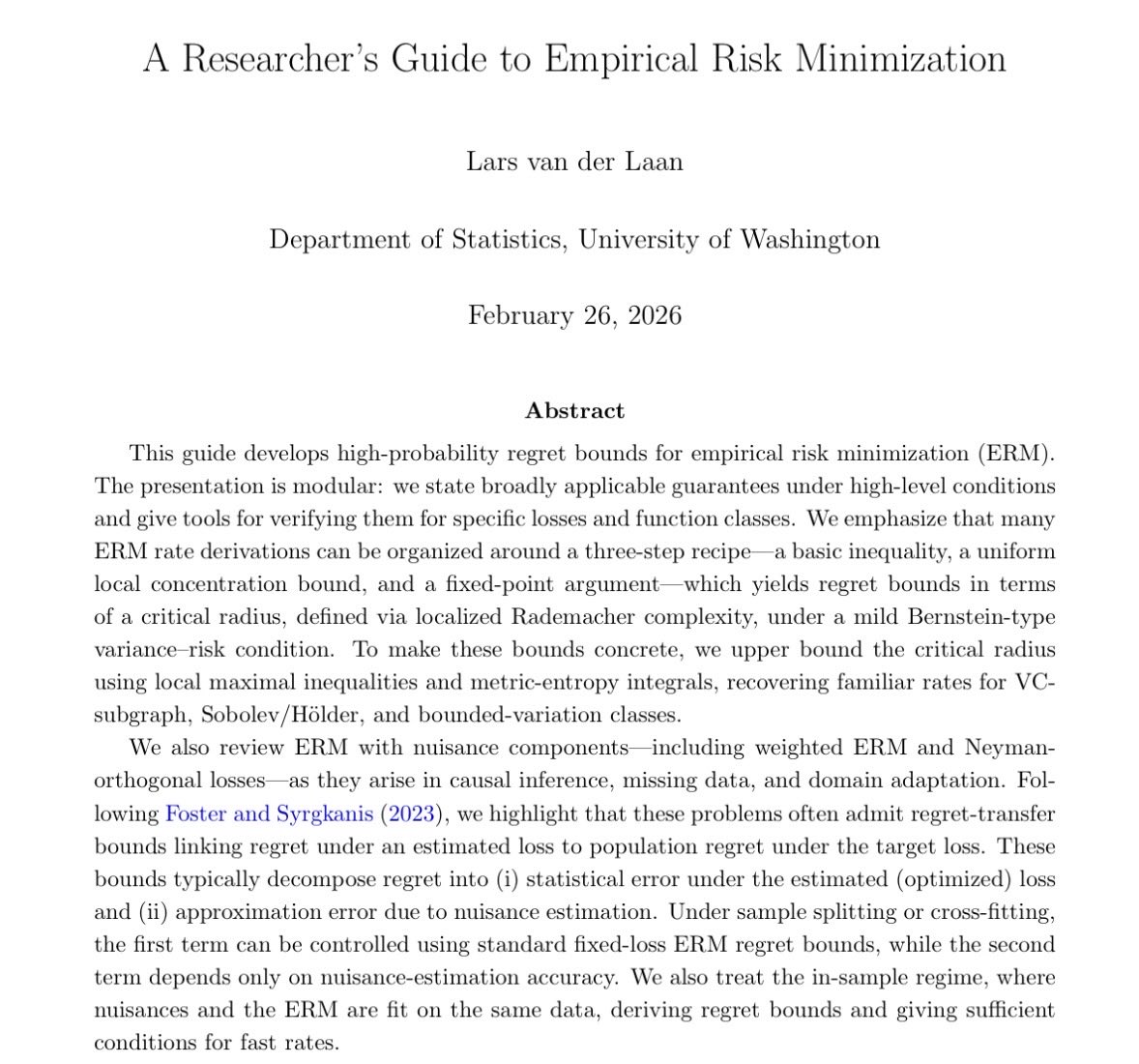
I put together a guide on regret theory for empirical risk minimization (ERM) as I understand it.
The goal was to compile results and proof techniques I’ve found useful in my own work. I hope people find it useful more broadly
Gilbert Strang's "The Big Picture of Linear Algebra" shows the relationship between four fundamental subspaces of an m by n matrix.
These four subspaces are:
- Column space: all combinations of columns of A
- Row space: all combinations of rows of A
- Nullspace of A: all solutions to Ax = 0
- Nullspace of A^T: all solutions to A^T y = 0
Dimensions:
- Dimension of row space = Dimension of column space = r (rank of matrix)
- Dimension of nullspace of A = n - r
- Dimension of nullspace of A^T = m - r
Orthogonality:
- Vectors in nullspace of A are orthogonal to vectors in row space.
- Vectors in nullspace of A^T are orthogonal to vectors in column space.
(Slide's source: https://t.co/gL43l3hdRW by Gilbert Strang, licensed CC BY-NC-SA 4.0)
Terence Tao: AI isn’t hype anymore in Math discovery.
Terence Tao is one of the greatest living mathematicians, in his new lecture explains how AI and human professional mathematicians are now complementary.
"There has been a really visible increase in capability. It is not pure hype by any means. To me, these advances show there is a complementary way to do mathematics. Humans traditionally work in small groups on hard problems for months, and we will keep doing that.
But we can also now set AI to scale: sweep a thousand problems and pick up all the low-hanging fruit. Figure out all the ways to match problems to methods. If there are 20 different techniques, apply them all to 1,000 problems and see which ones can be solved by these methods. This is the capability that is present today."
From 'Institute for Pure & Applied Mathematics (IPAM)' YT channel.
📁 Terence Tao, Fields Medal mathematician, says mathematics could become AI’s safest and most powerful domain.
Language models can be brilliant or completely wrong, but in math every claim is forced through logic and can even be verified by proof assistants.
Where other fields struggle with unreliability, mathematics can eliminate the noise and preserve only what is true.
A few friends have asked me about how I have been using Claude Code, so I decided to have Claude help me synthesize some of my key lessons and workflow tricks that I've used in the last month:
https://t.co/BMX6Z6mIe6
Large Language Models (LLMs) are probabilistic sequence models trained to learn the conditional distribution of the next token given a context, combining ideas from probability, statistics, and optimization at massive scale. Mathematically, they estimate P(xₜ | x₁,…,xₜ₋₁) by minimizing cross-entropy, which is equivalent to maximum likelihood over large text corpora. In probability, LLMs are autoregressive stochastic processes; in statistics, they are high-dimensional parametric estimators learned from data with regularization and asymptotic trade-offs. In machine learning, they implement representation learning through deep neural networks, mapping text into latent spaces that capture semantics and structure. In deep learning, transformers with self-attention and normalization enable efficient gradient-based training and generalization across tasks. In real-world applications—search, translation, coding, tutoring, and scientific discovery—LLMs transform raw data into coherent predictions, demonstrating how probabilistic modeling and statistical learning scale to intelligence.
Image source: https://t.co/S8lCy5nyij
Google put out an article on accelerating research with Gemini. I'm one of the 34 authors for my adventures in vibe-coding a research paper.
https://t.co/AAzhfEfXve
January is almost over, which means conference season planning is in full swing! If causal inference is your thing—and it should be—join us at the ACIC
The American Causal Inference Conference is coming to Salt Lake City, May 11-14, and it’d be great to see some of you there!
Geoffrey Hinton says LLMs are moving beyond imitation toward self-consistent reasoning
Instead of just predicting the next word, new models are beginning to identify contradictions in their own logic
This unbounded self-improvement will
"end up making it much smarter than us"
Had a great time presenting at #ACIC on doubly robust inference via calibration
Calibrating nuisance estimates in DML protects against model misspecification and slow convergence.
Just one line of code is all it takes.