Finally! After months of grinding, we’re launching Pilot Robotics 🚀
We’re bringing autonomy to forklifts, wheel loaders, and beyond.
The future of industrial work is autonomous. And we’re building it.
Heavy machinery is running out of operators.
Introducing @pilot_robotics (ALL18), the Waymo for industrial vehicles.
Pilot Robotics turns existing forklifts and loaders into autonomous machines by learning from experienced operators. Facilities can keep loading, hauling and moving materials without needing a driver in every cab.
Congratulations on the launch, @TheSonyWu and @ChenY46311!
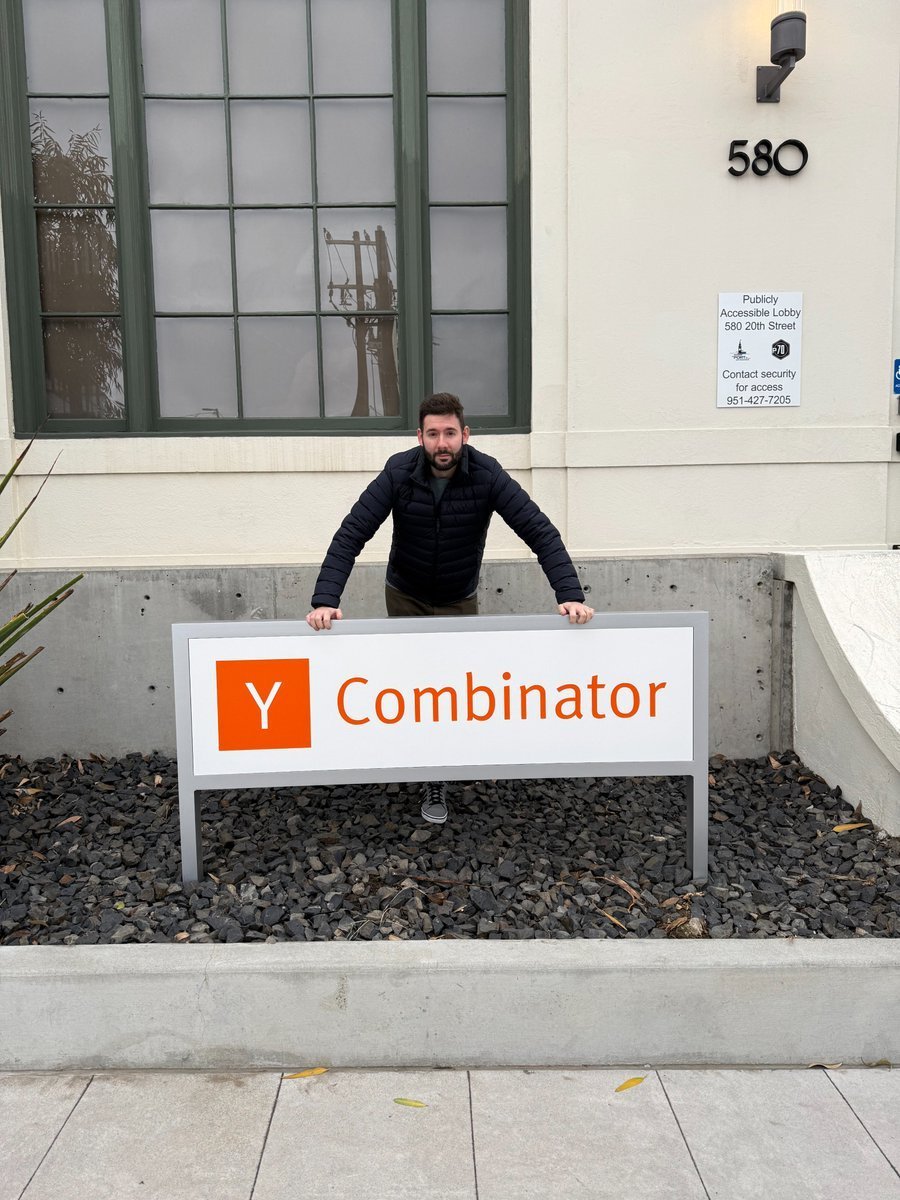
I’m 31. I built @GojiberryAI to nearly $5M in ARR and got accepted into Y Combinator.
If I had to start from 0, here's exactly what I'd do:
1. Sell it before I build it.
No code. Just a simple slide deck (mine was 6 ugly slides) explaining the problem, the solution, the outcome, and the price. I made my first $10k that way, before writing a single line.
2. Pick a painfully specific customer.
Not "B2B SaaS." Something like "founders at 20-person SaaS companies about to hire their first SDR." So specific that the right person reads it and thinks "that's me."
3. Start outbound on day one, but only to people showing intent.
Not scraped lists. People engaging with competitors, changing roles, raising money, or publicly posting about the exact problem I solve. That's the gap between a 1-2% reply rate and 25-40%.
4. Lead with value, never a calendar link.
Send a blueprint, not "got 15 minutes?" Let the resource do the selling, and the trial becomes the obvious next step instead of a pitch.
5. Pick ONE channel and go deep.
For us it was outbound first, then Reddit (10M+ organic views), then LinkedIn lead magnets. I wouldn't touch a second channel until the first one was clearly working.
6. Talk to customers every single day.
The product doesn't matter until you understand the problem better than they do. Spend 90% of every early call listening, not demoing.
7. Only build once people are actually paying.
Then keep it dead simple and price it to sell itself. We landed on $99/mo with a free trial, so the funnel runs without me dragging anyone onto a call.
8. Do this relentlessly for about 14 months.
That’s roughly how long $0 to $5M took us.
Bootstrapped.
No outside funding.
Most founders don’t lose because they can’t build.
They lose because they build too early, sell too late, and quit the channel before it compounds.
Recommended reading for the weekend:
1. @alexandr_wang — Why I'm Building Muse
2. @gregisenberg — AI-native services: a $100B opportunity
3. @FranklnTempletn — Macro Views: Growth Holds, Pressure Builds
4. @Google — Behind Project Suncatcher, our moonshot to put AI in space
5. @EpochAIResearch — The plunging price of thought
6. @AnthropicAI — Measurements for
understanding the pace of AI development inside frontier labs
Hope everyone has a great weekend!
As it turns out, the formula for being a high performer is incredibly simple and incredibly hard at the same time show up every day, do the hard work, bring your best, and expect the same from the people around you.
It doesn’t matter if you’re trying to be an athlete, founder, streamer, or comedian. The formula is the same. The difference is just the specialization.
That’s how you compete with startups 10x bigger than you or people with more resources than you.
And you hope the people you’re competing with slow down, get distracted, make excuses, or surround themselves with people who are incompetent
Most people aren’t built to operate this way consistently. That’s what separates good from excellent.
This $200B market shouldn't run on outdated technology.
These founders are building a new distribution layer for energy in Brazil, aggregating solar supply and giving resellers a single platform to sell businesses lower cost power.
Starting in Brazil. Thinking globally.
This is the ambition we back at Alliance.
Apply by tomorrow to be considered for early application acceptance.
Astra for Law: Frontier intelligence built for your practice.
A new offering powered by GPT-6 Astra with tools, settings, and context to support the expertise and judgment of lawyers and legal technology firms.
We are investing $8,000,000 into 20 teams.
Some founders come from SpaceX, Stripe or Google DeepMind.
Others come with an idea and no logo.
We back both.
Peter Thiel on why the name of your startup is predictive of success or failure
“This is a slight aesthetic thing that I believe in very strongly: the names of companies are often very predictive of future failure or success.”
PayPal and Napster are the first example Thiel gives:
“PayPal was a very friendly name — it was the friend that helps you pay. Napster was a bad name — you nap some music, you nap a kid. That sounds like a bad thing to be doing, and it’s no wonder the government then comes in and shuts the company down within a few years.”
“You want to be very careful of how you name companies,” Thiel warns founders. In the context of the sharing economy, he likes Airbnb more than Uber:
“Airbnb sounds very innocent like this virtual bread and breakfast — this very light, non-threatening sort of company. Uber sounds like a bad name from Germany sometime in the 1930s. What are you exactly above? Maybe the law? This is probably something that, again from a regulatory perspective, I think Airbnb is a vastly better name than Uber.”
And on the social networking side, Thiel likes Facebook more than MySpace:
“You can say that all these social networks involve both reading and writing… Over time, reading dominates writing. Facebook was about learning about people around you — about their real identities at Harvard. MySpace started among wannabe actors in Los Angeles, and it was about them coming up with fictional narratives around themselves and a lot of other people in LA who are generally like that. And because reading dominates writing, Facebook would ultimately dominate MySpace. There’s a certain version where the whole arc of the company and the whole product arc was implicit in the names.”
Source: @mercatus (Apr 2015)