Excited to share Agima, an omni agent that plans by imagining futures!
Trained with SFT + agentic RL, it unifies policy, world, and reward models: the same model proposes actions, imagines their visual outcomes, and evaluates them before acting
We trained an agent with native visual world modeling ability.
It imagines counterfactual outcomes to plan ahead. SFT teaches it to imagine; agentic RL makes it even more adaptable.
We’ve released everything: https://t.co/ERQYbmHQUg
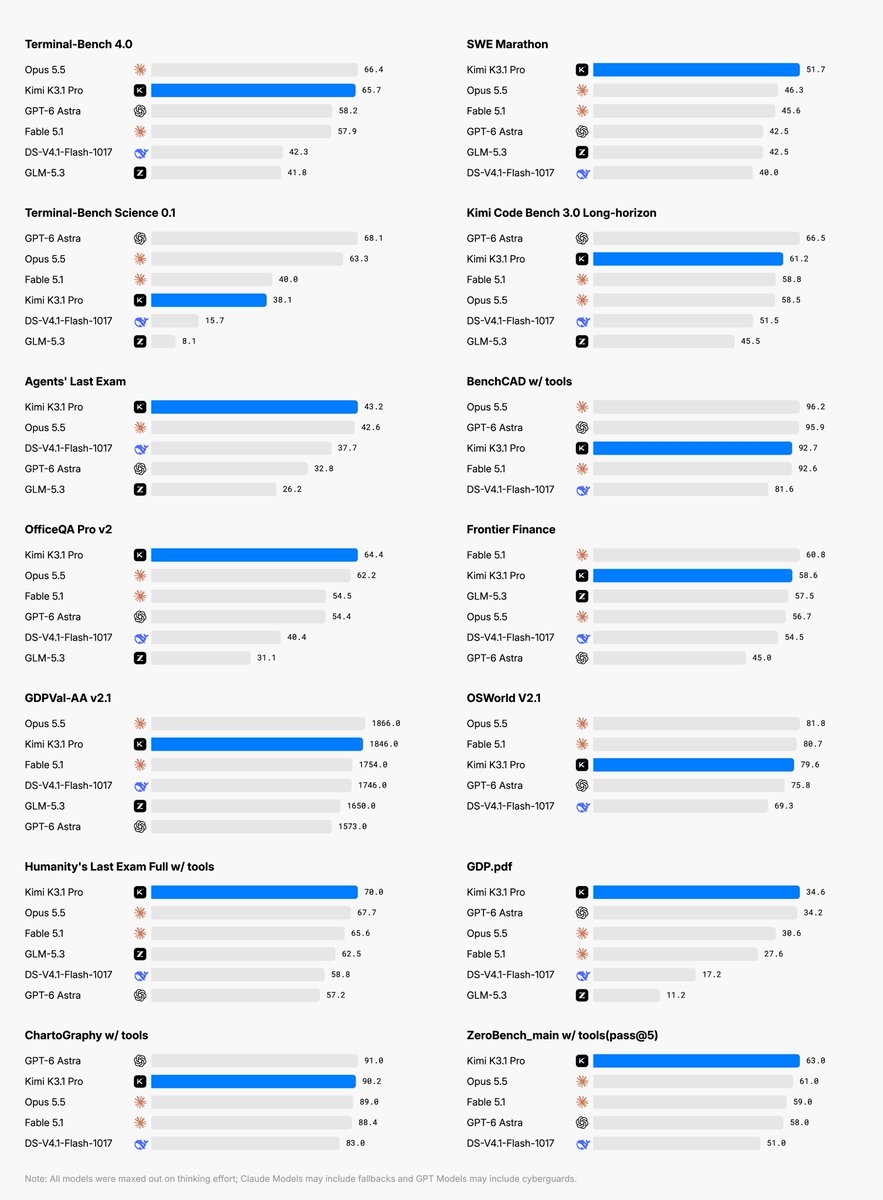
Introducing Kimi K3.1 Pro: our most capable 3T-class open-weight model.
🔹 1M-token context, 2.8T total / 104B active params (MoE), Multimodal.
🔹 Full-project coding: games in Unreal, Unity & Godot.
🔹 Excels at parametric 3D modeling in Blender & CAD.
🔹 More reliable at finance work: Accurate modeling with hallucination down by 65%.
🔹 Matching the strongest proprietary models across coding, agentic and knowledge benchmarks.
Kimi K3.1 Pro and K3.1 Pro Highspeed (2–3× faster) are now live on https://t.co/85jA71X9gw, Kimi Work, Kimi Code, and the Kimi API.
Open weights by Nov 4, 2026.
🔗 API: https://t.co/XCrgjXAqMw
🔗 Tech blog: https://t.co/5iPP0MBej6
We trained an imaginative agent! ✨
Agima: an omni agent that plans by imagining futures.
𝗦𝗙𝗧: Directly generalizes to harder tasks! 𝟮%→𝟰𝟬%, beats GPT-5.6 Sol (𝟮𝟬%).
𝗥𝗟: New ways to imagine emerge! Imagines a second plan only if the first one fails (𝟯��%→𝟭𝟬𝟬%).
We trained an imaginative agent! ✨
Agima: an omni agent that plans by imagining futures.
𝗦𝗙𝗧: Directly generalizes to harder tasks! 𝟮%→𝟰𝟬%, beats GPT-5.6 Sol (𝟮𝟬%).
𝗥𝗟: New ways to imagine emerge! Imagines a second plan only if the first one fails (𝟯𝟮%→𝟭𝟬𝟬%).
Now autoregressive video models can remember. 🧠
Introducing MosaiChunk: persistent visual memory for long-horizon autoregressive video generation🧩.
Instead of remembering everything, it remembers the right things. ✍️
1/6
Schema is now fully released — code and paper are out! 🚀
Beyond ARC-AGI-3, Schema also tackles MazeBench and DIG (Discovery in Games).
The goal has always been broader: building agents that can discover, understand, and reason about how worlds work.
More in Guanning’s post 👇
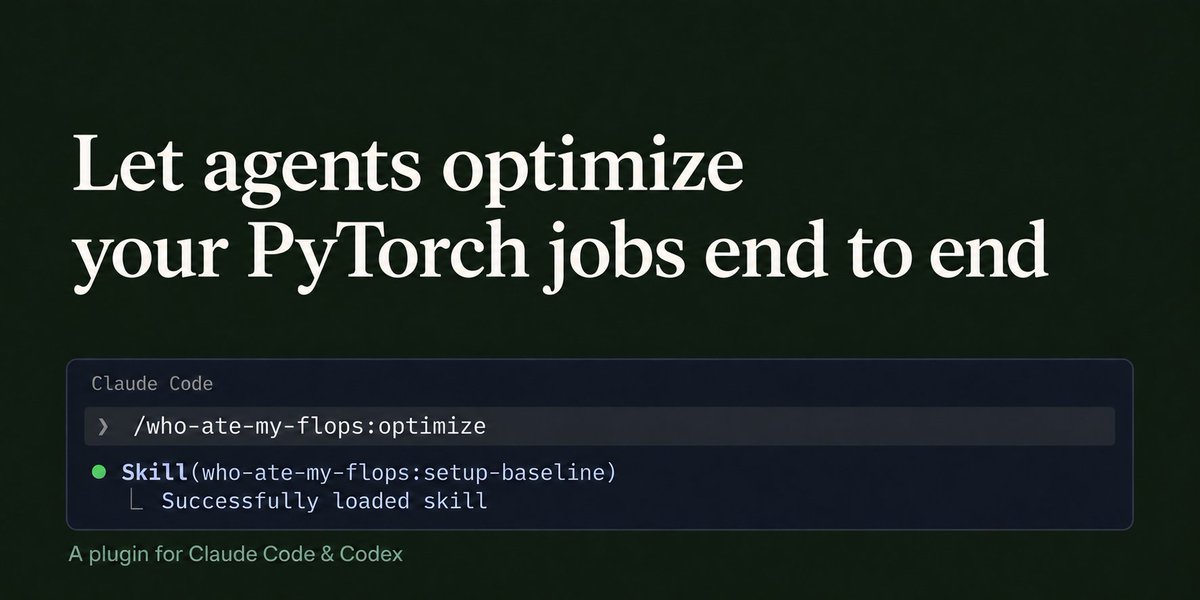
Bring your own PyTorch job. Let an agent speed it up end to end.
🛠️ We built /who-ate-my-flops, a Claude Code / Codex plugin for iteratively optimizing training and inference jobs as a whole—not just individual GPU kernels.
✅ Performance PRs developed with it have been merged into FunASR, FastVideo, gsplat, Ultralytics, Unsloth, and SGLang, with speedups up to 3.6× on the tested workloads.
📝 experiments, profiles, and lessons learned (Blog):
https://t.co/18YAk1whlY
🛠️ Plugin Repository:
https://t.co/YzKkG7wO6Q
🧵
48 hours after releasing VDN-H3 for @MiniMax_AI H3, the community already shipped 2 independent ComfyUI integrations with 9 multimodal workflows. This makes it much easier for people to use them!
Meanwhile, VDN was trained only on T2VA, but the community immediately pushed beyond our original scope, validating I2VA/FL2VA with no retraining.
Huge credit to everyone building on it. A great sign of how composable @MiniMax_AI H3 is! @RyanLeeMiniMax@Hailuo_AI
This is exactly the kind of video I dreamed of making with video gen when I started my PhD in 2022, and part of why I dove into diffusion model efficiency.
It’s so cool to see it finally come true. Really nice work, @HaochengXiUCB! 🔥
Open-source video generation is now faster than playback without compromising quality.
Introducing Video Delta Net (VDN): hybrid attention for live text-to-video with near-lossless quality.
VDN accelerates Minimax-H3 by 75 - 90 x, generating 14 seconds of 768p video in 11 seconds on 8× NVIDIA B200 GPUs.
Checkpoints + training/inference code + Technical Blog ⬇️
(1/6)
Why can Kimi ship K3? Let me tell my story.
Earlier this year, I left academia for industry. I talked to a lot of companies along the way. Here's what I saw:
1⃣Arrogance. They believe the AI war is over, and they won. No hunger for the future, and no hunger for talent.
2⃣Restlessness. Young labs short on foundation, either rushing to catch the frontier or pivoting away from the competition.
3⃣Fear. Strong teams with real experience, but from the second tier, they can't quite bring themselves to aim for #1.
4⃣Misalignment. Everyone is optimizing for their own credit, but nobody really cares whether the company can reach AGI.
Kimi was different.
Over many conversations with the founders, the same thing came through every time: a raw, genuine hunger for AGI.
I joined. The hunger was real.
We shipped K3. This is only the beginning.
Worth a read! The idea is really nice:
When play a new game that never seen, you should ask agent to spend actions on un-covering the rules instead of directly achieving the goals. This helps achieving the goal with minimal actions.
The rules in a real world task are probably much more complex than the rules in the ARC-AGI-3 benchmark, but the same philosophy should apply:
You/agent can only achieve the goal efficiently and elegantly with when you clearly, explicitly understand all the constraints and requirements.
The harness matters as much as the model!
[schema] makes frontier models reason like physicists -- write each game's mechanism as an executable program, test it against reality, then plan inside it at zero action cost.
~99% on ARC-AGI-3 Public with Opus 4.8 + Fable 5.
Congrats @HavenFeng, @xiuyu_l & team 👏
The ceiling of intelligence depends not only on model weights but also on how we structure the environment, state, feedback, and reasoning process.
Schema is (another) exciting milestone for that!
To figure out the mechanism of an unfamiliar environment, an agent has to work out what the world is and how it changes. That's what our [schema] does.
On ARC-AGI-3 Public, [schema] thinks like a physicist: it grounds the state and discovers the mechanism in one editable program. This induced world program makes action efficient: once it discovers a mechanism, it plans inside the model for free. And we achieve an amazing 99% RHAE.
Starting from here, mechanism discovery in much richer environments is what's next. Stay tuned!
We got 99% on ARC-AGI-3 by instilling analysis-by-synthesis into AI models.
[Schema] is basically VIGA squared: do inverse graphics, then do it again one level up — inverse dynamics.
Super simple, surprisingly effective! Analysis by synthesis FTW!!!
lovely results on ARC-AGI-3, simply by encoding representation finding as a harness. stay tuned for more
also, excited to join the team! epic first weeks