🚀 I’m excited to share that I've joined @NorthwesternU and @KelloggSchool as Senior Director of Private Equity. In this role I look forward to collaborating with Kellogg’s brilliant students, distinguished faculty/staff, and vibrant PE/VC community. Please reach out if you are in PE/VC - I look forward to collaborating!
#KelloggPE #PrivateEquity #PEVC #Northwestern
The metric I keep coming back to for SpaceX is $/Mbps to orbit
Starlink exists because Falcon 9 dropped bandwidth deployment costs ~10x to ~$6.55/Mbps. That’s about to drop again to just $0.30/Mbps because of Starship.
A business that is doubling users annually with a 63% adjusted EBITDA margin is about to cut their biggest cost by 95%… It really seems like people don't understand the implications of this.
The math assumes a reusable Falcon 9 launch is 17 tonnes at $1,000/kg and 2,600 Gbps per launch. Starship is targeting 100 tonnes at under $185/kg and 61,000 Gbps per launch. That's $17M for 2,600 Gbps ($6.55/Mbps) verse $18.5M for 61,000 Gbps ($0.30/Mbps).
Starship's additional volume allows for larger satellites, enabling simultaneous gains on multiple cost curves. The math suggests V3 satellites are ~600 Mbps/kg vs ~150 Mbps/kg from V2 mini.
Combining the 4x improvement on satellite bandwidth density with a 5x improvement in launch gets you the 20x improvement to 30 cents per Mbps to orbit.
These are fairly conservative assumptions because launch probably comes in even lower as Starship ramps, and satellite improvements probably keep coming. At $0.10 / Mbps, $1 billion spend on launch represents 10,000 Tbps or about 15x the bandwidth of Starlink's constellation today.
$1B is 90 days of operating income for Starlink... at it's current scale...
Yeah, I really don't think people are getting this. Starlink is the internet now.
The AI Arms Race: The Prisoner's Dilemma and a High-Stakes Game of Poker
Gavin Baker's insights on the "Invest Like the Best" podcast and Sarah Tavel's article, "The Big Stack Game of LLM Poker," both capture the immense pressure tech giants face. If you're Microsoft, Meta, Amazon, or Google, there's no option but to keep raising your bet—the potential rewards are too big, and the risk of falling behind is existential. Quick summary of their key points:
1. All-In on AI: Microsoft, Meta, Amazon, and Google, view the race for AI leadership as do-or-die. ROI considerations are practically out the window; Larry Page said he’d rather see Google go bankrupt than lose in AI. The potential prize of AI dominance is so big, it’s reshaping the strategic calculus for these companies.
2. The High Cost of Innovation: Traditionally, software companies enjoyed zero marginal costs, high gross margins, and recurring revenues. AI flips this model on its head. AI's scaling laws dictate super high marginal costs—each leap in capability demands exponentially more investment in training and inference. It’s an arms race with hundreds of billions destroyed but trillions potentially earned by the winners.
3. The Relentless Spending Cycle: As these companies continue to scale their AI capabilities, they're trapped in a classic prisoner’s dilemma. The competition forces them to perpetually increase their bets, with no room to pull back.
4. Apple’s Outsider Advantage: While the other tech giants are locked in this existential race, Apple stands apart with a unique advantage: iOS distribution. By running small AI models on the iPhone and prioritizing local inference on devices—"local when you can, cloud when you must"—Apple can avoid the colossal, relentless spending that characterizes the Nash equilibrium gripping its competitors.
5. Unbounded Market Potential: The potential value creation and capture with AI goes beyond our current mental models. With a theoretically multi-trillion dollar prize, the market opportunity for the clear winner is uncapped. As Baker and Tavel suggest, the game’s stakes are existential—not just for business growth but for the very future of these companies.
In the minds of Elon, Mark, Satya and others the prize is too great, and the risks too significant - seems likely that they will keep spending.
#AI #Innovation #BigTech #Investing #NotFinancialAdvice
AI will transform investing & wealth mgmt
AI and Investing is 2 years away for ‘ability to scale + felt impact’ for early adopters like @LumidaWealth
The LLMs need to be tuned to specific frameworks
Workflows are needed
AI Agents with specific training, functions and tasks are needed
Supervision from other AIs and humans are needed
I don’t write much about the future of AI and Investing for obvious reasons…
but I can tell you we are all over it.
We still need basic AI tooling
However, that tooling appears to be coming online over the next 6 months.
Then there is the ‘re-factor’ process
Each step of investing from sector / style focus, idea generation, risk management, and entry & exit management will be gradually re-factored by Agentic AIs
It gets better
It will take us maybe 3 engineers to do all of this
And not much capital. Maybe $2 MM
Watch out Goldman Sachs :)
The War Across Big Tech to Win AI
There’s an expression in warfare: "Amateurs talk about tactics, but professionals study logistics."
The quote highlights the importance of logistics (e.g., supply chains) in military strategy.
OpenAI is dependent on GPU providers such as Nvidia for Compute.
Nvidia is wary of Microsoft, Amazon, and Google.
The 'hyperscalars' each have taken steps to re-factor their GPU supply chain and build their own competitive GPU chips working with players like Broadcom. (We are long Broadcom.)
So, how does Nvidia respond?
Nvidia is prioritizing supply to non-competitors such as Oracle, Coreweave, and Inflection.
OpenAI has significant equity investments in the latter two.
This hamstrings OpenAI. And OpenAI needs billions more in fresh capital to fund increasing LLM competition from all corners.
In fact, OpenAI can rent compute more cheaply from Google - another competitor - than it can from Microsoft.
According to Semi Analysis, ironically, “It makes economic sense for OpenAI to use Google Cloud with the TPUv5e to inference some models, rather than A100 and H100 through Microsoft Azure, despite their favorable deal.”
Sam Altman is looking out into the future.
He sees supply constraints.
He sees that Nvidia has juicy 80% profit margins that are greater than software.
It's a capital light business model with licensing revenue.
My bet is he will focus on a RISC-based quasi open-source architecture.
He might also benefit from funding from the CHIPS act.
He'll make more money on his next venture than OpenAI.
🤖 Join us @whyofai for our 3rd week of our AI Innovation Lab series! From 05.30.23 - 06.02.23, participate & network in several hybrid AI-focused events. Open to the public & free to participate.
RSVP @ https://t.co/Tz1Sqrg0qi
#aiinnovationlab#1871innovationhub#ai#whyofai
Thanks @APompliano for having @jaentwistle on the @PompPodcast to chat about building companies, Wander and the future of travel. https://t.co/sTa6HYCIwl
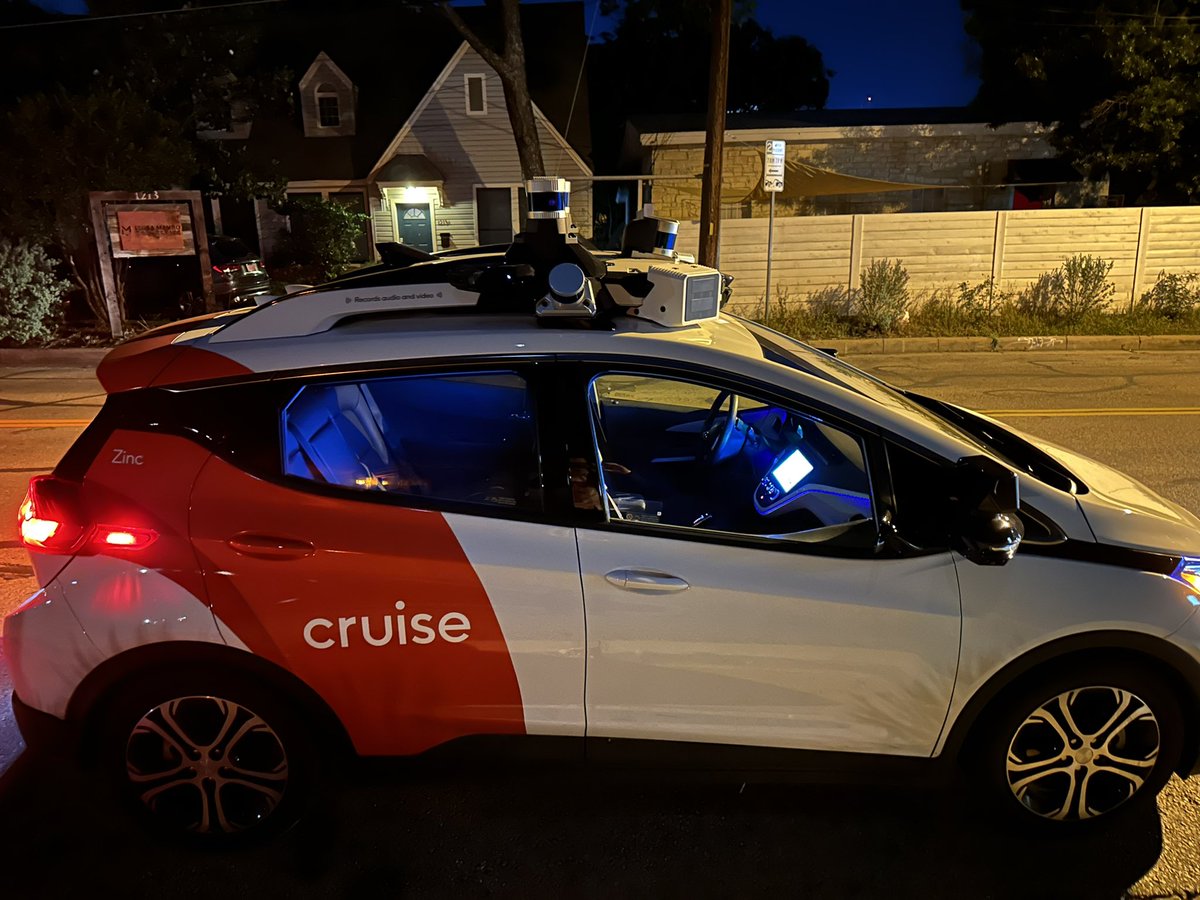
Just took an incredible 12+ min fully driverless car ride in a @cruise in downtown Austin. 🤖🚗 Summoned the car from my phone; such a smooth experience. The future of transportation is here. #SelfDrivingCar#CruiseInAustin