@coachsnehaa Please don’t implore more Indians to travel outside India 😭😭, our global image is already at an all time low due to the shit Indian travellers have pulled abroad in the recent years
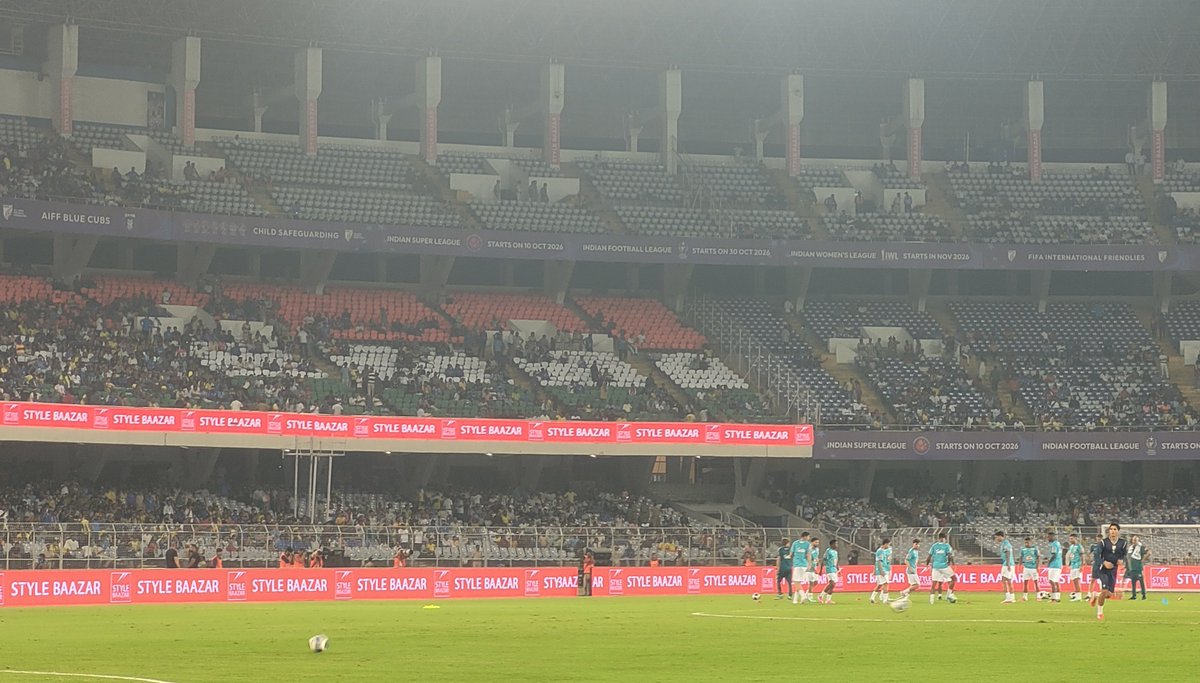
Lot of empty seats at the Salt Lake stadium for the much anticipated Brazil game against India. Don't see it a full house. That will be the biggest disappointment
Lot of empty seats at the Salt Lake stadium for the much anticipated Brazil game against India. Don't see it a full house. That will be the biggest disappointment
Many years ago, during my time studying South Asian studies at Johns Hopkins University in the US, my professor solved a long-standing mystery for me: Why do Indians constantly emphasize "purity," yet their public sanitation is so poor?
The answer lies in the fact that what many Indians mean by "purity" is actually ritual compliance, not physical cleanliness. Consequently, a cup of water that looks greasy and filthy can be considered supremely "pure" simply because it was drawn from a specific sacred site, by a specific holy person, at a specific auspicious hour.
Once you grasp this distinction between ritual purity and physical cleanliness, it becomes easy to understand the attitude of many Indian scholars toward democracy. Just as they are willing to ignore physical grime and actual hygiene for the sake of ritual purity, they are equally willing to disregard tangible governance performance for the sake of democratic formality.
This explains why, in the classic debate comparing China and India, whenever outsiders point out that "India lags behind China" based on sheer common sense, the most common and lazy copium is: "We are simply unwilling to compromise our principles."
This is clearly a highly satisfying answer for many, for it allows them to claim the moral high ground while dodging the objective gap in actual performance.
However, the harsh reality is that if a cup of water is contaminated, anyone who drinks it will get very sick, no matter how ritually pure it is deemed to be.
By the same token, no matter how self-gratifying the obsession with democracy is, if it fails to deliver tangible performance, it will be exposed as an illusion the moment it faces a true test of hard power.
Harsh: No matter how desperately you torture spreadsheets and contort exchange rates, the simple truth is that nobody knows how the world will look in 2075 or even in 2047.
What we do know is that in 2026 China is far ahead of India across a range of parameters, and that the claim from the early 2000s that India would rapidly close the gap has turned out to be false.
Does this mean you’re wrong? Not necessarily. Perhaps all your magical calculations have given you the gift of clairvoyance and events will unfold precisely the way you would like them to unfold. If that happens I will rejoice and publicly congratulate you.
My claim is much more humble: In 2026 there is no meaningful China-India race. Those who see Xi Jinping’s reception in Washington as proof of India’s arrival on the world stage are, to put it mildly, not quite connected to reality.