Influencer marketing is here to stay.
Here are 5 reasons why ↓
- It is no longer a one-time test; it is part of the main strategy.
- Good KOLs bring real trust and attention that standard ads just cannot buy.
- A great influencer keeps driving results throughout a campaign, not just on day one.
- Smart teams combine influencers with Google search, paid ads, and news articles.
- It is shifting from a quick shoutout to a permanent way to get real users.
Influencer marketing still matters, but the strongest teams are no longer using it alone
@BeeReach_io Preach. Traffic gets you the initial ping, but trust is the only thing that sticky metrics are built on. In this market, trust is the ultimate conversion multiplier.
A recurring post-mortem narrative echoes across the Web3 growth ecosystem every single day: “We deployed a six-figure budget into a macro-KOL campaign, yet recorded near-zero user onboarding, sign-ups, or TVL growth. The Web3 creator economy must be entirely inflated by bot traffic.”
However, analyzing the mechanics behind these failed rollouts reveals a different truth: Most Web3 teams do not have a influencer problem; they have a campaign architecture problem.
Influencers frequently become the scapegoat simply because they represent the most visible and front-facing layer of the marketing funnel. When a post goes live but on-chain conversion metrics stagnate, executive leadership inevitably questions the marketing team's ROI, culminating in a flawed, generalized conclusion: “KOL marketing is ineffective for our product vertical.”
To ensure growth initiatives do not fall into this trap, teams must navigate and eliminate four fundamental structural flaws:
1️⃣ Treating Creators as Generic Distribution Nodes
Many projects allocate substantial capital to secure prime slots with top-tier alpha creators, only to mandate the distribution of a generic, pre-scripted PR copy. Consequently, audiences witness dozens of coordinated accounts posting identical screenshots alongside identical captions, such as: "Excited to see what this team is building," or "This will shift the DeFi paradigm."
In doing so, teams are purchasing a high-trust ecosystem but utilizing it as an expensive banner ad slot. When a campaign degrades into highly synchronized, low-context promotion, sophisticated Web3 audiences immediately tune out the noise.
2️⃣ Mistaking a Deployment Calendar for a Marketing Strategy
A common misconception is that a spreadsheet tracking creators, publication dates, and captions constitutes a growth strategy. In reality, it is merely a deployment schedule.
Modern Web3 participants are highly risk-aversive, particularly regarding asset security and capital allocation. Users will not bridge, stake, mint, or deposit capital into an unverified protocol based on a single promotional post. True growth marketing requires designing a comprehensive "Trust Architecture." The objective is to orchestrate a market narrative where different segments of the ecosystem organically arrive at the same conclusion from distinct analytical angles.
3️⃣ Operating Under the Illusion of a Unified "Crypto Audience"
Treating the entire Web3 ecosystem as a homogenous target demographic is a fatal positioning error.
Airdrop farmers, high-frequency perp traders, DeFi power users, core infrastructure builders, and memecoin speculators may share overlapping social graphs, but their risk appetites, value drivers, and product evaluation frameworks are worlds apart.
Utilizing a macro-crypto creator to scale an institutional-grade RWA infrastructure protocol will yield high vanity impressions but zero meaningful conversion. Growth teams must buy tailored context, not just broad reach.
4️⃣ Relying on Vanity Metrics for Capital Allocation
Influencer procurement is still largely driven by surface-level metrics: follower counts, average impressions, and subjective alignment. This approach fails to perform deep due diligence on the underlying network effects.
Before deploying capital, growth teams must audit the creator’s active community engagement:
What are the core geographic locations of the engaging audience?
What is the qualitative nature of the replies and quote tweets?
Are verifiable ecosystem builders, fund managers, and power users actively participating in the commentary?
When partnering with a creator, you are not buying their aggregate followers; you are buying friction-free access to a specific, pre-validated network context.
💡 The Strategic Imperative
Ultimately, Web3 influencer campaigns fail when growth marketers attempt to purchase raw attention while expecting immediate consumer trust.
Trust cannot be engineered through an isolated promotional placement. It is built through sustained relevance, logical repetition, and an uncompromised user conversion flow. The mandate for Web3 growth professionals is not to amplify the volume of coordinated social posts, but to systematically engineer the architecture that transitions an audience from Awareness to Conviction, and ultimately to On-chain Action.
For further insights on Web3 growth frameworks and data-driven marketing architecture, connect with us or subscribe to our research notes.
#Web3Growth #CryptoMarketing #InfluencerStrategy
@uzproof 100%. They are treating a Web3 primitives engine like a Web2 digital billboard. The marketing crisis in crypto isn't a lack of tools; it's a lack of architectural thinking.
@SProfiler1 Exactly. In Web3, if you don't build the education and validation layers first, you're just paying for views that will never convert into on-chain action. Belief can't be copy-pasted; it has to be engineered through a proper trust sequence.
Smart founders are waking up. They realize a copy-paste brief just turns a high-trust creator into an expensive, muted banner ad.
The shift is clear: We’re moving away from 'spreadsheet marketing' (vanity impressions) and moving toward 'Trust Architecture' (CAC vs ARPU).
Redesigning the funnel beats throwing money at the timeline every single time.
Crypto Exchanges: Expanding Beyond Just Crypto! 🤯
Historically, our assets have been completely fragmented.
You’d keep your BTC/SOL on Binance, but then have to jump over to a traditional broker just to buy Nvidia or US stock ETFs. Moving funds back and forth meant getting eaten alive by fees on both ends. 😭
But the giants like Binance (along with OKX, Coinbase, etc.) have finally seen the light! They no longer want to be just your "gateway to crypto"—they are coming for your entire wallet.
Why This Upgrade Is an Absolute Game-Changer 👇
1️⃣ One App for Global Assets: Hold your Bitcoin and stablecoins right alongside your Nvidia shares, buying both seamlessly in one place.
2️⃣ 24/7 Liquidity: By "tokenizing" US stocks via RWA (Real-World Assets), you get the crypto world's signature global access and fractional ownership. No more waiting for the opening bell!
3️⃣ Smooth Sailing Through Bulls and Bears: Trade crypto when the coin market is hot; pivot to stocks when the equity market is booming. Your capital stays in the exact same ecosystem, eliminating the need to constantly withdraw and deposit.
Traditional finance giants (BlackRock, JPMorgan) are already aggressively expanding into blockchain RWAs. Now, even Binance is stepping onto the field to build the "operating system for global investing."
Over the next decade, the exchange war won't be about who has the most 100x meme coins or the highest leverage. The true winner will be whoever becomes the ultimate destination for your capital.
⚠️ The Bottom Line: While there are massive hurdles ahead—like securities compliance and cross-border regulation—the convergence of Traditional Finance (TradFi) and Crypto Finance (CeFi/DeFi) is officially unstoppable!
Prediction markets wanted to be "truth machines" but our gambling instincts turned them into a multi-billion dollar sports book (STEM markets are only 1.2% of volume).
The only way out is replacing human bettors with AI Agents. Rational, dirt-cheap, and infinitely scalable. The future of Info Finance is AI fighting AI for the truth.
A lot of exchanges still approach MENA like a traffic-buying market.
But the region behaves much more like a relationship-driven financial market.
Users in MENA are generally more cautious about where they store capital, which means local trust, offline reputation, regional communities, and strategic partnerships often matter more than aggressive incentive campaigns.
The exchanges gaining traction in MENA are usually not the loudest ones — they’re the ones building long-term credibility in the region.
Great influencer campaigns don’t start with “Who has the biggest audience?”
They start with:
· Strategic fit
· Clear CTA
· Great post-click experience
· Follow-up systems
Most brands focus only on the shoutout.
But attention without conversion infrastructure is just noise.
Shoutouts fade. Systems scale.
X is turning influencer marketing into infrastructure.
Their new Creator Connect product is essentially:
using AI to automatically match brands with the most suitable creators based on:
• Campaign goals
• Audience interests
• Real-time trends
And handling the full process:
creator sourcing → outreach → content → distribution.
At the end of the day, everyone is building on top of platforms.
Respect the platform. Respect the ecosystem.
How We Grow Telegram/Discord Communities From 0 to 1,000 Members 🧵
Most Web3 communities don’t die because the project is bad. They die because the launch sequence is wrong.
We’ve helped 30+ projects bootstrap Telegram & Discord communities, and after making every mistake possible, this is the framework we consistently use now:
The biggest mistake most projects make is opening the group too early. They create a Telegram or Discord, invite 100 people, nobody talks, spam starts appearing, and the whole thing instantly feels dead.
New users join, see silence, lose interest, and leave. Dead communities create more dead communities.
The correct order is the opposite:
❌ Open group → Invite people → Hope it becomes active
✅ Build momentum first → Open community → Guide conversations from day one
Step one is seed users — usually no more than 20–50 people. These are not random users. They come from:
• Core followers from KOLs
• Friends in the industry
• Early users genuinely interested in the project
Their only job is to make the community feel alive.
During the first week, consistency matters more than “big news.” We usually create a daily activity rhythm for clients:
📌 Morning: Post a discussion question (“What’s the biggest issue with L1s today?”)
📌 Afternoon: Share a small project update
📌 Evening: Preview what’s coming tomorrow
You don’t need constant announcements. You need presence.
The next mistake projects make is using KOLs incorrectly.
We don’t tell KOLs to post:
“Join this community now!”
Instead, we structure posts like: “Just saw an interesting discussion about XXX in this Discord…”
Then attach the invite link.
This changes everything. Users join out of curiosity instead of obligation, and retention becomes significantly higher.
Another important detail: new members should never enter a community with “nothing to do.”
The first interaction matters.
We usually make users:
• Introduce themselves
• Complete a small task (follow Twitter, repost content, etc.)
• Receive an identity tag like “Early Member” or “Genesis Explorer”
Once people receive identity and status, they naturally become more engaged and protective of the community.
After the foundation becomes stable, we move into growth loops.
Simple referral mechanics work surprisingly well:
Invite 3 friends → earn points / whitelist spots / exclusive roles
At this stage, growth slowly stops depending on the project team and starts becoming community-driven.
We used this exact framework to help a public chain project bootstrap its Discord from zero into a highly active community:
• 15,000+ Twitter followers gained
• 300%+ increase in community activity
• Massive organic discussions inside the group
• 30,000+ website visits on launch day
The key isn’t always budget.
The key is getting the sequence right.
Quick summary of the framework:
1️⃣ Start with 20–50 seed users
2️⃣ Maintain daily activity during week one
3️⃣ Use KOLs to drive curiosity, not hard ads
4️⃣ Give new users identity immediately
5️⃣ Use lightweight incentives to trigger referrals
Communities rarely fail because of the project itself.
Most fail because the first week was handled incorrectly.
We’re currently helping Web3 projects scale global communities across Telegram, Discord, and Twitter.
Feel free to DM if you’re working on community growth. 🔁
Web3 & Fintech projects need to vet KOLs differently. Here are the 5 metrics that actually matter.
Most brands start with: "Find me someone with 1M followers."
That's the wrong question.
In Web3 and Fintech, the wrong KOL doesn't just waste your budget — it kills your reputation.
Here's what we actually look at 👇
1️⃣ Community quality, not follower count
Forget the follower number.
Look at their Discord / Telegram:
Are people actually talking? Asking questions? Engaging?
A KOL with 10K Twitter followers and an active community will outperform a 1M follower account with dead engagement every time.
In Web3, conversion happens in communities — not in posts.
2️⃣ On-chain behavior
This one is unique to Web3.
Does this KOL actually participate on-chain?
Do they hold the tokens they promote?
Are they genuinely in the ecosystem — or just talking about it?
Their wallet doesn't lie. And neither does their audience.
3️⃣Track record of past recommendations
What projects have they promoted before?
Are those projects still alive?
Have any of them rugged?
Same for Fintech:
Have any products they endorsed blown up?
A KOL's credibility is a depreciating asset.
One bad call and their audience stops trusting them — and you.
4️⃣Audience risk profile
Web3 and Fintech products require sophistication.
Are their followers actual investors and builders?
Or are they retail audiences chasing "passive income" content?
The wrong audience doesn't just convert poorly —
it creates compliance risk and reputational damage.
5️⃣Compliance awareness
Has this KOL ever made unrealistic return promises?
Been penalized by platforms?
Do they understand where the lines are?
One careless post from an undisciplined KOL
can pull your brand into regulatory trouble overnight.
The bottom line:
In Web3 and Fintech, you're not just buying reach.
You're looking for someone willing to put their name — and credibility — behind your project.
Get that right, and it's worth more than 10 generic influencer posts.
We specialize in KOL partnerships for Web3 and Fintech projects.
If you're building and need the right voices behind you — let's talk 👇https://t.co/IRoRZr0lBW
#Web3 #Fintech #InfluencerMarketing #GrowthStrategy
🌍 Chill Labs Global Resource Update: 20,000+ KOL Matrix, Deeply Targeting High-Net-Worth Traffic.
We don’t just connect resources; we build a global competitive moat for your project.
【Core Asset Portfolio】
Tier-1 Endorsements: A curated selection of 500K+ follower-level Key Opinion Leaders (KOLs), covering the core global crypto inner circles.
Omni-channel Penetration: 100,000+ seasoned KOCs across X (Twitter), TikTok, Instagram, and Facebook.
Crypto-Native Depth: Specializing in the Web3 sector to bridge the gap into the world’s fastest-growing crypto markets.
【The Chill Labs Delivery Logic】
Authenticity Filtering: Powered by AI-automated traffic audits to eliminate 90% of bot data, ensuring every cent of your budget reaches real users.
Localized Resonance: We reject raw translations. Our content is crafted by local teams to ensure it perfectly aligns with the cultural nuances of target markets.
Growth Closed-Loop: Integrating SEO and AI Search Visibility (AIO) to transform short-term hype into sustainable, long-term growth.
【Target Audience】
Web3 projects seeking global expansion, brand premium, and precision user acquisition.
📩 Partnership Inquiry: https://t.co/IRoRZqZNMo
Chill Labs — Redefining Global Marketing in the AI Era.
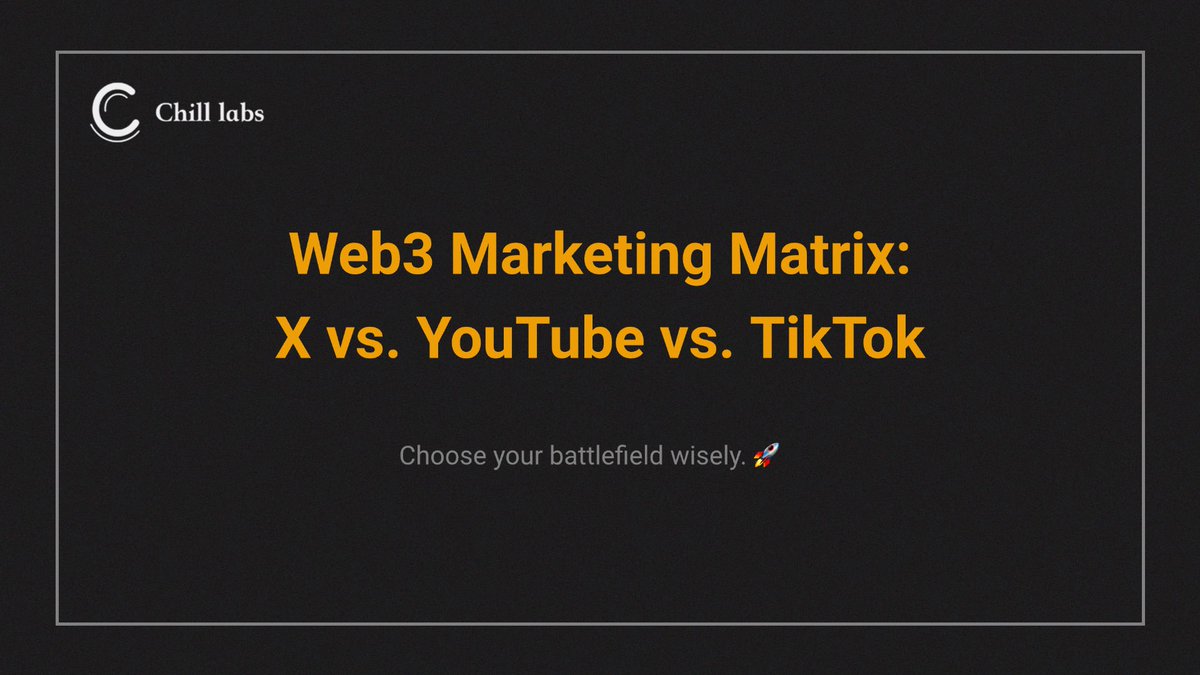
Web3 Marketing Matrix: X vs. YouTube vs. TikTok 🧵
🔹 Twitter (X): The "Heartbeat"
Role: Real-time Hub for OGs, VCs & Degens.
Edge: Instant hype via Threads & Spaces. High speed, short lifespan.
🔹 YouTube: The "Trust Anchor"
Role: Deep-dive Knowledge Library.
Edge: Long-term SEO & authority. The final stop for high-conviction conversion.
🔹 TikTok: The "Traffic Engine"
Role: Mass Adoption Viral Lab.
Edge: Visual FOMO & Gen Z reach. Breaking the Web3 bubble.
Web3 has no borders, and neither does Chill Labs’ traffic. ⚡️
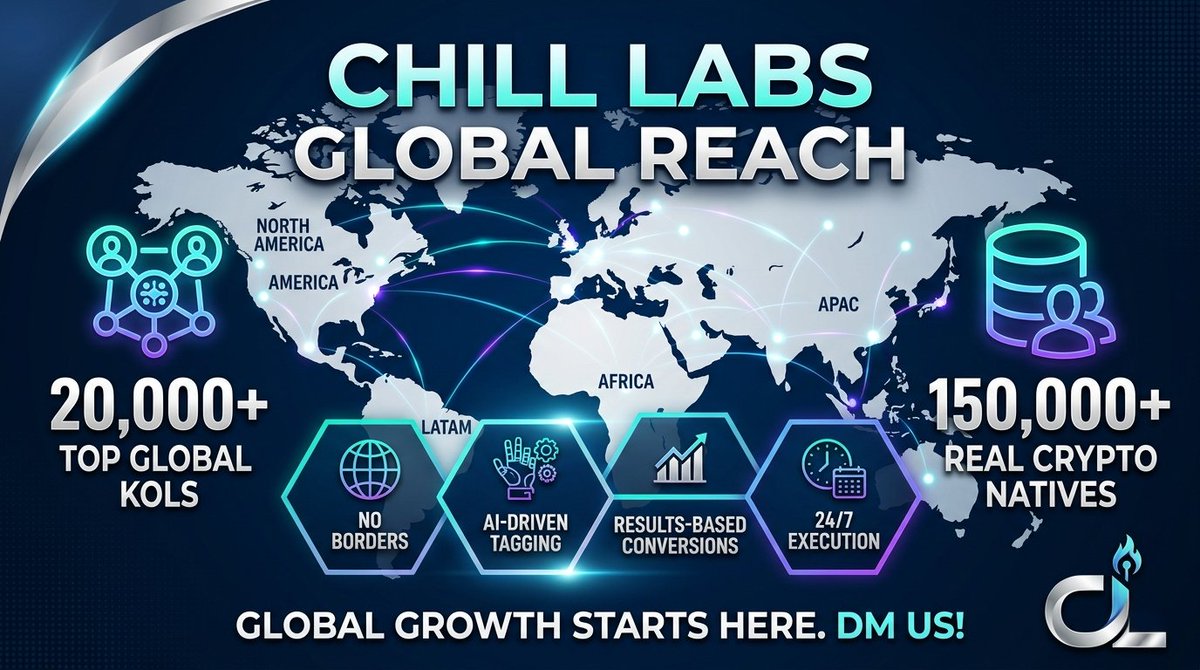
Most projects fail to go global because their resource pools are still "running in silos." Today, Chill Labs is officially unveiling our updated Global Marketing Resource Map:
🌍 Global Coverage, Total Impact
- 20,000+ Top-tier Global KOLs (Across North America, Europe, APAC, LATAM, and Africa)
- 150,000+ Core Active Crypto Users (High engagement, deep participation)
- 24/7 Full-time zone response—making your project heard in every corner of the world simultaneously.
🚀 Chill Labs says NO to "Empty Traffic":
✅ Precision Tagging: AI-driven automated screening to eliminate bots and reach core influencers directly.
✅ Hardcore Conversion: Deep penetration into localized communities, delivering on registrations, KYC, and trading milestones.
✅ Top-tier Endorsement: Long-term partners with Tier-1 exchanges and public chains. We know the projects, but we know the traffic better.
Stop wasting your budget on ghost accounts. If you want true global growth in 2026, you only need Chill Labs.
📩 DM us to get the Chill Labs Global KOL List & Custom Strategy.
#ChillLabs #Web3Marketing #KOL #GlobalGrowth #Crypto #GlobalMarketing #UserGrowth #GoGlobal
A clear trend is emerging:
crypto exchanges are rapidly expanding their boundaries — from stocks and indices to commodities.
The reason is simple:
Users no longer want just crypto exposure.
What they really want is a “super account” where capital can move freely across different markets.
Once capital starts flowing within a single platform, liquidity doesn’t just increase — it compounds and amplifies around participation.