@RushDoshi@shehzadhqazi Good defensive measure against foreign competition. But we need accompanying offensive industrial policies to strengthen domestic industry.
Banning frontier tech is complicated. We don’t know how it will evolve, and domestic firms don’t compete in many niches of the value chain.
Following a big week for China's domestic chip ambitions, put together a schematic of China's emerging semiconductor manufacturing hubs: https://t.co/RjRhrjnP8y
NEW: Say goodbye to the people movers at Dulles airport.
President Trump is set to unveil a $22.5 billion renovation of Dulles as soon as tomorrow that will scrap the mobile lounges, arguably the most unpopular part of the airport, and significantly expand the airports capacity.
With @JenniferJJacobs
https://t.co/kiAX4GpW9C
@ChrisRMcGuire@BaldingsWorld Good defensive measure. I assume in order to properly incentivize US/allied re-shoring of robotics supply chain we will also need accompanying offensive industrial policies?
This is a very, very big deal. Moving forward, new Chinese robots won't be able to be sold in America.
Technically the FCC order requires a license for any robots not made in the US and that has under 65% US components by value, which captures nearly all robots (if for no other reason than the value of advanced chips, very few of which are made in the US) - so a lot will depend on how the administration handles licensing. However, assuming the administration's intent is to issue time-bounded licenses to US/allied companies producing robots outside the US, but not issue licenses to Chinese companies, this could be transformational for the US robotics industry. It incentivizes US/allied re-shoring of robotics supply chains while preventing China from flooding the US market with cheap robots that also pose national security risks (similar to Chinese connected vehicles).
This is exactly how we should be applying import bans: focused on technologies and sectors that are rapidly growing and for which Chinese domination would pose economic and national security risks, and implementing them before China has such a large US market presence that extricating Chinese products becomes politically and financially impossible. Kudos to @BrendanCarrFCC and others at the FCC for tacking this important issue now.
🔔 NEW FROM @CSISFreeman@CSISGeopolitics...
In the past year alone, three of the Politburo's original 24 members—General He Weidong, General Zhang Youxia, and Ma Xingrui—have been removed from office.
The @CSISFreeman Chinese Leadership Chart has now been updated to reflect the latest changes to China's senior military and political leadership.
https://t.co/6S59iDryB2
Why is Zhang Youxia still listed as a Politburo member and the Vice Chairman of the Central Military Commission of the CPC despite being investigated and purged?
Ma Xingrui, He Weidong are both completely removed from all websites.
https://t.co/VPWPIfyugW
To add on this:
▪️ Chongqing-Chengdu model: “Jack of all trades” - be good at many but great in few; position as gateway to SEA
▪️ Inner Mongolia model: the Forest Gump “get lucky with natural endowments” model - from coal to solar to wind … to even having a cool climate appropriate for datacenters
▪️ Dongbei model: The “let’s show the world what China would have looked like if it held onto traditional Soviet-style Communism” model
▪️ Guizhou model: Infrastructuremaxxing - “terraform the mountains today, Mars tomorrow”
One of the most fascinating things about visiting Washington, D.C. is its large Ethiopian community. It’s one of the city’s most distinctive and charming cultural influences.
Why does the U.S. capital have such a large Ethiopian population?
SCMP: "Chinese provinces have now released their growth data for the first half of the year, and the figures show a clear bifurcation between thriving tech hubs and the rest of the country."
https://t.co/n0vEMnZiIl
Blockbuster, record-setting CXMT IPO. A huge morale boost for China’s memory-chip industry and its DRAM ambitions.
Also a massive win for 合肥国资 (are CXMT’s largest shareholder, with roughly 37% ownership when the entire Hefei state-affiliated entities network is counted.)
Hefei will now become the classic underdog story that bureaucrats across China want to copy, with many inevitably touting their own projects as “Hefei 2.0!”
But that’s potentially very concerning. The much-celebrated Hefei model depended on a very unusual and difficult-to-replicate set of conditions, plus a nontrivial stroke of luck.
My fear is that we will see lots of copycat Hefei models in name, accompanied by the political showmanship, wasted resources, and serious inefficiencies…
There are obviously important lessons to draw from Hefei that are instructive today. One is the smart use of government-guided venture capital to function as seed funding, absorb some of the large early-stage risks, pave the way for private capital to come in, and lay the foundations for “patient capital.”
But one critical element that made the Hefei success story click is not easily replicable: the key figure (Zhu Yiming) and his almost perfect marriage with Hefei’s own governance culture and ambitions back then.
Journalists will write about Zhu, and they should! But here is the quick version: Tsinghua graduate, U.S. PhD studying semiconductors, cut his teeth in Silicon Valley, became a leading memory-chip expert there, and then returned to China. (Sound familiar?)
The Hefei government back then made the right bet on his business and gave it enough time and space to fail, while leaving the key tech and business decisions to professionals.
(By the way, Hefei also made plenty of failed bets. That is normal. Venture investing requires accepting that many bets will not work out.)
But circumstances have now changed. Local governments are under much greater fiscal strain, with less risk appetite and, frankly, fewer resources to spend over a more expanded list of priorities (remember Xi asks them to prioritize “invest in people”/ 投资于人?) Government investments are also facing much greater scrutiny.
China has more Zhu Yimings these days.
But how will the other half i.e., local government play out under today’s very different conditions?
One caveat: the CXMT IPO is already generating tensions in China’s capital markets (liquidity drain from other tech firms and tensions between the primary and secondary markets, for example.)
There is also the broader chill created by the anti-corruption campaign over the financial sector.
And look at what happened after SMIC’s mega-IPO. There is still no clean or simple story there.
As I wrote in my previous note, China’s capital markets will be CRITICAL to watch. Their vulnerabilities, and the policy tensions surrounding them, may be the softest underbelly of China’s hard tech ambitions…
(Also posted on Substack, which I’ll be gravitating toward more... link in the next post!)
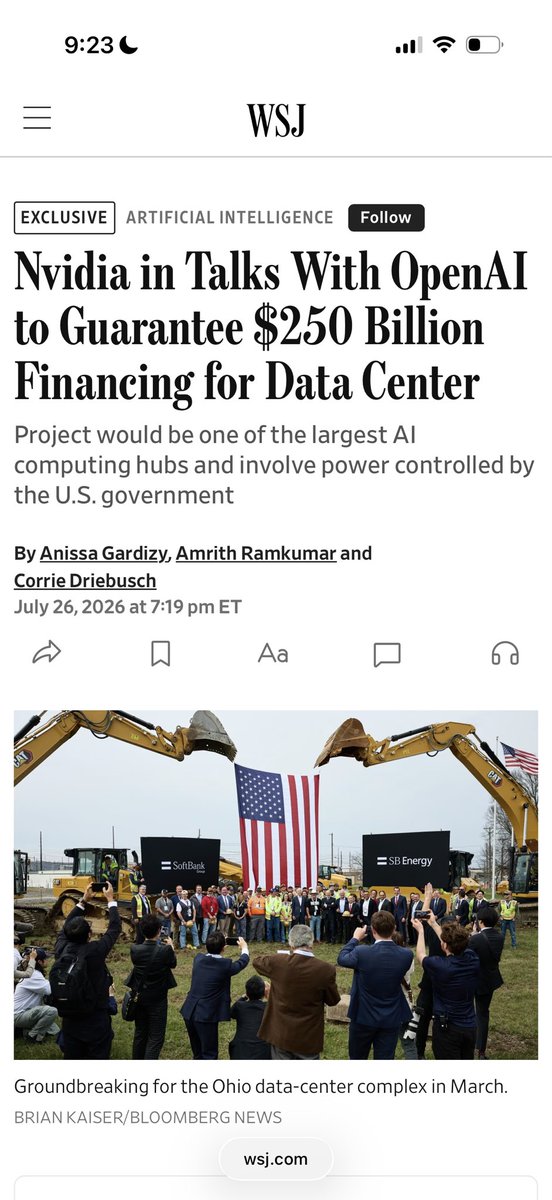
Ahh, the wonders of state capitalism in which the government controls which data centers get power and which do not…..
“The power for the project is controlled by the U.S. government and funded separately by Japan under a recent trade deal. Commerce Secretary Howard Lutnick is involved in deciding who will get the power, some of the people said.”
@niubi A summer internship at AEI and studying abroad in Taiwan now make someone “anti-China”?
Edward’s willingness to engage with China is a positive for mutual understanding. It should be encouraged, not attacked. I only hope the Dunhuang Media Center doesn’t take advantage of it.
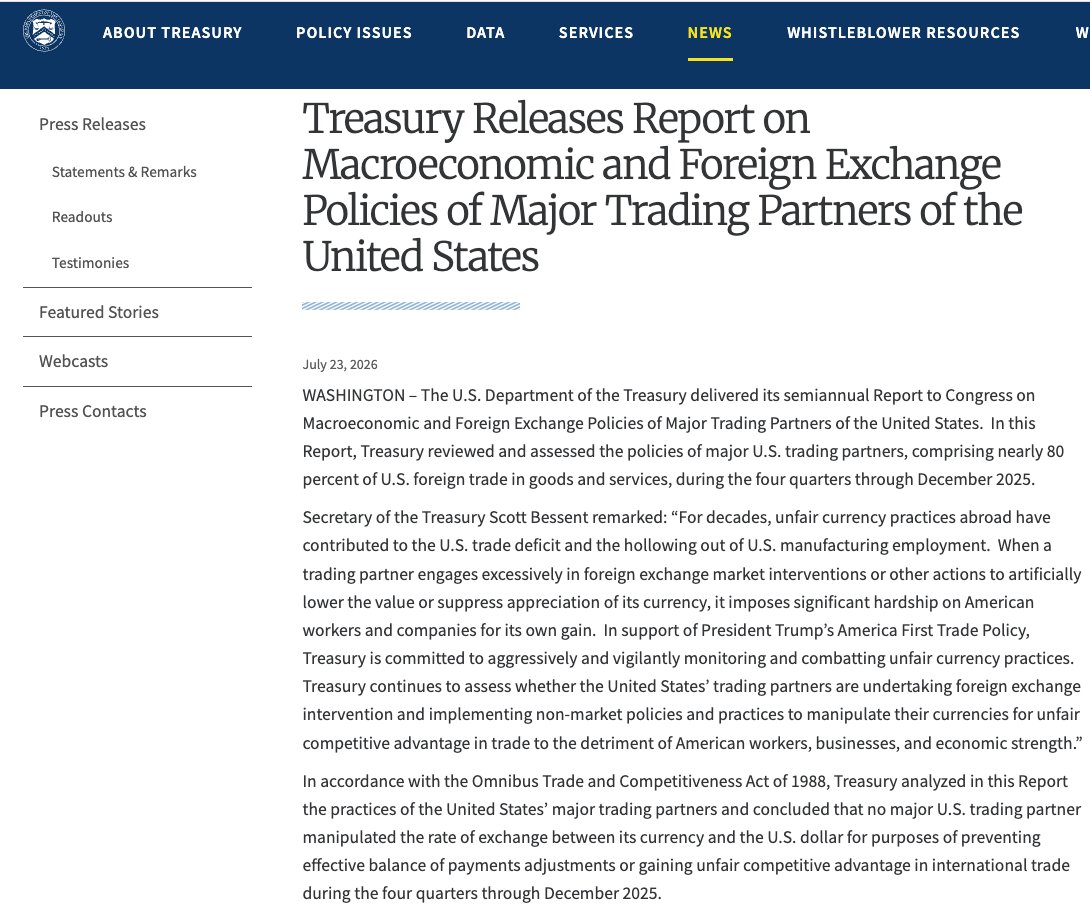
This Treasury report is clear-eyed, thoughtful, and sensible. The report concludes that in 2025 no major trading partner of the US, including China, manipulated its exchange rate specifically with the intent of deriving an unfair trade advantage vis-a-vis the US. The problem of trade imbalances has to do with untenable macro-policies and not about currency manipulation.
https://t.co/nDfgumZ1RA
Status of Humanoid robot orders in factory setting in 1st half of this yr:
Very popular in auto sector where Ubtech's Walker S is working @ BYD/Geely/Dongfeng/Zeekr/FAW & BAIC
BYD's own robot in 2 factories
Agibot A2-W, Xiaomi CyberOne, Galbot S1 also in auto supply chain
Agibot G2 has been filmed multiple times now doing work @ Longcheer assembly line for inspection & such
CATL is using Talbot S1 in in battery packing line
Walker S2 is also serving Airbus
Other industries include mining, appliance & service. Their presence will continue to expand as more worker means more data for training & improving.
@kyleichan This seems to be the pattern across most of China’s priority industries.
The U.S. often has the technological leader, but China has far more firms competing across specialized niches throughout the industry.
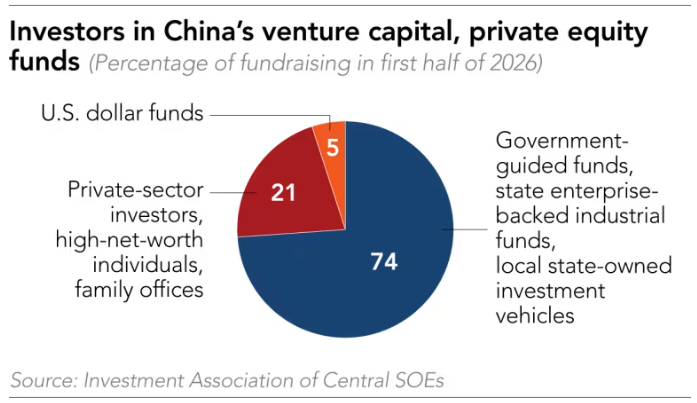
In China, public funding makes up a large slice of the country's venture capital pie. State enterprises and government-managed investment funds accounted for 74% of the money raised by venture capital and private equity funds.
https://t.co/G9ivcqhOEZ