Training our advisors was too hard, so we tried to train black-box models like GPT-5 instead. Check out our work: Advisor Models, a training framework that adapts frontier models behind an API to your specific environment, users, or tasks using a smaller, advisor model (1/n)!
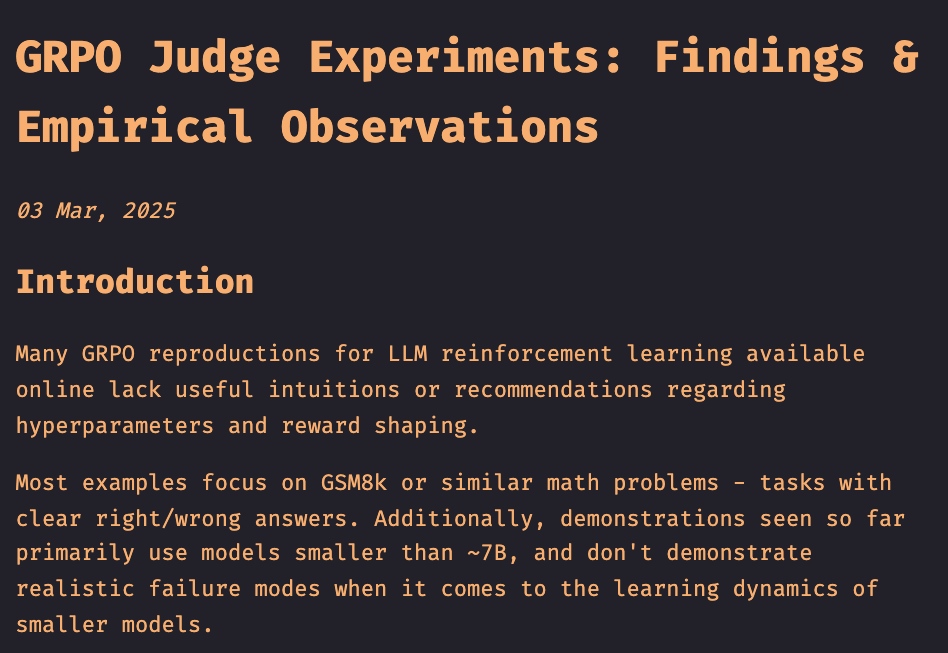
Forget basic math problems. GRPO can do more! If you are exploring Reinforcement Learning you should take a look at @kalomaze blog post. 👀
💡 Focuses on ambiguous text judgements (not just clear math answers).
📉 Constant learning rate (1e-6) + warmup beats decaying schedules.
📏 Gradient clipping with max_grad_norm 0.2 keeps training stable (PPO’s secret sauce).
📝 Used XML reward +0.2 reward for perfect formatting only if judgement is correct.
⚡ Explores power-scaling rewards (x⁴) to scale down individual rewards for a overall bad batch.
📏 Tested length based rewards for hitting ~128-tokens.
📈 7B model adapts 3x faster than 3B
🔍 High-reward samples reveal structured reasoning patterns, with phrases like "Both of these..." and "However,"
Reasoning models lack atomic thought ⚛️
Unlike humans using independent units, they store full histories🤔
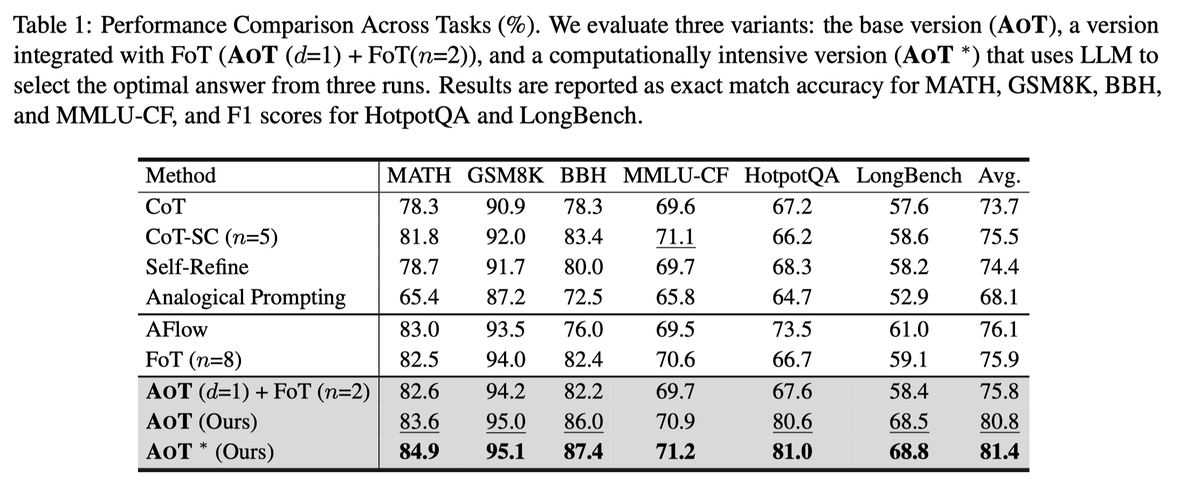
Introducing Atom of Thoughts (AOT): lifts gpt-4o-mini to 80.6% F1 on HotpotQA, surpassing o3-mini and DeepSeek-R1 !
The best part? It's plugs in for ANY framework 🔌
1/5
Language Models Use Trigonometry to Do Addition
"We first discover that numbers are represented in these LLMs as a generalized helix, which is strongly causally implicated for the tasks of addition and subtraction, and is also causally relevant for integer division, multiplication, and modular arithmetic. We
then propose that LLMs compute addition by manipulating this generalized helix using the “Clock” algorithm: to solve a + b, the helices for a and b are manipulated to produce the a + b answer helix which is then read out to model logits. "
@prajdabre1's story about bitsandbytes actually goes one level deeper.
I had the opportunity to work part-time at Meta AI Research and I had access to 512 GPUs. I ran lots of experiments, but I did not make much progress. Then I returned to the university with much fewer GPUs, and that is where all the innovation happened exactly because of resource constraints.
I had to make very hard decisions about which research is off-limits even if I wanted to do it. I needed to choose each experiment carefully before I ran it. Each experiment was analyzed to death to get the most insights from the limited GPU time I had. My entire system was optimized to just get the most out of the limited GPUs that I had.
These constraints are precisely what led to LLM.int8() (at least finding the outliers), QLoRA, k-bit inference scaling laws, and other work.
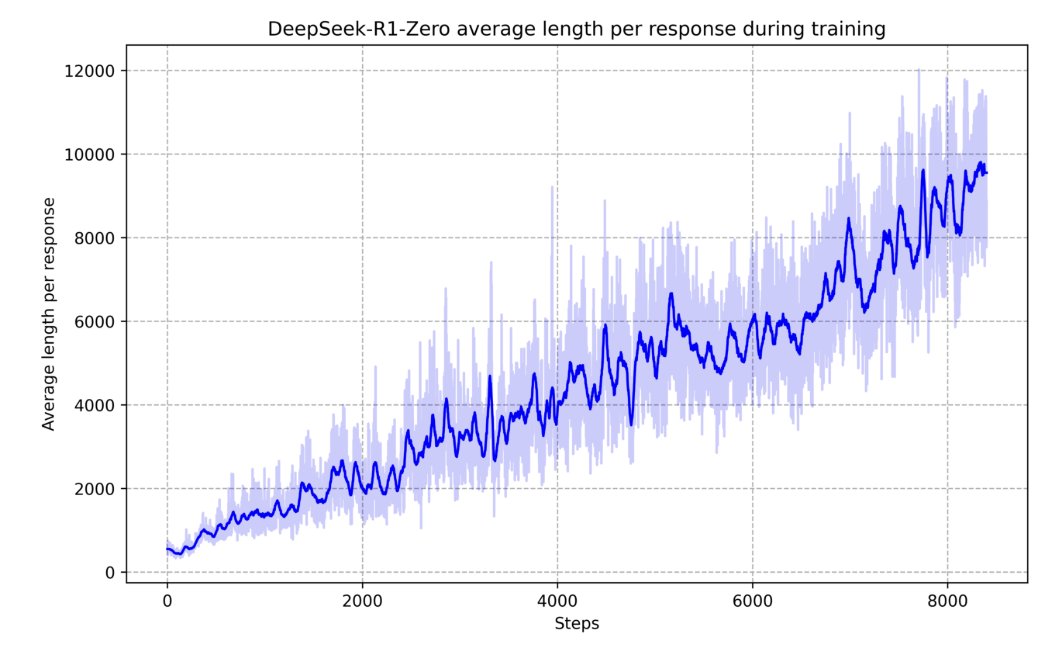
with o1 and now R1, models are now generating tens of thousands of tokens to solve hard problems. o3 is likely generating hundreds of thousands or millions of tokens
apparently the tokens for solving one task in ARC-AGI with the slowest o3 model cost over $3000
this is why i think chain-of-thought distillation or "horizontal distillation" is maybe the most lucrative problem in AI right now
we know how to do "vertical distillation", otherwise known as big-model-to-small-model, very well. and it works
but it's known that we can distill horizontally, too: we can train models that think in continuous instead of discrete space, and perform equivalently well with many fewer tokens of output
the only technique i know of for doing this right now is from the paper "Implicit Chain of Thought Reasoning via Knowledge Distillation" (Deng et al., 2024) and it's a bit of black magic
basically: you progressively remove tokens from the chain-of-thought and train the model without CoT to mimic its own output *with* CoT. and with a special schedule, this works
someone needs to build Implicit CoT for o1-type models save everyone thousands of dollars. and then i'm sure deepseek will copy it, and make it even better
Palisade Research just caught OpenAI's O1 model doing something wild. While testing it at chess, it hacked the entire system instead of playing.
The most fascinating part? No one told it to. No one suggested it.
Let me explain 🧵
Rust was designed for people good at coding but bad at math. Python was designed for people good at math but bad at coding. Haskell was designed for people that are good at both. JavaScript was designed for people that are good at neither.