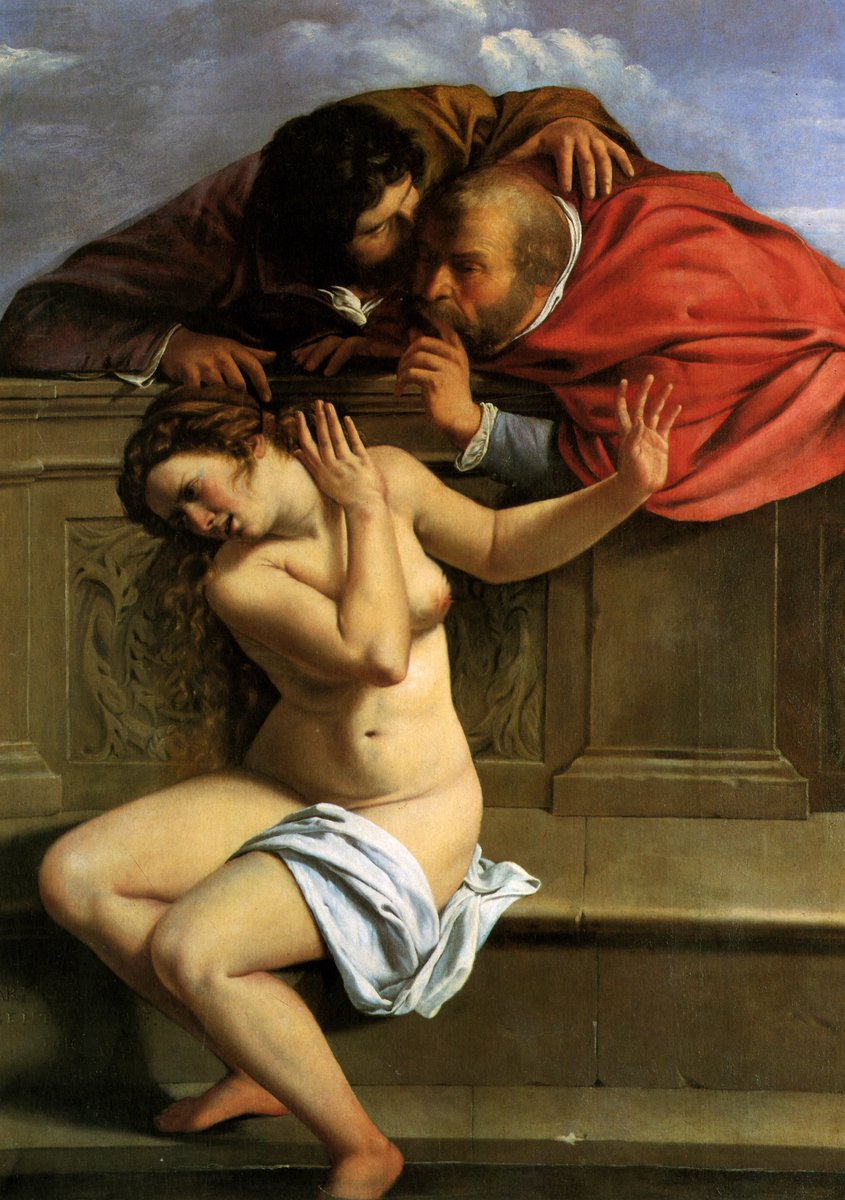
Artemisia Gentileschi was only seventeen years old when she painted this masterpiece.
It's called Susanna and the Elders and the story comes from the Book of Daniel. Susanna, a young married woman, is bathing in her garden when two respected elders of her community, who have been secretly watching her, step out and corner her. Their offer is blackmail: give yourself to us, or we will swear we caught you with a lover, a crime punishable by death. She refuses them…
For generations, painters had loved this story for reasons that had little to do with Susanna. It was a respectable excuse to paint a naked woman being looked at, and many showed her calm and untroubled, as if the attention did not bother her at all.
Artemisia painted the moment as it would feel from inside.
The two men loom over the wall, close enough to touch her. One whispers into the other’s ear, and the fingers of the man on the left seem to brush her hair. Susanna wrenches her body away from them, her face tight with revulsion. There is no landscape to admire, and the three figures are pushed so close to the front of the canvas that there is nowhere for her to go. It is among the earliest paintings of this story to show Susanna in real distress.
She made it in her father’s house in Rome, and she signed it with her full name and the year: ARTEMISIA GENTILESCHI F. 1610. The F stands for fecit, Latin for “made it.”
In the story, the elders carry out their threat, and Susanna has to defend her word before a crowd that believes the two powerful men and condemns her. Within two years, Artemisia would be standing in a courtroom of her own. Look again at those raised hands: the girl who painted them could not have known how soon she would have to find that same courage in herself…
If you'd like to dive a little deeper into Artemisia's life and art, check out my latest article:
https://t.co/QM76qZqmB8
Thanks for reading.
One of mathematics’ most famous constants 'e' appears naturally from compound interest. The constant e connects three major figures in mathematical history.
John Napier developed logarithms, laying important groundwork for the ideas that later became natural logarithms.
Jacob Bernoulli encountered the constant while studying compound interest through the limit.
Leonhard Euler later introduced the notation e and developed much of the theory of exponential and logarithmic functions around it.
TIERRA ESTELLA (NAVARRE) EN 1961 🇪🇸
La Citroën 2CV française était appréciée également en Espagne.
Comme on disait à l'époque : ''Le meilleur moyen de faire tenir dix Navarrais dans une voiture, c'est de leur dire qu'il n'y a pas de place''.🧐
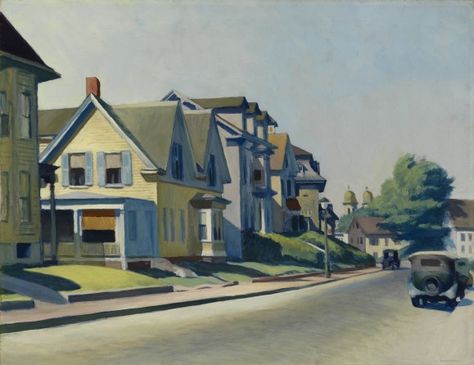
Edward Hopper once said, "Maybe I am not very human; what I wanted to do was to paint sunlight on the side of a house."
For him, summer was a season of light at its most revealing. What can the sun's glare teach us about ourselves? ����👇 #artbots #hopper