@JermaineCurtis Thank you for sharing such insightful information. I’m really enjoying it. I would like to request an online session for Korean baseball coaches. How can I get in touch? email or What’s App
When I was with the Cincinnati Reds, I saw Joey Votto doing one of the strangest drills I'd ever seen.
He was using a tiny one-handed training bat.
But he was holding it with two hands.
Then it got even weirder.
He wasn't standing in the batter's box.
He was standing almost on top of the net.
The end of the bat was nearly touching the net.
The knob was almost touching his chest.
Our hitting coach had pulled the L-screen all the way over to the net.
There was only a tiny window to flip through and hit through.
When the coach flipped the baseball...
Joey kept hitting line drives right back through the opening.
Over and over.
Every ball went back through the middle.
So I asked him:
"Joey, what are you working on?"
He said:
"My front shoulder is flying open."
Then he pointed toward center field.
And said:
"I want my direction going there."
Not pull side.
Middle.
That's why he made the drill so difficult.
If his front shoulder flew open...
He couldn't hit the ball through the window.
The drill gave him immediate feedback.
I remember thinking:
That makes a lot of sense.
Because I was fighting the same thing.
My front shoulder was opening early too.
So I tried it.
And immediately felt the difference.
I stayed through the ball longer.
And the middle of the field started opening back up.
Here's What I'd Do Tonight
1. Window Drill (10 swings)
Create a narrow window with a net, screen, or object.
Your goal is simple:
Hit line drives through the opening.
2. Middle-Field Front Toss (10 swings)
Every ball must be hit through the middle.
Not pulled.
Middle.
3. Gap Round (10 swings)
Let the ball travel.
Drive it to the opposite-field gap.
Focus on keeping the front shoulder closed.
That's it.
30 focused swings.
One thing I've learned:
A lot of hitters try to fix their swing.
Elite hitters often create drills that make the mistake impossible.
Joey Votto didn't tell himself to stay closed.
He built a drill that forced him to.
Thank you for reading,
Jermaine Curtis
P.S. - If you enjoyed this, and thought it was helpful, please share it.
(This tells me you want more content like this)
In 2011, Japanese telecom company Docomo created one of the most beautiful adverts we've ever seen.
A giant xylophone in Kyushu playing Bach's "Jesu, Joy of Man's Desiring" with a wooden ball rolling down its keys.
Doing two one-day pitching mechanics clinics with @TeamMstrd next week! Would love to see all of you coaches and parents ahead of the 2026 season so we can help kids throw strikes and stay healthy! Sign up in the replies! 👇
I'm not a huge fan of drills.
Drills seem helpful because
- "we need to focus on the fundamentals"
- "the basic building blocks of technique"
- "we must first work on technique before swimming fast"
Drills are typically so disconnected from actual swimming that they don't provide a lot of validity.
Drills are:
- Disconnected from the actions of swimming
- Do not provide the same opportunities that swimming does
- Engage internal focus of attention
- They focus on the actions of the body instead of the effects on the water.
When drills are slow, internally focused they do not provide any context relevant contexts for how we actually race.
Providing constraints to swimming and working through challenges that are externally focused and provide the same opportunities that swimming does in order to accelerate learning.
The decision making piece is huge in the hitting process. Swinging at your pitch & taking balls is often the separator between elite & very average hitters. The best hitters often sit on pitches/locations verses just reacting to ball flight. This simple drill with small balls gives you an opportunity to work on decision making relative to pitch recognition/trajectory. Throwing two small balls at once is an easy skill to learn.
"The Dodgers go further. They teach. Bob Geren said it flat-out on MLB Now before Game 7 of the World Series: they don’t just want the best players in the world they want the smartest."
https://t.co/q5LtcMOwtd
As a hitting coach, I watched players come back to the dugout after making an out.
They'd look at me and ask, "What'd you see?"
I'd go through the mechanical stuff like back side collapse, front side energy, head came off the ball. Man, it was wearing me out!
Finally, I realized I needed to simplify.
So the next time a player came back asking what I saw, I just asked him: "Did you get a good pitch to hit?"
That usually stopped the conversation. Because if you don't "get a good pitch to hit," it's hard to get a hit.
This works in our lives too.
Whatever task I take on, I ask myself: Am I putting myself in position to succeed?
Did I eliminate distractions? Did I prepare? Did I practice? Am I ready to produce?
In life, your "good pitch to hit" probably isn't the same as mine.
That's the beauty of it all.
I've swung at some bad pitches in my life... so have you.
But one bad swing doesn't always end the at-bat.
Hitting is a lot like life.
It can be simple, but not easy.
"Everything a coach says can add to or subtract from players' confidence. 코치가 하는 모든 말이 선수의 자신감을 키우기도 하고 빼앗기도 한다."
ISG Baseball Korea Clinic
3rd & 4th Dec. Seoul
Kellen Lee, Seattle Mariners Mental Skills Coach
@PeterCaliendo https://t.co/U8yXHfeT8C
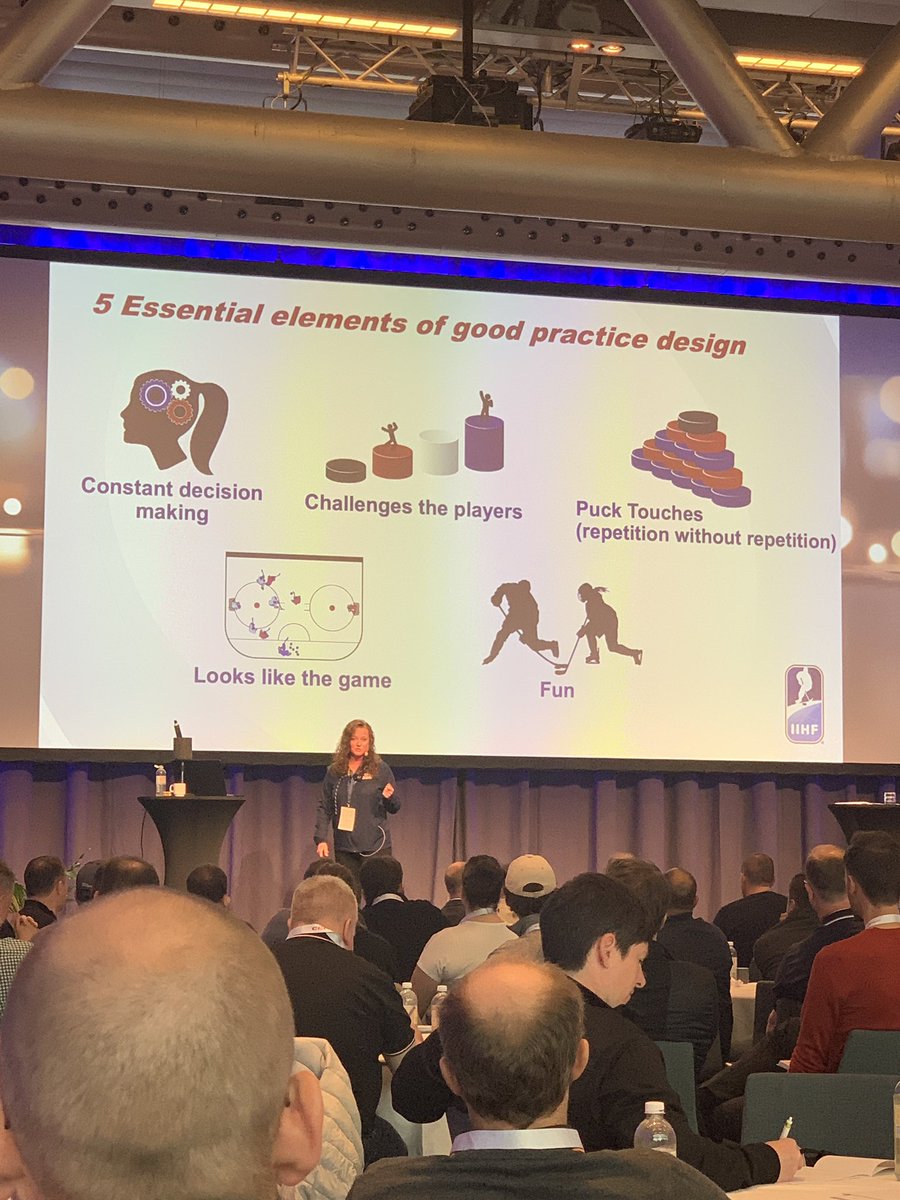
Heather Mannix from @usahockey presenting on practice design.
What should a practice contain to develop skilled players. No mention of flow drills, isolated or unopposed drilling.
Make use of the CLA and non-linear methods.