Essential reading from anyone who cares about American technological leadership, industrial strength, and national security, from @fiiiiiist and the team at @IFP.
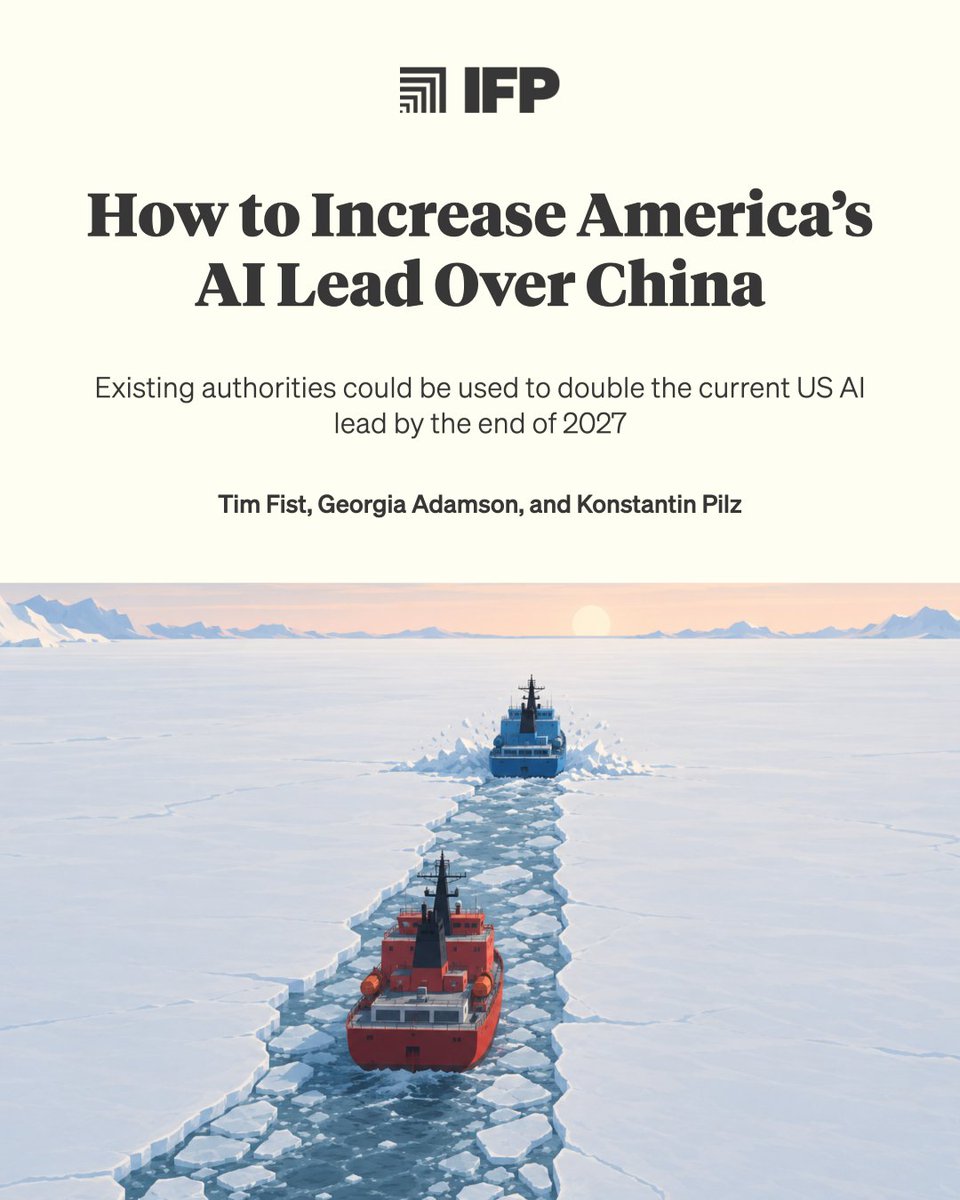
Big new IFP report from @GeorgiaCAdamson, @KonstantinPilz, and me on the US-China AI competition.
We spent the last 6 months digging into how Chinese AI companies’ access to compute and distillation of American models translate into the current US-China capabilities gap.
The result is a 23k-word research report, including an interactive analytical model that visualizes changes in the US AI lead under different policy interventions.
Our findings:
1. The US AI lead over China is currently only around 6 months.
2. The US could roughly double this lead, to over a year, using authorities already available to the federal government.
3. On chips: China’s access to AI chips will roughly double over the next year, with chips housed in data centers overseas accounting for roughly half of China’s 2027 compute.
4. On distillation: the current ~16x US training compute advantage would normally yield a 13-month lead. But we estimate adversarial distillation halves this to around 6.5 months.
5. Increasing the lead would have some obvious benefits:
- Give the US broadly a greater cyberdefensive advantage against Chinese threat actors.
- Give US AI companies breathing room to spend more R&D resources on making their systems safer and more secure, without fear of being overtaken by less safety-conscious Chinese competitors.
6. Provide the US government more leverage in negotiations with China about the future of AI.
7. The two most important interventions are:
- For BIS: Create a new end-use control to restrict China’s remote access to training clusters abroad — China’s largest and fastest-growing source of frontier-scale compute.
- For DOJ/FTC: Create a narrow safe harbor to allow US companies to coordinate on countering Chinese adversarial distillation.
8. Both interventions (and all the others we discuss in the report) are things the federal government could do today.
9. To estimate the effects of each policy intervention, we model the US lead as a function of its compute advantage over China and China’s ability to adversarially distill the capabilities of the US frontier.
10. The model makes many simplifying assumptions, but provides a useful way to assess and rank the impact of different policy interventions at a high level.
Read the full report here: https://t.co/7pC9ZKtikx
President Trump has made clear that America must WIN the AI race. That means strengthening export controls to keep advanced AI chips out of the hands of the CCP.
Unfettered access to American AI technology risks accelerating China’s military capabilities and expanding its surveillance and repression. We cannot fuel the CCP’s rise at the expense of our national security.
Read this @AmerCompass article to learn more: https://t.co/6djw0rndsA
America dominates global AI by leading the world in building advanced AI chips. But that dominance isn’t guaranteed; China is aggressively trying to catch up.
To maintain our lead, Congress needs to close the gaps in America’s export controls. @Chris_Griz has a roadmap. 🧵👇
.@AmerCompass: The AI OVERWATCH Act, “introduced by…Jim Banks (R-IN)…would address the direct sale of advanced AI chips to adversaries.”
“It would codify existing restrictions…securing those restrictions against future administrative changes.”
https://t.co/sdYUITp3jT
SCOOP: While Bo Hines was leading the White House’s push to pass the Genius Act, Tether—the company with the most at stake in the bill—was steering millions of dollars to a company he co-owned.
Right after the bill passed, Tether hired him as its U.S. chief.
[Gift link] https://t.co/OWEI7gGX2Q
This is absolutely wild per Status — ABC News completely retracted this story like two days ago just totally nuked it. No note, no explanation , no comment. It had been shared by tons of top lawmakers and democratic officials.
Smart decision by the @FCC. Chinese labs do the certification testing for the vast majority of electronics products sold in the US that need FCC approval. This should obviously be done by US/allied labs, not Chinese ones. This chart shows how absurd this problem has become.
China's weaponization of rare earths basically has pushed Europe to think about a two round game -- a set of tariffs intended to counter China's export surge, and a "second strike" capacity if China response to "inside the rules" tariffs with supply restrictions
1/2
I guess @BenShapiro did a monologue last week in which he said tariffs, not foreign policy, are causing affordability problems and driving down President Trump's popularity. So I made a video. If you watch carefully, you _may_ be able to see what caused inflation to spike...
AI is “above all else a tool”. By definition, tools point to the human intelligence that crafted them and draw much of their ethical force from the intentions of the individuals that wield them…[like] misuse for selfish gain at the expense of others.” -Pope Leo XIV
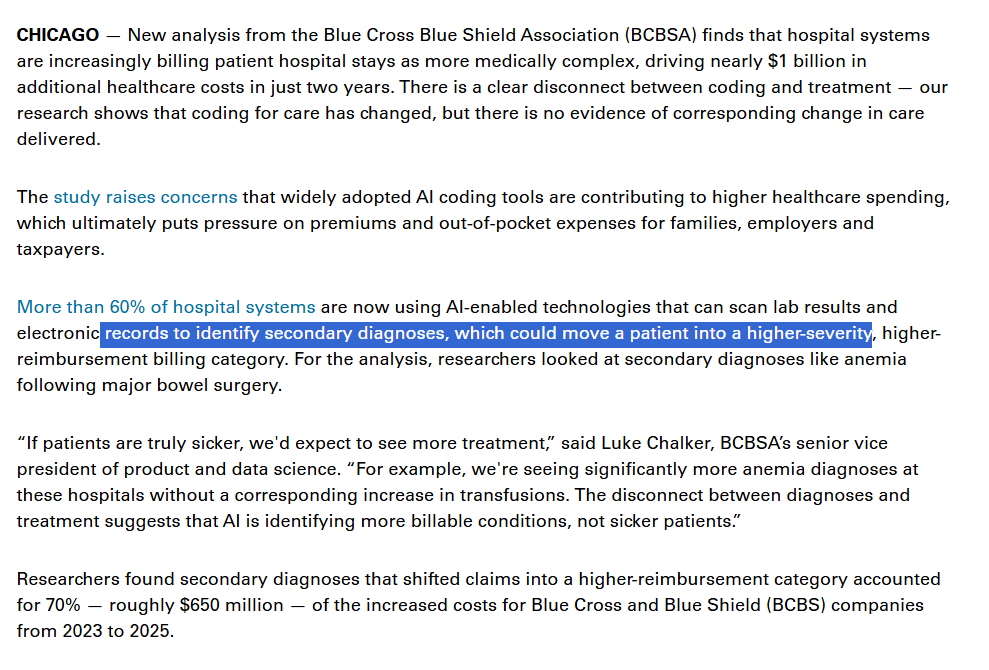
The Blue Cross/Blue Shield Association says that AI is already driving *up* healthcare costs, as hospitals use the technology to find instances where they can bill more for the same level of care. https://t.co/af1SzA7D8v
Obama cancelling Keystone XL was objectively dumb and arguably original sin
I hope the permitting reform efforts are a chance for Democrats to introspect and start thinking harder about the general equilibrium effects of energy policy
Keystone cancellation did 0 for emissions
Fun fact for @RandPaul: Reagan said those words at the start of a paragraph that continued:
"...the Government must act compassionately and responsibly. In order to see farmers through these tough times, our administration has committed record amounts of assistance, spending more in this year alone than any previous administration spent during its entire tenure."
Because unlike @RandPaul, Reagan understood that in many cases government does need to take action, and that having the capacity to act effectively is vital to sustaining the trust of the citizens you are supposed to be serving.
https://t.co/sSr6CFMiAj
For many years, both restrictionists and many advocates of high-skilled immigration have recognized that the leverage employers have over visa holders is unfair to both the workers themselves and to American peers.
If an employer can destroy your life, they can use that leverage to pay you less or otherwise mistreat you. The greater their leverage, the greater the incentive to hire workers who are (at least partially) "captive."
For years, workers on our primary nonimmigrant work visas have had 60 days to find a new job or depart after losing their job. That's not a ton of time. Most white-collar workers who get laid off spend longer than that looking for their next gig. But it is enough time for many to find a new job, meaning employers don't have *total* control. You can still figure something out if you, for example, resign because an employer is abusing or underpaying you.
But DHS is now proposing to eliminate even that 60-day grace period. Now, losing your job would mean immediately pulling your kids out of school, selling everything, and leaving. DHS is, in effect, putting employers entirely in charge of their employees' immigration status. This is a major step in the wrong direction, and one not asked for by either critics or supporters of these visa programs.
This is not going to improve prospects for American workers. Instead, it will further incentivize employers to hire visa holders over Americans.
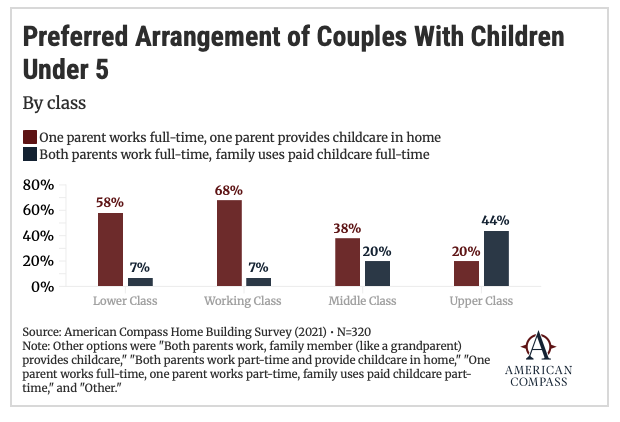
Under current regulation, all parents in the household must work or be engaged in job/educational training as a condition of receiving a childcare subsidy from the Child Care and Development Fund. Households with a stay-at-home parent are categorically ineligible for the benefit, which means public policy puts its thumb on the scale in favor of one childcare arrangement (commercial child care) over another (child care provided by a parent).
Such a policy is inconsistent with the preferred arrangement of working families, who—as polling from American Compass and others has found—overwhelmingly prefer that one parent work full-time while the other parent provides childcare at home. A rulemaking that empowers states to experiment with expanding program eligibility to households with a stay-at-home parent is a good policy shift that gives families a true choice on how best to raise their children.
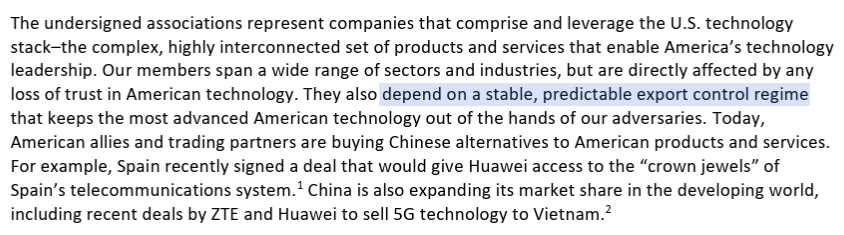
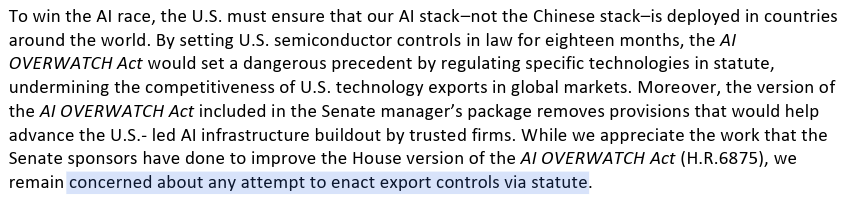
1/ All you really need to know about the tech industry's anti-export-controls letter is that they "depend on a stable, predictable export control regime" but "remain concerned about any attempt to enact export controls via statute." What are we even doing here?
Really sharp piece from @Chris_Griz in @commonplc about why the new Trump Media scheme to sell early access to the president’s posts is such an affront to the public—particularly at a time when concerns about government corruption have never been greater. https://t.co/lnCKRUtYJs
"The deeper outrage of Truth API... is the simple (lower-case t) truth that leveraging public office for private gain is gross. Selling access to Oval Office social media posts is a betrayal of the public trust"
From @Chris_Griz for @commonplc:
https://t.co/foLPiKZ7WG
“Lawmakers must move swiftly in codifying the critical concessions in this settlement into a law that governs all platforms equally. But they must also tackle this problem at the root: children do not belong in the attention economy, whether as data mines for Silicon Valley to exploit, or as self-exploiting “entrepreneurs” addicted to producing what Silicon Valley demands. Parents may not be perfect gatekeepers—but it’s time to at least give them back the keys.” -Brad Littlejohn @AmerCompass@commonplc
The window to shore-up our chip export controls and secure US AI leadership is closing rapidly.
We're calling on House leadership to include these three critical reforms in the FY27 NDAA:
- The Chip Security Act
- The MATCH Act
- AI Overwatch Act