Interesting fun fact: The Economist Intelligence Unit estimates we lose 28% of our working day to distractions and ineffective work routines.
Across a year, that adds up to a whole quarter of work lost!
Weird trivia: KitKats are named after a mutton pie, invented by a man called Chris, not far from Fleet Street.
Rowntree trademarked the names 'Kit Cat' and 'Kit Kat' in 1911, a couple of years after competitor Maynards release Wine Gums, which competed with Rowntree's own 'Fruit Gums'.
(side trivia: when Wine Gums were first released they were marketed literally as an alternative to wine. Both Maynards and Rowntree weren't keen on people drinking, and Rowntree themselves had a line of hot chocolate called 'Elect' that was marketed as an alternative to beer).
Anyway... until that point, Rowntree had relied largely on just having category name products (hence 'fruit gums', 'fruit pastilles' being such generic names), but started picking up trademarks.
They registered 'Kit Kat' and 'Kit Cat' in 1911, and first used the name 'KitKat' about 10 years later, initially as a short-lived chocolate selection box. They were still not really focused on brands but, a few years later, they hired J Walter Thompson to conduct market research on consumer needs, which resulted in pushing much more into them: Black Magic, Aero, Smarties, Polo were all developed in the years to come.
And... in the middle of that, in 1935, they wanted to launch what they referred to as a "chocolate bar that a man could take to work in his pack up" (a suggestion from a staff feedback initiative). They developed this product and referred to it initially as the 'Chocolate Crisp'. Having moved from generic categories on other products to brand names, they sought something better: At the time, Rowntree had a 'Company Psychologist' called Nigel Balchin, who was responsible for the 'Black Magic' brand. It seems that he noticed they had these old trademarks on the books for 'Kit Cat' and 'Kit Kat', and swapped the clumsy 'Chocolate Crisp' for 'Kit Kat'. The rest is history, and they now sell 5 billion of them a year: chocolate bars that a man (or woman) can take to work in their pack up.
Returning to the pies: The original Kit Kat Club (not to be confused with the Berlin nightclub, or Cabaret destination), from where the inspiration for first trademarking the KitKat name came, was an 18 century literary and political club, with members including the UK's first de facto prime minister Robert Walpole.
In later years the Kit Kat Club met on The Strand, at what is now the newly reopened Simpsons in the Strand. But originally they met in a tavern on Shire Lane (now part of the Royal Courts of Justice). That original tavern was run by a piemaker called Christopher Catling (referred to in a note at the time as 'a Pudding Pye man').
Some readers will know that 'Kit' is a nickname for people called Christopher (eg. Kit Harington is actually called Christopher), and therefore Chris Catling - the pie man - was colloquially known as Kit Cat, and his mutton pies were sold as Kit Cats. As a result of the literary club meeting at his shop, they called themselves 'the Kit Kat Club', and 'Kit Kat' became a way more famous name than a local pie shop may ordinarily achieve.
Therefore, through a series of odd disjointed steps, and a prime minister, and company psychologist, and temperance promoters, KitKats are named after mutton pies, created by a 'pudding pye man' called Chris.
Please, can we bring this idea back? VW once allowed customers to order a built-in coffee machine for the Beetle! ☕️
https://t.co/ckzO1EyCCc
cc @rorysutherland thought you'd enjoy this!
@JustinStanford@FlyCloudline Bravo dear chap! Can we take a ride when we’re over in SA again next week…our little ones only two so pretty light still 😂
Day 1 | #FutureReboot@ChrisRawlinson , Founder of @42Courses, kicks off the ICCO European Forum—reframing how leaders learn, lead & stay relevant in a fast-changing comms world.
🎟 Early Bird tickets live
⏳ Limited spots
👉 https://t.co/4aKVebo2Ow
This book is I think what most wish they could do in January 😂
(Also, in all seriousness, it is a good book too, well researched by the neuroscientist Dr Joseph Jabelli)
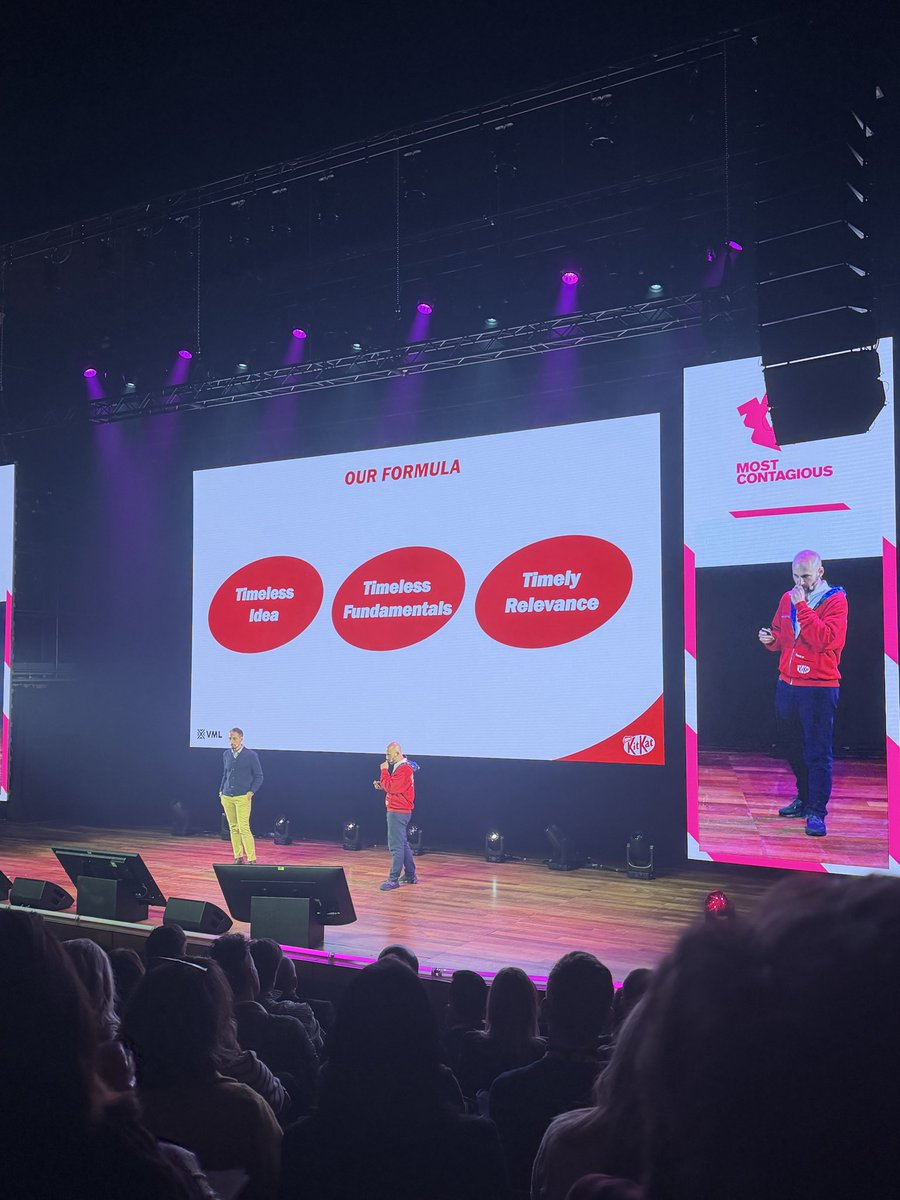
The KitKat marketing playbook.
1. Have a timeless simple to understand idea- e.g. Have a break, have a KitKat.
2. Timeless fundamentals - for KitKat they believe breaks are good (ie everyone needs a proper break, and the ritual (breaking) is built into the product use)
3. Timely relevance - Often the hardest part, it’s hard to remain culturally relevant and be ambitious…but super important. E.g people always have breaks but how those are taken has changed over the last 70 years and the KitKat ads always lean into that change to remain relevant.
From the Most @contagious event
“Don’t advertise the brand, advertise something the brand did” - Nils always asks his teams to look to create real world moments that cause a spectacle and get people talking. Find ways to help people make it their own too - @nilsleonard at @contagious
Oh my god! They’ve started going up. 1st one at Bank Station. Please post a pic if you see one over the coming weeks. They cost a packet and they might be taken down if people complain. Oh, and thanks again for your support. It really helped 👊
This is the backbone of any good strategy.
The 4C’s Worksheet.
The process starts with specific questions that dive into the company, consumer, category, and culture.
COMPANY RESEARCH Summary of financial report / product strength
CONSUMER RESEARCH Consumer profile / journey
CATEGORY RESEARCH Competitor audit
CULTURE RESEARCH Cultural trend reports
Then, we distill them into key guiding insights.
👉 If you want to kick off strategy by learning creative strategy, join my free workshop: https://t.co/7xITqbG7aH
Can I ask a marketing favour of the hotel industry? Can you come up with a better phrase than "Adults Only"? I quite like the idea of no kids, but this implies I'll have to spend my holiday in a gimp mask being molested by random Germans.