People often talk about AI as if it were some mysterious form of intelligence.
Underneath the surface, much of modern AI is built from surprisingly familiar mathematics. Neural networks repeatedly apply linear algebra, nonlinear functions, calculus and optimization to numbers. During training, the model adjusts millions or billions of parameters to reduce its error, essentially searching through an enormous mathematical landscape for better solutions.
So, is this really the mathematics behind AI?
In large part, yes. But the interesting part is how these simple pieces scale into systems capable of learning patterns from astonishingly complex data.
O Mistério da Máquina de Anticítera: A Tecnologia Perdida dos Gregos
Em 1901, mergulhadores de esponjas encontraram os destroços de um antigo navio romano próximo à ilha grega de Anticítera.
https://t.co/oHsNXX1YfI
#MáquinaDeAnticítera#AntikytheraMechanism#Anticítera
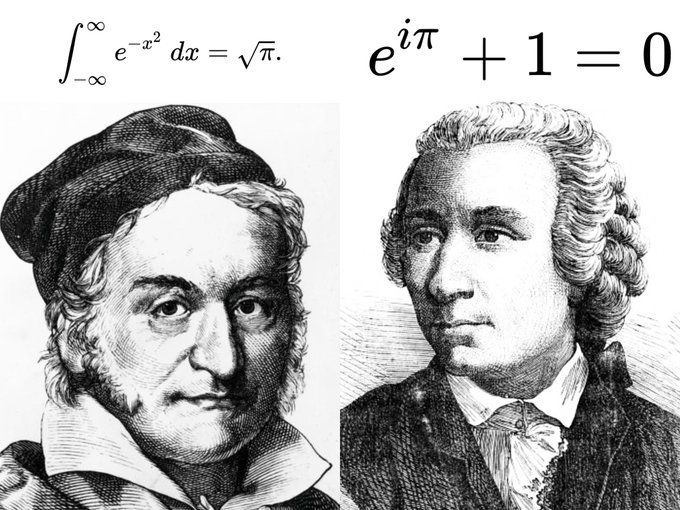
Euler’s identity is often called the most beautiful formula in mathematics because it unites five fundamental constants: 0, 1, i, π, and e.
Equally elegant, and almost mystical in spirit, is Gauss’s integral. Here, π and e are linked not by the imaginary unit, but by infinity itself.
Gauss believed that anyone who did not quickly grasp Euler’s identity would never become a top mathematician, yet even he did not find his own integral obvious.
Unlike Euler’s formula, Gauss’s integral has clear practical value. Its function produces the famous bell curve, used to model heights, test scores, measurement errors, and many random processes. The same curve also appears in everyday tools, such as the Gaussian blur used in image editing.
Snell's Law ✍️
It explains how light bends when it moves between two different materials, like air and glass, because light travels at different speeds in each one. When light enters a denser material at an angle, it slows down. The part of the light beam that hits first slows down before the rest, causing the entire ray to pivot and bend toward the normal line. On the other hand, when light enters a less dense material and speeds up, it bends away from that line. This effect is why objects underwater look shifted or shallower than they really are. It is also the main principle used to design lenses for glasses and cameras, allowing them to focus light accurately.