Dear girls, marry a trader.
He already handles Trump’s mood swings every day, so yours won’t scare him.
Plus, he’s extremely loyal, the market breaks his heart daily and he still never leaves.
Cheating? Almost impossible.
Even on a date he’ll be busy checking charts instead of looking at other girls.
And when he makes big money, nothing can ruin his day…
Going out with friends? - Sure.
Expensive restaurant? - Yes.
Need money? - Take it.
$SLV $AGQ $SILVER
The morning opened with a clear regime shift.
Trump nominated Kevin Warsh for Fed Chair. Warsh is widely viewed as a hard-money hawk. At the same time, a U.S. government shutdown was averted at the last minute.
Gold and silver had effectively been propping each other up over the past week. Silver looked vulnerable, but gold’s parabolic move prevented a breakdown, resulting instead in a double-top structure.
This setup has historical precedent, most notably in 2006 and 2011.
Quietly behind the scenes topping macro news added up: Greenland resolution, Tariff step back, FED chair hawk(ish)...
As the macro narrative flipped, the “chaos premium” and “debasement trade” evaporated almost instantly. This came on top of rising margin requirements and billions of dollars in call options being offered throughout the week.
With today being Friday, those call positions became trapped. Market makers were then able to delta-hedge back toward neutral by selling underlying shares.
That’s when the dominoes began to accelerate.
As silver broke below key whole-number levels, where the largest call strikes were concentrated, selling pressure increased exponentially. Billions of dollars in call options rapidly went to zero.
The selloff intensified into the 1:30 PM window, driven in part by the $AGQ rebalancing mechanism.
As a 2x leveraged ETF, AGQ must rebalance daily to maintain its leverage ratio. A 10% drop in silver leaves the fund over-leveraged, forcing it to sell futures into weakness.
The “Kill Zone” (1:00–1:25 PM ET) is where the mechanics turned brutal:
1:00 PM: Order cut-off
1:25 PM: NAV calculation
HFTs and authorized participants knew AGQ would be forced to unload significant volume. They front-ran the 1:25 PM window, stripping remaining liquidity.
Silver didn’t merely decline, it gapped through multiple support levels. Selling pressure peaked precisely at the 1:25 PM NAV print. Once the mechanical rebalancing was complete, price finally found a floor.
Things Markets Taught Me
In this post I’m not trying going to try and explain markets in the technical sense. This is an attempt to explain what markets taught me through lived experience and, more broadly, what they revealed to me about life.
I got into trading in 2018 out of a mix of curiosity and competitiveness. I was always drawn to markets, the economy, and how everything seemed interconnected beneath the surface. Even early on, I knew I wanted to build something of my own. Trading felt like the purest form of entrepreneurship: performance-based, unforgiving, and directly tied to how the world actually works.
At a young age I could already feel that the traditional 9–5 path wasn’t for me. It wasn’t just about work; it was about structure. Becoming a cog in a machine for someone wealthier, smarter, and more removed from the consequences of your effort felt deeply misaligned. You could hear it in people’s voices, see it in their actions, just a quiet resentment, a slow erosion of meaning and society seemed very nihilistic in this sense. For a lot of people, that energy turns into depression, even if they don’t have the words for it, and it did for me as well.
It felt hopeless and that energy caused a lot of depression, but what drove me was that knowing this truth was the first step to actually building a meaningful life and was a white-pilling experience for me. I knew that the world had more to give and trading was something that could help me find that. Markets felt like a place where reality was exposed without filters because it was expressed through actions and price, there was no hiding from that. Trading became a way to engage with that reality directly... not as an escape, but as a lens to understand it.
I learned pretty quickly that markets don’t reward effort, intelligence, or good intentions. They reward alignment with reality. That was the first lesson that stuck with me.
Early on, I thought edge came from knowing more or doing better... more news, more indicators, more opinions and just grind and be the best person you can be. But, over time, I realized everyone has access to the same information now. There were still people that were way more capable, smarter, and more ambitious than me and the internet continues to flattened that advantage. AI finished the job pretty much. Information is no longer scarce, everyone has the tools at their finger tips and as a growing person, trader and entrepreneur, there was still so much to figure out. And with the top 1% of the 1% of people on social media getting pushed to the top of the algorithm, it makes you think you are behind pretty much. Now everyone is a multimillionaire at 21 and at the same time, you are still navigating life.
Markets and information today are like drinking from a fire hose. Data, headlines, narratives, signals, all screaming at once. The challenge was never about being better, smarter, more hard working... it’s deciding what not to care about. Noise is the tax you pay for accessibility and every year it gets worse and worse.
I used to think discretion and data were opposites. Data felt rigid and mechanical; discretion felt human and adaptive. One lived in spreadsheets and backtests, the other in intuition, tape, and experience. I thought choosing one meant sacrificing the other and people were either quant traders or discretionary, you should specialize with one and learn it. But... They aren’t the same. Data tells you what tends to be true. Discretion decides whether it matters right now. And really your measurement doesn’t kill intuition, it sharpens it. The more I measured outcomes, the more honest my instincts became. Patterns either survived contact with data or they didn’t.
One of the hardest truths I learned is how much randomness exists in markets. Even good trades lose. Even bad ideas win and probably way more than we care to admit. Edge is fragile, contextual, rare, temporary, and HARD to achieve. There is no easy lunch. It was really funny because most people don’t fail because they’re wrong — they fail because they don’t understand how to tolerate uncertainty. I know I definitely did not, our human bodies were not built for that, and it literally causes fight or flight in our brains.
Most assume outcomes should quickly validate good decisions and punish bad ones. In reality, uncertainty is lumpy, uneven, and often unfair in the short run. Traders failed all around me because they expect linear feedback from a non-linear system. They size too big, quit too early, or change frameworks mid-stream because they mistake temporary outcomes for permanent information. Understanding uncertainty means accepting that being right is probabilistic, not immediate and that survival matters more than validation.
And I learned the hard way!
I have blown accounts, struggled and wanted to quit, many times... more than I want to admit. But the silver lining is that the moments that mattered most weren’t when I predicted something correctly, but when I recognized something was broken and the closer I connected those dots the better. It was the love for patterns.
For example: an overextending stock will force positioning, panic, leverage and force a reversal in someway or another over time, but all of these share one thing.
Constraints
Markets move not because of charts, but because humans and institutions are constrained by something.... Rational or not. It could be risk limits, mandates, fear, and time pressure or even just gambling and FOMO. Those constraints don’t disappear, no matter how advanced AI or technology gets.
That’s why markets aren’t solved and never will be. AI makes information cheaper, faster, and cleaner but it doesn’t remove incentives and never will. It doesn’t remove fear. It doesn’t remove forced behavior. Edge still exists because context still exists.
The same lesson applies beyond trading and by taking an interest in other things, I actually tended to notice this more and more. I'm still learning how to conceptualize it but I think it comes down to specialization. Specialization used to be protection. In the 9-5 world, where you are a cog in a machine, you are doing a task. Your literal job is to concentrate on a specific task or skill and be as precise and fast as possible. With AI, it can do it better and faster than ever before. Machines will always be better at narrow, repetitive tasks. They don’t get tired. They don’t doubt. They don’t forget. If your value comes from being a cog in a larger system, you’re competing with something that doesn’t need sleep. You can spend years studying law so you can work at a firm and write contracts for businesses or individuals, and overnight an AI can draft it in less than 5 second. Some people argue that its going to be PEOPLE using AI that replaces people that dont. But really... it has already happened. As the technology improves there is going to be a day where it will probably fully replaced for these specialization task.
What can’t be automated is synthesis. Judgment across domains. Deciding what matters, not just executing how and what. But the future belongs to people who can connect ideas that don’t obviously belong together.
second order thinking.
Stocks move generally from the first order effects from new information. It is almost priced immediately. An example of the first order is that when yields move higher, growth stocks sell off, and the dollar strengthens. That’s the obvious, consensus reaction and it happens fast because everyone is watching the same headline and naturally. this is correct. But more and more its just a race to who can recognize this first.
But the second- and third-order effects are slower and often where the real edge is. Higher rates don’t just change discount rates; they quietly tighten financial conditions. Months later, that tightening shows up as reduced capex, slower hiring, and stress in leveraged parts of the system. Credit spreads widen, refinancing windows close, and companies that looked “fine” suddenly need liquidity. Eventually, this feeds back into earnings, defaults, forced selling, and only then into broader equity weakness or sector rotation.
What about AI as a theme? when we build AI infrastructure quietly increases demand for energy, packaging, logistics, and petrochemical inputs. Electricity prices rise in certain regions, freight tightens, and resin production (a byproduct of petrochemicals) gets reprioritized toward higher-margin industrial uses. Now introduce supply constraints. Gelatin (used in gummy bears) comes from animal byproducts. If energy costs rise and transportation tightens, meat processing margins compress. Some suppliers cut output or divert supply elsewhere. At the same time, higher fuel and packaging costs squeeze low-margin consumer goods producers. No headline says “AI hurts gummy bears,” but suddenly candy manufacturers face higher input costs, thinner margins, and delayed shipments.
The second and third order effect shows up later: prices creep up, package sizes shrink, or certain SKUs quietly disappear from shelves. Consumers feel “inflation” in weird places and don’t know why.
markets price headlines fast, but they price propagation slowly. AI doesn’t need to “touch” gummy bears directly. It just needs to stress shared inputs energy, logistics, labor, capital and the effects surface where no one was looking.
By the time those effects are visible in the data, the catalyst itself is old news. The market already “knew” rates were going up and in this lens everything is priced in.
Most of us were trained to fit into boxes. Markets taught me that reality doesn’t live in boxes. it’s unified, messy, probabilistic. We may never fully understand it, but how we observe it matters. Markets just happen to be the lens I use to study that.
So at the end of the day, what has the market taught me.
Smart people don’t chase individual ideas but instead they invest in ways of thinking. They reduce reality to first principles and then see systems rather than isolated events, and live in probabilities instead of certainties. They understand leverage and how to get more output from the same effort and use abstraction to compress complexity without losing truth. They respect compounding and let time do the heavy lifting, build feedback loops to learn faster than everyone else, and rely on mental models that transfer across domains. They preserve optionality instead of forcing outcomes, and value clarity more than anything. The ability to say the hard thing simply. These aren’t personality traits but rather they’re cognitive assets. Stack them long enough, and intelligence stops looking like talent and starts looking inevitable.
What I didn’t realize at first is that this same structure exists outside markets. The depression I felt wasn’t random early on. It came from living in systems that demand certainty, linear progress, and fixed identities in a world that is anything but. If you are struggling in markets or even life, perhaps this resonates with you. We’re taught that effort guarantees outcomes, that specialization guarantees safety, and that following the path guarantees meaning. When reality violates those assumptions, when effort doesn’t pay, when randomness dominates, when systems feel rigged, people will naturally internalize it as personal failure. Markets taught me that uncertainty isn’t a flaw in the system; it is the system. Once I understood that, a lot of the nihilism lifted. The problem wasn’t me, I AM NOT BROKEN. It was the expectation that life, like work or school, should behave linearly.
Markets taught me that uncertainty isn’t a flaw in reality, but its the defining feature. Reality is unified in this way, and meaning depends on the lens through which it’s observed. For other people that lens is art, science, or something else entirely. For me, markets are that lens.
If you take anything away from this essay let it be this. Learn broadly. Measure honestly. Think in context.
And don’t confuse information with understanding because there is someone or something that can do that thing 1000x better.
I hope you found this helpful for your trading, investing or just life in general.
If this way of thinking resonates and you want to go deeper, send me a DM or drop a comment down bellow. I also teach and share more of my work inside my Discord.
like, repost, and follow for more.
Good morning everyone!
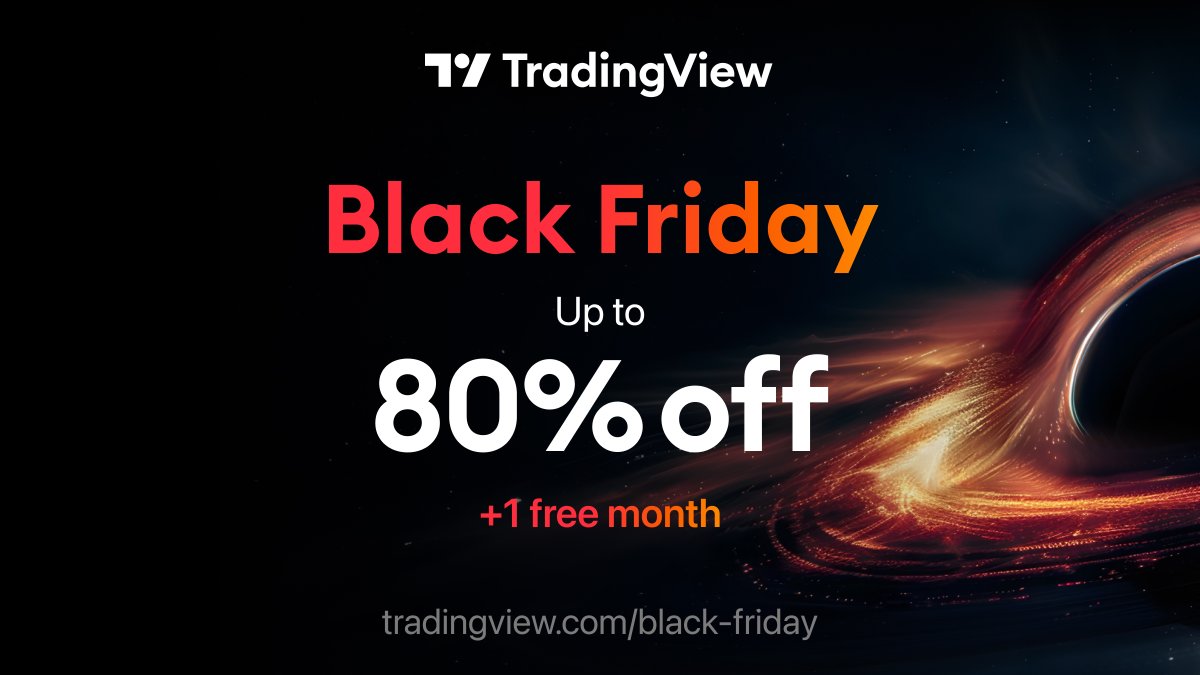
I am excited to announce @tradingview's annual Black Friday Sale, up to 80% off. This year it is bigger and better than ever before (last year was up to 70% off).
As part of this announcement, I've partnered up with TradingView to give away NOT one but two annual plans - one premium and one ULTIMATE.
To enter:
1. Like AND retweet this post
2. Follow me and @tradingview
3. Tag 3 friends that may be interested in this giveaway
Good luck and Happy early Thanksgiving!