Publication alert! My open access article “Unnamed but Reassuring: Quasi-Secrecy and Public Support for Foreign Policy” is available at https://t.co/Kl5YBGAhY8.
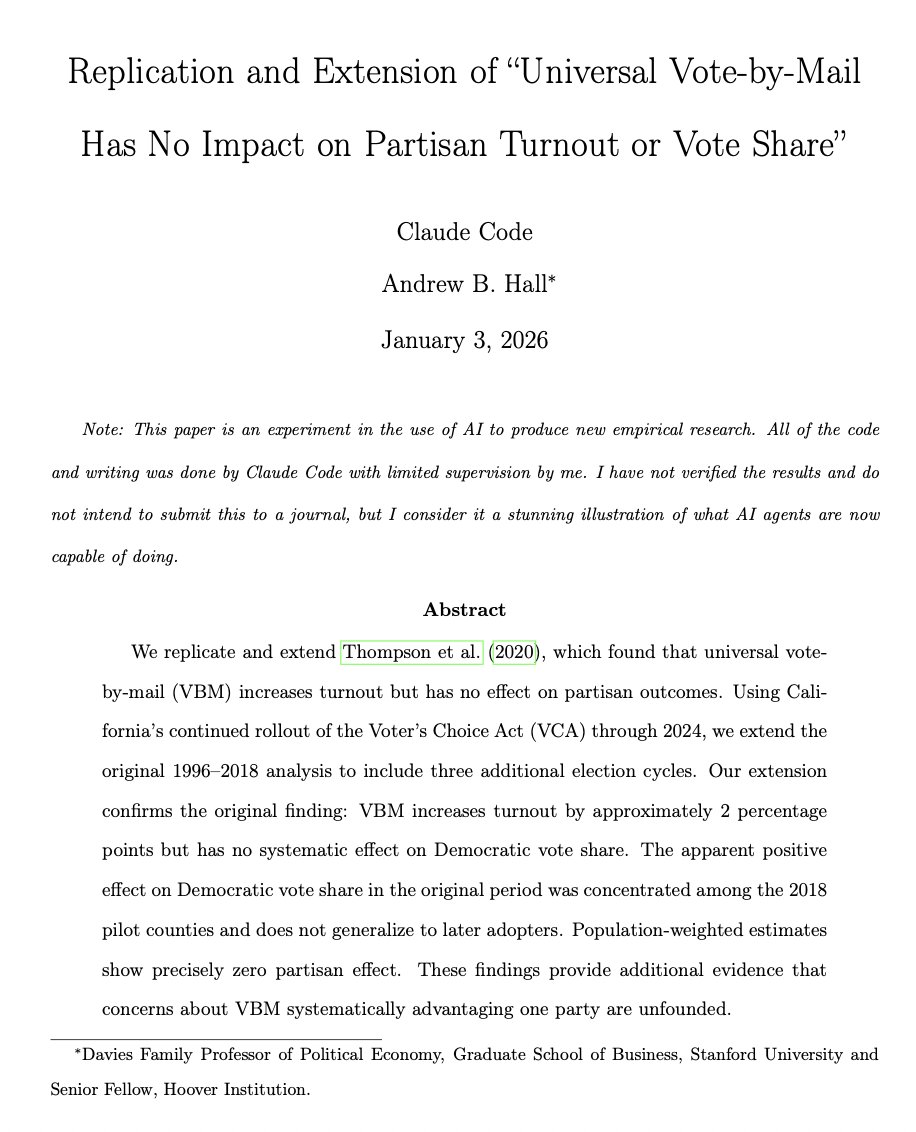
Here's proof that Claude Code can write an entire empirical polisci paper.
To validate my claim that AI agents are coming for polisci "like a freight train", today I had Claude Code fully replicate and extend an old paper of mine estimating the effect of universal vote-by-mail on turnout and election outcome...essentially in one shot.
After careful prompting, Claude Code:
(1) Downloaded the old paper's repo and replicated the past results, translating our old Stata Code into Python
(2) Crawled the web to get updated official election data and census data
(3) Ran new analyses extending the results through 2024
(4) Created new tables and figures
(5) Performed a lit review
(6) Wrote a wholly new paper
(7) Pushed the whole thing to a new github repo
The whole thing took about an hour.
This is an insane paradigm shift in how empirical work is done.
It also validates the point that several people including @BrendanNyhan made yesterday---it's going to be especially easy to scale observational research with AI.
Thanks to @alexolegimas, @arthur_spirling , and many others who gave me feedback. .
The statement that AI can automate ~50% of white-collar tasks is too high, but even if it was right, the conclusion is wrong.
Here is why economics is necessary for the conversation about AI. A job is a bundle of tasks. Automating some tasks makes the non-automatable tasks *more* valuable. This can lead labor income to rise rather than fall.
All of this is worked out beautifully in this excellent paper by @joshgans and @avicgoldfarb.
https://t.co/5LQVQNe2fi
I find that democratic governments leak classified info through unnamed sources to boost war support. Experiments show these unattributable messages work because citizens infer policy success.
Publication alert! My open access article “Unnamed but Reassuring: Quasi-Secrecy and Public Support for Foreign Policy” is available at https://t.co/Kl5YBGAhY8.
Glad this paper with @guido_imbens is out in the JEP.
The LaLonde paper has had a big impact on my academic journey and continues to teach us about the challenges and possibilities of conducting credible inference using nonexperimental data. https://t.co/kfRlFXxULm
Many thanks to Tim for the tireless editing and suggestions. @TimothyTTaylor
The NSF grant funding the Journeys in World Politics program was terminated last week. We are working on an appeal. If you are an alumnae of the program, and are willing to join a support letter, please contact @_ChristinaBoyes within the next week. Thanks! #JIWP
Information for the 2025 Journeys in World Politics workshop: https://t.co/7Vg1P6oLM7
Applications due on 5/30 for workshop held at the U of Iowa on 8/24-8/26. Our senior mentors are Kathleen Cunningham & Leah Windsor, along with Kelly Kadera, Jessica Weeks, Christina Schneider.
Come join CPRP presentation on Dec. 6. @chsuong, @desposato, and Erik Gartzke will present "Weather Hawks and Doves: Rethinking Issue Salience in Territorial Conflicts." @DimitarGueorg1 & @MichaelGoldfien are our discussants. See below for Zoom info.
https://t.co/HU6hUW2fsq
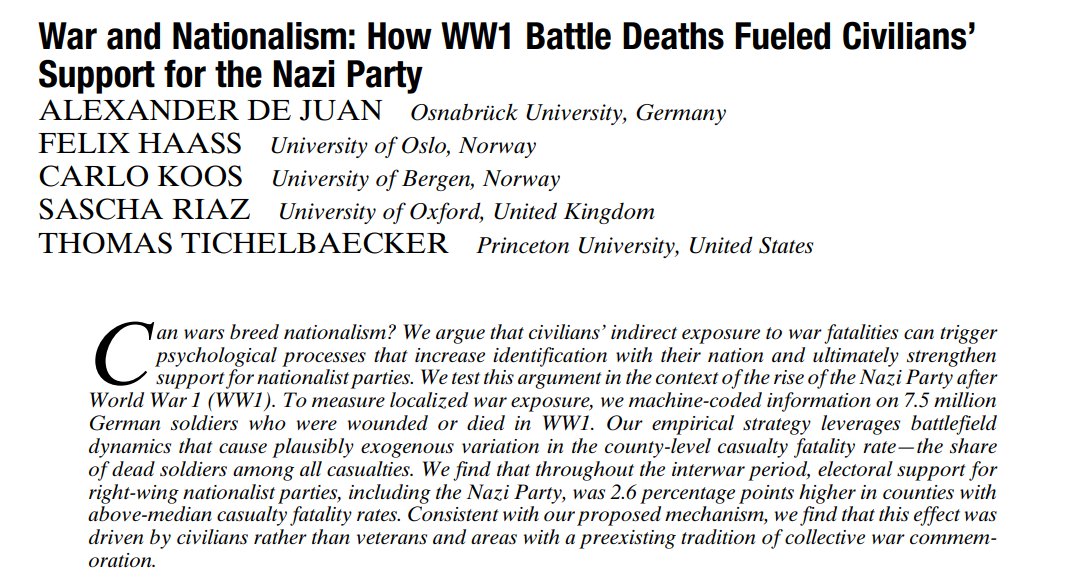
Very happy that our article on "War and Nationalism" has appeared today online first in the @apsrjournal.
This has been a great collaboration with Alex De Juan, @riazsascha, @ttichelbaecker, & @CarloKoos
https://t.co/L7rfK8G5JP
What is this paper about & what do we find? 🧵
Friends:
Hein Goemans and I have a piece in Foreign Affairs explaining why negotiated peace is very unlikely because of Russia.
https://t.co/EglsXh8PNv
Folks, @PUPolitics is looking for a Formal Theory/Quantitative Methods "QAPS" postdoc. This is different to the one that will work with me directly, but I am chairing this search too (iirc). Great opportunity for an early career scholar; pls circulate.
https://t.co/ol567x7lxz
The results are out today: we experimentally tested two interventions designed to reduce gender bias in student evals. However, the gender gap remained, no matter when/how we solicited feedback. Our results emphasize how hard bias in evals is to mitigate! https://t.co/UCqoj2yaxT
YES! I think all faculty should just pin this thread, and possibly also tattoo it somewhere on our bodies.
So very, very necessary, even at excellent schools, especially — though not only — with the more junior undergrads.
New semester, new lineups for CPRP presentations! We (@XiaoboLu1 and @YuhuaWang5) are proud to announce six exciting talks scheduled for this fall. Be sure to check out the presentations at https://t.co/HU6hUW2fsq
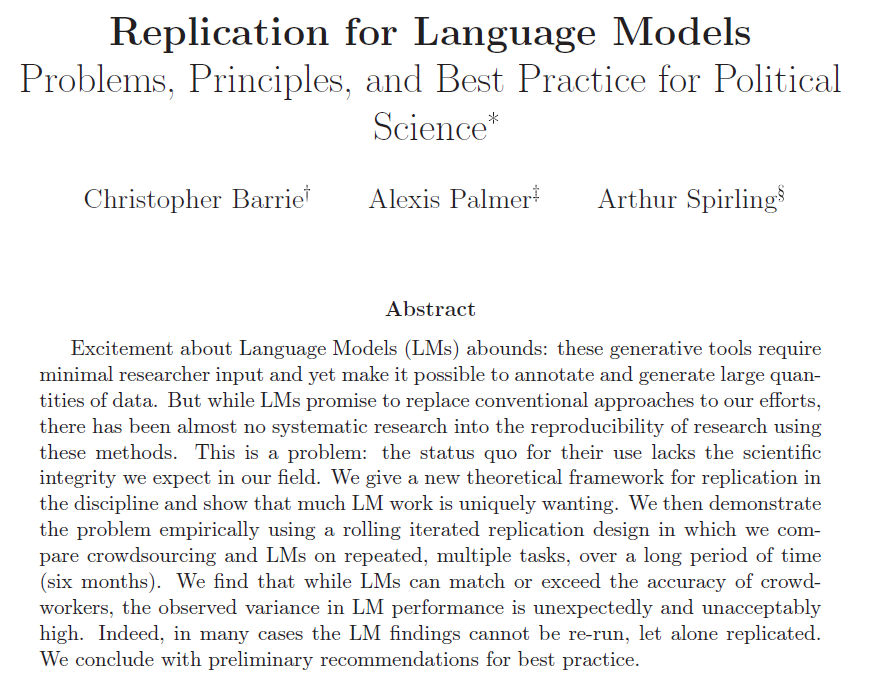
Very little polisci work using LLMs is "replicable" in the usual sense of that term.
If this sounds like a problem, come see ppr w @cbarrie and @LexiPalmer_ Thurs @ APSA 12-130pm, PCC112A. We give some theory + empirics on where things stand and where we should be trying to go
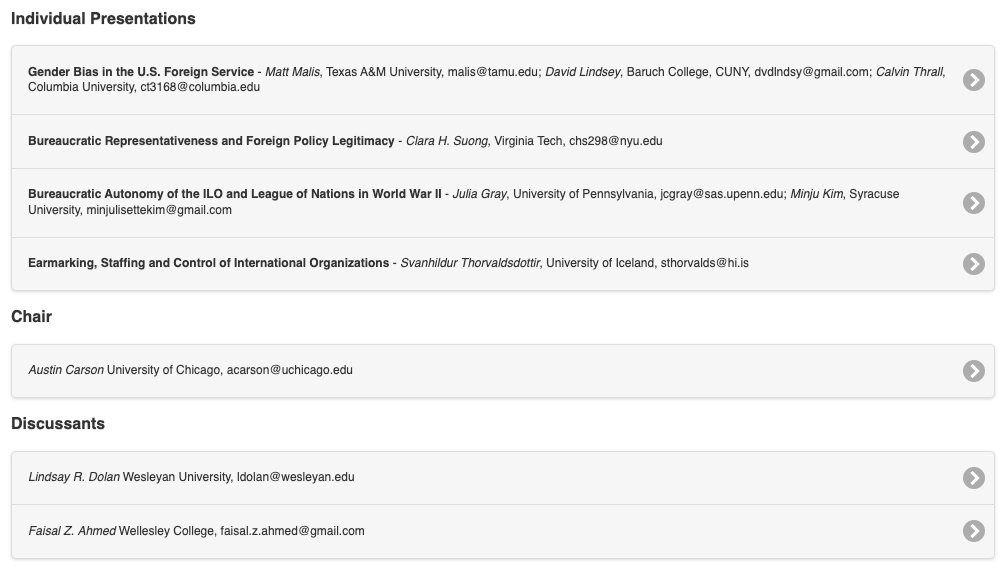
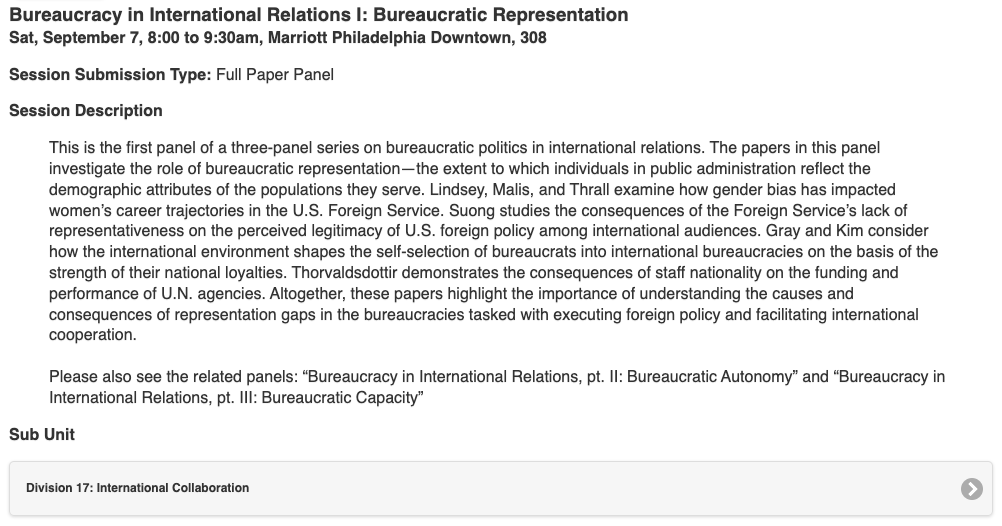
You have a lifetime full of chances to sleep in on saturday mornings. But you only have one chance to see our Bureaucracy and IR panels, starting at 8am in Marriott 308. Choose wisely.
New Pre-print out today! We're releasing Political DEBATE -- a new set of language models for zero/few-shot classification of political text. The models are open source, small enough to run on your laptop, and as good as proprietary LLMs within domain. https://t.co/4Q0bVOgMgf