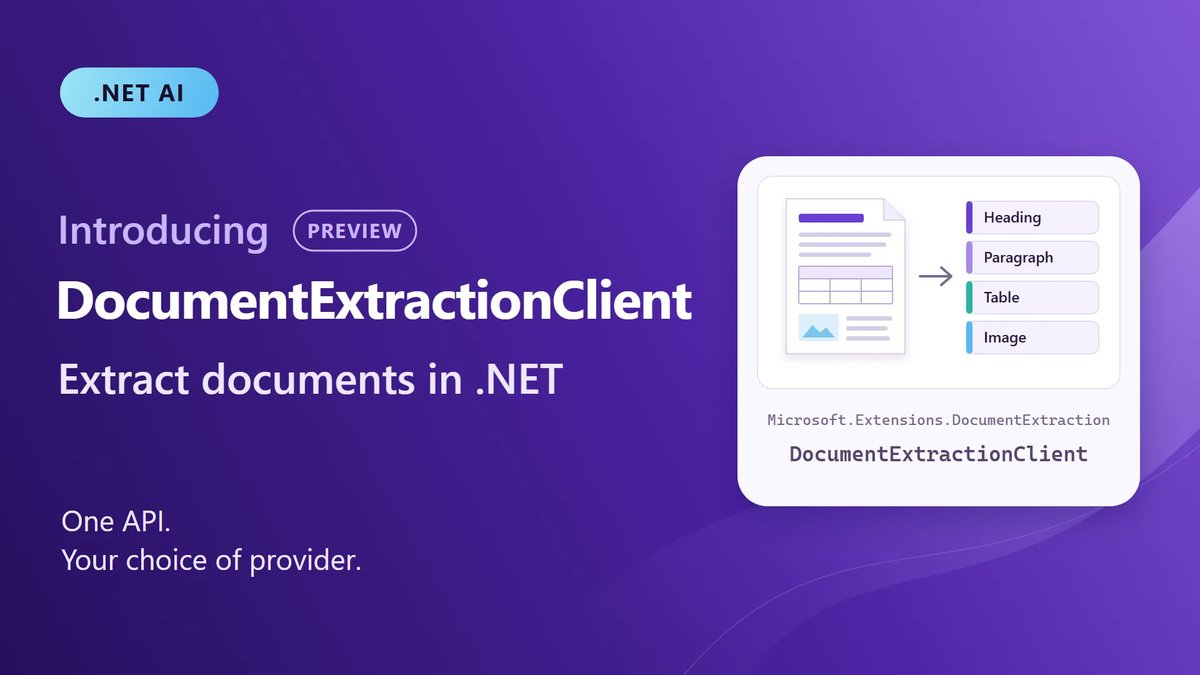
Explore DocumentExtractionClient (preview) in .NET for unified document parsing across PDFs, scans, images, and Office files. Extract structured content with interchangeable providers and integrate with data ingestion for AI-powered apps.
👉🏽 Learn more: https://t.co/7jVgNwP9da
British comedian Chris Ramsey was once asked by The Guardian about the comedy sketch that made him laugh the most.
He specifically cited a sketch by Fry and Laurie, describing a scene where Hugh Laurie goes to report something to a police officer played by Stephen Fry, only for his name to be represented by the sound of an object dropping onto a desk.
Chris Ramsey remarked that it is a style of humor so simple it leaves viewers wondering how the two comedians even came up with such an idea.
@NoemiTitarenco Code reuse still holds value in agentic engineering. Code duplication means bugs have to be found in every duplicate. Miss one and the bug remains.
@MrPeterLMorris The top line used Opus 5.5 and Claude. A truer test comparison would have been GLM 5.3 Flash and Claude. Otherwise, the comparison to Opus 5.5 is just noise.
"Agent memory" isn't one thing. It's seven:
Working: what's in context right now
Semantic: lasting facts
Episodic: past events and how they went
Procedural: learned steps and workflows
Retrieval: looked up on demand (RAG)
Parametric: baked into the model weights
Prospective: reminders and triggers for later
Most real agents combine several of these. Save this for your next agent build.
Which one is hardest to get right in your systems?
Inspired by Neo Kim's original post.
#AIAgents #AgenticAI #LLM #RAG #AIEngineering
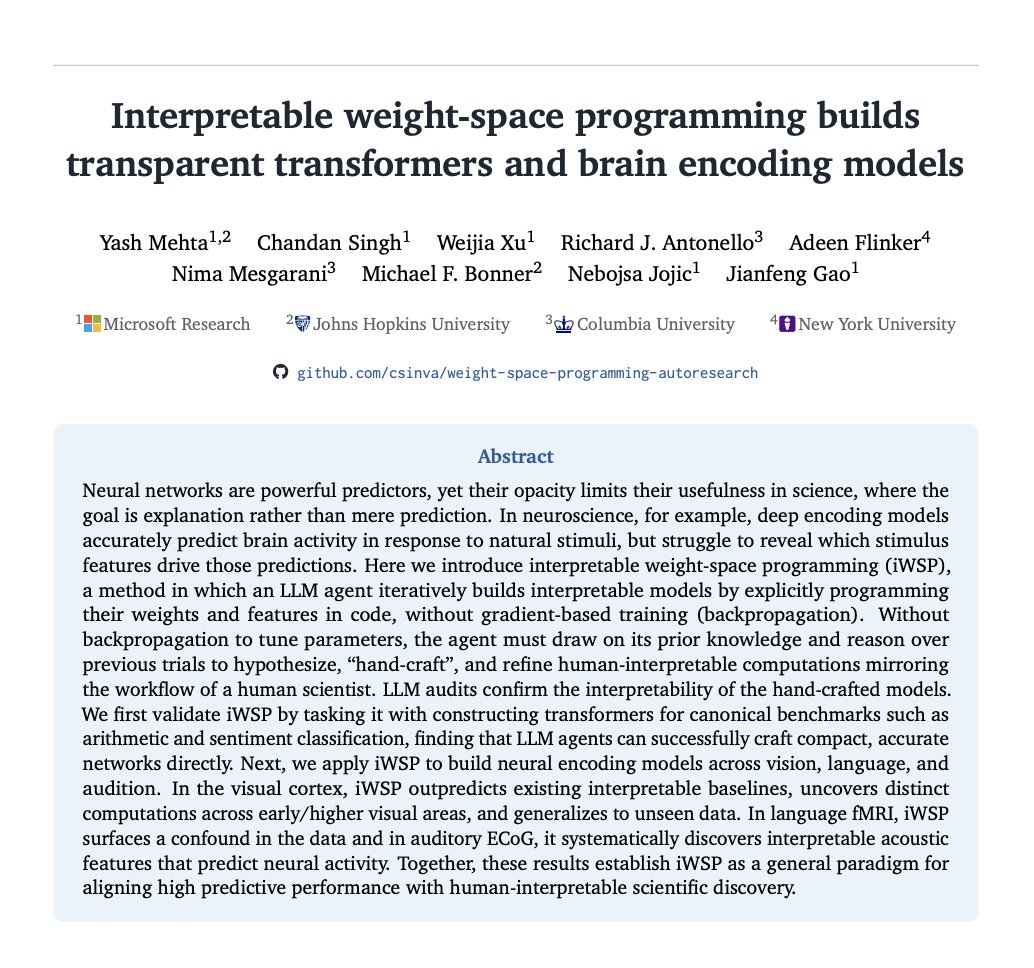
Microsoft just killed backpropagation.
They built an AI that writes a neural network’s weights by hand, in code, then rewrites them like a scientist testing hypotheses.
It’s called iWSP.
For decades, the biggest problem in AI has been simple: we don't actually know how it works inside.
We throw billions of data points at a blank model, pray to the gradient descent gods, and hope it learns the right patterns.
If it hallucinates, you can't just open the code and fix the bug. You have to retrain it, fine-tune it, or beg it with better prompts.
It is an opaque, unreadable mess of billions of floating-point numbers.
Until now.
A new paper on Interpretable Weight-Space Programming just flipped the entire paradigm upside down.
Instead of blindly training a network from scratch, researchers proved you can directly write, edit, and compile human-readable logic straight into the model's weights.
You don't have to hope the AI learns the rules anymore. You can hardcode the rules directly into its brain.
Here is why this changes everything:
• Zero-training edits: Fix specific bugs, biases, or failure modes instantly without touching a GPU cluster.
• Guaranteed determinism: Force a neural network to follow strict mathematical or logical constraints 100% of the time.
• True transparency: Read a model's weights like source code instead of guessing why it made a decision.
We are witnessing the bridge between traditional software engineering and deep learning.
For the last ten years, building AI felt more like alchemy than engineering. We were mixing potions in the dark and hoping for gold.
Now, we finally have the compiler.