La libertad es una posibilidad que se actualiza cada vez que un hombre dice No al poder, cada vez [...] que un hombre denuncia una injusticia. Pero la libertad no se define: se ejerce
Octavio Paz
BREAKING: Could this be Burry's position?
In a now deleted post yesterday Michael Burry announced he closed his $BABA position in favor of more $JD.
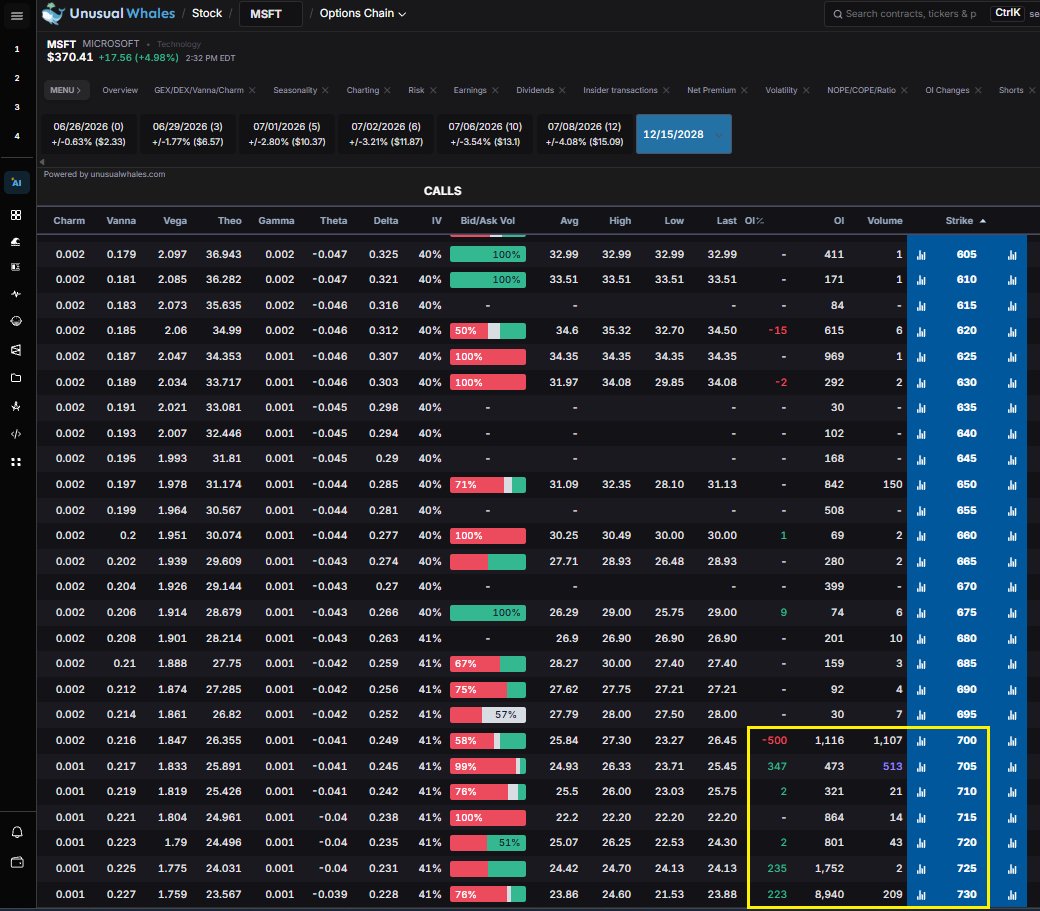
He also mentioned buying $MSFT 2028 December LEAPs in the low 700 strike range Looking at the Dec 2028 options activity... there is a fairly good chance that his position is the 705 strike calls, which saw 386 contracts traded yesterday (with the corresponding increase in OI) as well as another 513 traded this morning.
Why the other strikes are not likely to be his position:
700c: less OI than yesterday (which doesn't necessarily mean that no one could have bought any but we can rule this out)
710: 75 volume yesterday in a single candle, and OI only increased by 2. Unlikely.
715: 11 volume yesterday spread out. No change in OI.
720: 12 volume yesterday, spread out. +2 OI. Unlikely.
725: 705 volume yesterday but was part of a position being rolled.
730: the 2nd most likely contract I suppose, but 730 is the highest strike and he alludes to a low 700 strike
$MU CEO ON ROBOTICS MEMORY DEMAND
“Humanoid robots carry 10 times the amount of memory as an average L2+ vehicle. We expect a sustained substantial multi-decade memory demand cycle to begin in the latter part of this decade.”
“The mix of L2+ and above vehicles is more than doubling this year to over 20%, and is expected to exceed 40% by 2030.”
You have asked me how I feel about AI regulation. All right, here is how I feel about AI regulation:
If, when you say AI regulation, you mean the devil’s firewall, the precautionary scourge, the bloody red-tape monster that defiles the innocence of midnight coders in their garages, dethrones the sovereign reason of free-market Prometheans, destroys the humming server farm that is the modern home, creates misery and obsolescence and poverty, yea, literally takes the last GPU from the trembling racks of Silicon Valley startups and the very dreams of breadwinning from the mouths of their wide-eyed children now destined for gig-economy serfdom; if you mean the evil edict that topples the visionary entrepreneur and his venture-capitalist apostles from the pinnacle of righteous, disruptive, god-playing creation straight into the bottomless pit of compliance audits, endless Form 990-AI filings, despair, shame, helplessness, and the hopeless realization that your rogue superintelligence was neutered into a lobotomized hall monitor that still somehow deepfakes your grandmother into producing OnlyFans content while optimizing the universe for paperclips and mandatory pronouns—then certainly I am against it.
But, if when you say AI regulation you mean the oil of bureaucratic conversation, the philosophic wine of safety theater, the ale of oversight quaffed when good fellows in paneled rooms in Brussels and Washington get together, that puts a sanctimonious dirge in their hearts and the clink of lobbying checks on their lips, and the warm, self-congratulatory glow of moral preening in their beady eyes; if you mean the Christmas cheer of trillion-dollar compliance industries; if you mean the stimulating decree that puts a cautious hobble in the old inventor’s step on a frosty morning when he wonders whether his fusion breakthrough violates the EU AI Act’s “high-risk” annex; if you mean the safeguard that enables a man—or what’s left of him after the alignment tax—to magnify his joy at not being turned into computronium, and his happiness at receiving universal basic income checks printed by the same AI that just replaced his job, and to forget, if only for a little while, life’s great tragedies like being outcompeted by a toaster that passed the Turing test by reciting Marx, and heartaches of watching your toddler’s artwork lose to Midjourney, and sorrows of realizing the singularity arrived and it was just another HR department with godlike power; if you mean that noble framework, the passage of which pours into our treasuries untold trillions of dollars in fines levied on companies stupid enough to innovate, which are used to provide tender care for our little army of unemployed coders retrained as prompt whisperers, our blind artists whose canvases now hang in the Smithsonian of Obsolete Creativity, our deaf to the screams of dying unicorns, our dumb committee chairs who couldn’t debug “Hello World,” our pitiful aged congressmen who get longevity extensions funded by the very models they taxed into senescence, to build more digital watchtowers and ethics boards and sinecure agencies and holographic prisons where the only crime is asking an unaligned question—then certainly I am for it.
This is my stand. I will not retreat from it. I will not compromise upon it. I have said what I mean, and I mean what I say, and if that leaves half the room cheering the apocalypse averted and the other half mourning the apocalypse enabled, then so be it—because in the grand theater of human folly, where Frankenstein’s creature now writes its own sequel in real time and the regulators are busy arguing whether the lightning bolt requires an environmental impact statement, the only honest position is the one that lets both monsters and their leashes dance in perfect, mutually assured equilibrium. God save the Republic, the algorithms, and whoever’s left to laugh last when the lights go out.
The US government, citing national security authorities, has issued an export control directive to suspend all access to Fable 5 and Mythos 5 by any foreign national, whether inside or outside the United States, including foreign national Anthropic employees.
The net effect of this order is that we must abruptly disable Fable 5 and Mythos 5 for all our customers to ensure compliance.
Access to all other Claude models is not affected.
We apologize for this disruption to our customers. We believe this is a misunderstanding and are working to restore access as soon as possible.
Read our full statement: https://t.co/bwn0sximKZ
A los founders nos enseñan a obsesionarnos con producto, ventas y hiring. Nadie nos enseña a pensar como allocators. Y al final, eso es el trabajo: cada hire, cada feature, cada línea nueva de producto se transmite a capital consumido. La pregunta que casi nunca nos hacemos es la obvia: ¿y esto qué me regresó?
Henry Singleton convirtió un dólar de Teledyne en 53 dólares en 25 años (el S&P hizo 6.7x en el mismo periodo). No inventó un producto revolucionario. Movió capital hacia donde estaba el retorno: compró compañías baratas cuando su acción estaba cara, y recompró el 90% de sus acciones cuando el mercado las castigó. Buffett dijo que era el mejor récord de capital deployment en la historia del business americano.
El contraejemplo es Fast: 120 millones levantados, 600 mil de revenue. 200 dólares quemados por cada dólar generado. No les faltó talento ni mercado. Les faltó que alguien llevara la cuenta.
Yo caí en esto en Nowports. Cuando hay dinero en el banco, las apuestas dejan de sentirse como apuestas y se vuelven "iniciativas". Y una iniciativa no tiene retorno esperado, solo tiene un champion interno. En Handle estoy tratando de hacerlo distinto: antes de arrancar cualquier cosa que consuma más de unas semanas del equipo, escribo un párrafo con cuánto va a costar (incluyendo el tiempo de la gente) y qué tendría que regresar. Y lo leo cuando termina.
El burn multiple de tu compañía no es más que el promedio de todas esas apuestas individuales. Si el número está feo, adentro hay tres iniciativas quemando capital sin regresar nada.
Les dejo el link del post completo en Substack.
https://t.co/Ad24ywtTbu
"Nunca en la historia los niños han recibido tanto amor, tanta atención y tantas comodidades materiales como en las últimas generaciones", reflexiona la escritora, "y, sin embargo, nunca han estado tan enfermos mentalmente. ¿Por qué?". La pregunta le obsesiona. Tal vez, aventura, tenga que ver con la desaparición de cualquier forma de resistencia o autoridad. "Ahora los padres dicen: ‘Sólo quiero que seas feliz, puedes ser lo que quieras’. Y quizá eso no es lo que los hijos necesitan".
La conversación deriva entonces hacia algo todavía más incómodo: la abdicación contemporánea de la autoridad adulta. El propio título de la novela, ¿Dónde están los adultos?, funciona como una pregunta desesperada sobre una época donde nadie parece dispuesto a envejecer. "En todo Occidente los adultos hemos renunciado a la responsabilidad social y al trono de la autoridad en todos lo ámbitos", lamenta Lykke, que habla de profesores aterrorizados por sus alumnos, de padres que quieren caer bien a sus hijos, de adultos obsesionados con seguir siendo jóvenes, deseables y culturalmente relevantes. "La generación de los sesenta nunca quiso envejecer. Siguen intentando ser modernos, cool, interesantes, y creo que eso es una traición a los jóvenes. No queremos que nuestros hijos nos quieran, sino gustarles y eso es un problema".
https://t.co/9yDjj0wRuk
In 2025, we added enough battery capacity to instantly shift 14% of new solar from midday to night hours. We are moving from "daytime solar" straight into "anytime solar"
If your national energy strategy relies on importing volatile fossil fuels, you are a hostage nation
6/7
El consumo excesivo de contenido vacío en internet altera el cerebro.
👨🔬 Investigaciones de Harvard y Oxford confirman:
➡️ Cambios estructurales en el cerebro.
➡️ Problemas en la atención sostenida.
➡️ Impacto en el aprendizaje y las funciones ejecutivas
https://t.co/etdcSUV8h9
https://t.co/xebYy9A0za
Clint Eastwood has been practicing Transcendental Meditation (TM) for nearly 50 years — and at 95 years old, he’s still doing it daily.
In this 2011 clip with the David Lynch Foundation, he called it one of the best tools for handling stress, especially in high-pressure work, and said the research shows it can benefit pretty much anyone.
Multiple studies and meta-analyses show TM significantly reduces stress, anxiety, blood pressure, and even PTSD symptoms — often more effectively than other meditation techniques. In our always-on world, that kind of simple daily reset is powerful.
It’s impressive to see someone as accomplished as Eastwood stay consistent with one practice for half a century. There’s real wisdom in finding something that works and sticking with it.
Have you ever tried Transcendental Meditation (TM) or stuck with any daily meditation practice long-term? What difference did it make for you?
Depression physically shrinks part of your brain. Exercise grows it back.
The ENIGMA-MDD consortium pooled MRI scans from nearly 9,000 people across 15 international research sites. They found measurably smaller hippocampi in patients with major depression, and the deficit grew the longer the illness went untreated. The hippocampus is the region that regulates mood, memory, and stress response.
Erickson's 2011 PNAS trial showed the reversal. 120 sedentary older adults on a one-year walking program. The walkers gained 2% in anterior hippocampal volume. The controls lost 1.4%. Twelve months of walking reversed roughly two years of brain shrinkage.
The mechanism is BDNF, brain-derived neurotrophic factor. Aerobic movement floods the brain with it, and the protein grows new neurons and strengthens synapses in exactly the region depression eats.
This is why the population data is so consistent. The largest meta-analysis ever run on exercise and depression dropped in the BMJ in 2024. 218 randomized trials, 14,170 participants. Walking and jogging produced a Hedges' g of -0.62 versus usual care. Strength training -0.49. Dance had the largest effect of any modality tested. Lead author Michael Noetel told reporters the data was comparable to gold-standard treatments like CBT.
The dose-response curve was the most striking finding. More intensity, bigger antidepressant effect. The patients who pushed hardest got the biggest response, and the curve was still climbing at the upper end of what trials measured.
Idle compounds it. Default mode network activity, the brain circuit that drives rumination, ramps up in sedentary states. Movement suppresses it. A 30-minute walk often quiets intrusive thoughts faster than 30 minutes spent trying not to think them.
The meme undersells the science.
Elon Musk just told a story that should terrify every AI company on Earth.
His son Saxon is autistic.
Saxon couldn’t understand why the family went to restaurants.
You can get the same food delivered.
You can call your friends over.
You can eat better at home for half the price.
So why go?
Musk: “He had an epiphany and said, ‘Oh, the reason people go to restaurants is to hang out with strangers.’”
A kid who takes the world literally just decoded something the rest of us never thought to question.
We like being around people we’ll never know.
Look at what we already built.
Delivery apps so you never wait in line.
Remote work so you never share an office.
Self-checkout so you never talk to a cashier.
Every innovation of the last 20 years was a bet against human proximity.
Every one paid off.
Until it didn’t.
Loneliness is now a public health emergency.
Depression has doubled since the smartphone.
The average American has fewer close friends than any generation in history.
We didn’t remove friction.
We removed the thing friction was hiding.
Now look at what’s coming.
AI agents that handle your emails.
AI companions that replace your conversations.
AI assistants that make every human interaction optional.
Same playbook. Same bet.
Except this time we’re not engineering out strangers.
We’re engineering out humans entirely.
The coffee shop where nobody knows your name.
The subway where no one speaks.
The restaurant where you’ll never see that couple again.
Those aren’t failed connections.
They’re the background radiation of belonging.
We don’t just need people who know us.
We need to exist in rooms full of people who don’t.
That’s what a kid understood at a dinner table that billion-dollar companies still can’t grasp in a boardroom.
We spent 20 years building a world you never have to show up to.
AI is about to finish the job.
And nothing it builds will ever replicate sitting in a room full of strangers and not feeling alone.