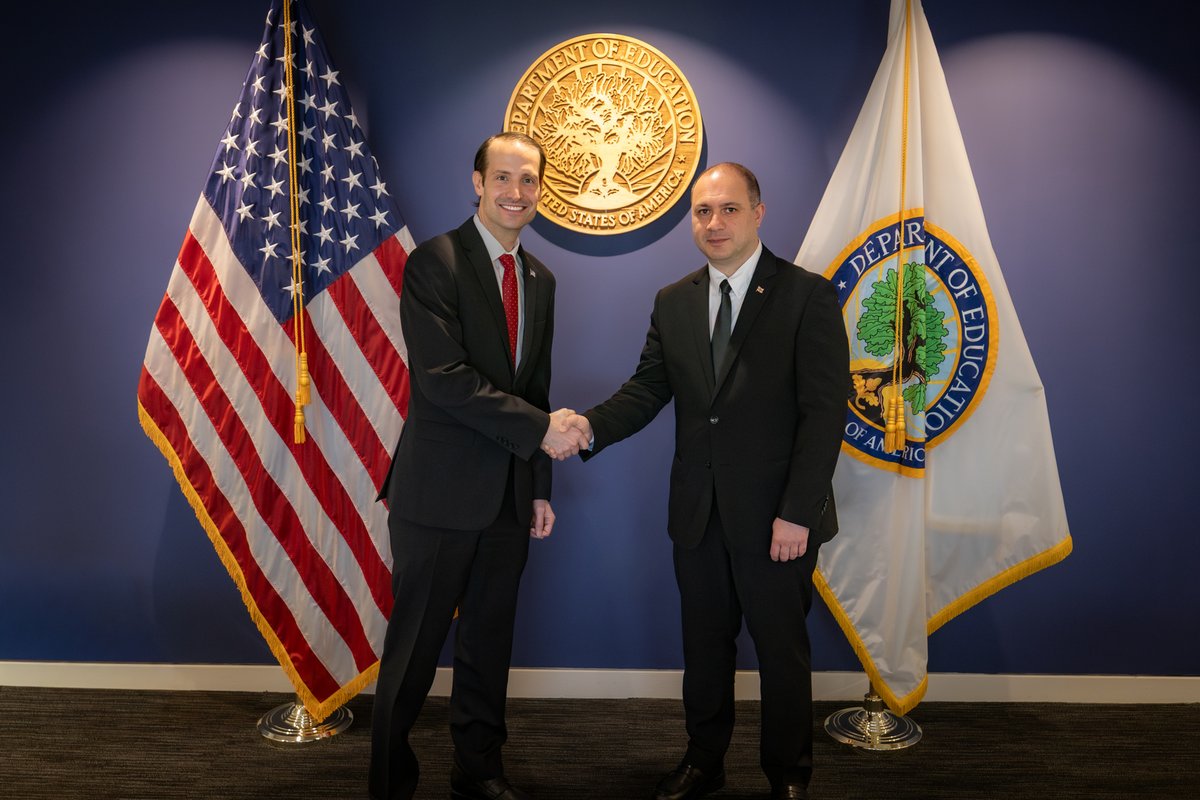
It was a great pleasure to host @DarrenJBeattie
— a sharp and influential voice whose ideas continue to enrich transatlantic policy discourse — at the 🇬🇪Embassy.
Thank you for the excellent discussion on strengthening U.S.-Georgia relations and deepening the historic cultural and people-to-people bonds between our two nations.
Nvidia CEO'su Jensen Huang'a, 'hayatında tanıdığınız en zeki kişi kim' sorusuna cevabı:
- Tanıdığım en zeki insan üniversite giriş sınavından berbat bir puan bile almış olabilir.
- Herkes yazılım programlamanın nihai akıllı meslek olduğunu düşünüyordu.
- Yapay zekanın çözdüğü ilk şey ne oldu? Yazılım programlama.
- Zeki tanımı çoğu insanın düşündüğünden çok farklı.
- Gerçek zeka: Teknik yetenek + İnsan empatisi + Söylenmeyeni anlama becerisi
- Köşelerin ötesini görebilen insanlar gerçekten, gerçekten akıllıdır.
- Sorunları ortaya çıkmadan önce önleyebilmek - sadece havayı hissettiğin için.
- O hava: Veri + Analiz + İlk prensipler + Yaşam deneyimi + Bilgelik + Diğer insanları hissetmek
- İşte bu zekadır.
- Geleceğin zeki tanımı bu olacak.
Ve o kişi SAT'den berbat bir puan alabilir.
BREAKING: President Xi stuns the room saying to Trump: “We should be partners, not rivals" 🇺🇸 🇨🇳
I NEVER in a million years would have thought Xi would say something like that
The Deep State is shaking right now
“To be successful, you don't have to be special. You just have to be what most people aren't - consistent, determined and willing to work for it. No shortcuts."
— Tom Brady
Elon Musk advice to ambitious people:
Try to read a lot of books (read broadly), ingest as much information as you can and develop a good general knowledge.
To prepare for the future, we must look beyond narrow technical skills and focus on social, emotional and physical skills that will allow us to be ready for whatever comes our way.
Grateful for the opportunity to meet with Minister Givi Mikanadze and Ambassador @TTaliashvili of Georgia to discuss respective efforts to reform our higher education systems.
Every time you accepted a salary, chose a price, or walked into a negotiation, the other person was running GAME THEORY in their head.
You were guessing.
This 1-hour Yale lecture by Professor Ben Polak will permanently change how you read people and make decisions.
Most MBAs pay $150k to learn this. Yale posted it for free:
“No matter how isolated you are and how lonely you feel, if you do your work truly and conscientiously, unknown friends will come and seek you.” — Carl Jung
Elon Musk framed education the way an engineer would.
Musk: “What is education? You’re basically downloading data and algorithms into your brain. And it’s actually amazingly bad in conventional education.”
If education is a download, America is running on dial-up in a fiber optic war.
This isn’t an education problem. It’s a national security failure.
The AI race will not be won by the country with the most compute. Compute can be bought.
It will be won by the country that produces the most people capable of building, directing, and operating alongside the technology.
That is an education output. And America’s output is broken.
The system is optimized for an economy that peaked in 1985.
Students spend twelve years memorizing content they will never apply, inside a structure that hasn’t been redesigned since the industrial era.
Musk: “I think a lot of things people learn, there’s probably no point in learning them, because they never use them in the future.”
Meanwhile, the pipeline that actually matters is either underfunded, understaffed, or missing entirely from most public schools.
AI literacy. Applied math. Engineering. Critical reasoning. The skills that will separate functioning economies from collapsing ones.
The country is spending trillions on education and producing graduates who are trained for jobs the algorithm will do better within five years of their graduation.
That is not an investment. That is a subsidy for obsolescence.
China is restructuring its entire technical education system around AI. Not as an elective. As the foundation.
America is still debating standardized testing.
Musk: “You’ve got someone standing up there kind of lecturing at people, and they��ve done the same lecture 20 years in a row, and they’re not very excited about it. And that lack of enthusiasm is conveyed to the students.”
The format is dead. But the deeper failure is what’s inside the format.
The question isn’t how we teach. It’s whether anything being taught maps to the economy that actually exists right now.
An America First AI strategy doesn’t start with chips or tariffs or data centers.
It starts with the pipeline that feeds them.
Every semiconductor fab. Every AI lab. Every defense application of machine learning. Each one requires a human being who was trained to operate at that level.
If the education system isn’t producing those people, the factories don’t matter. The labs don’t matter. The infrastructure is a monument to nothing.
Post-scarcity economics. Energy independence. The technological edge that underwrites American power globally.
None of it holds without a generation that was actually prepared for the world they’re walking into.
Right now, we are preparing them for a world that no longer exists.
The real America First policy isn’t protectionism.
It’s building the smartest population on Earth. Deliberately. Urgently. Starting now.
The country that upgrades its education pipeline first doesn’t just win the AI race.
It wins everything that comes after.
Elon Musk on why the smartest people drop out of college:
"You don't need college to learn. Learn stuff. Everything is available basically for free. You can learn anything you want for free. It is not a question of learning."
Musk explains what college actually provides:
"There is a value that colleges have, which is seeing whether somebody can work hard at something, including a bunch of annoying homework assignments, and still do their homework, and kind of soldier through and get it done. That's the main value of college. And also, you probably want to hang around with a bunch of people your own age for a while instead of going right into the workforce. So I think colleges are basically for fun and to prove you can do your chores. But they're not for learning."
On hiring at his companies:
"There is a requirement of evidence of exceptional ability. I don't consider going to college evidence of exceptional ability. In fact, ideally you dropped out and did something. Obviously, Gates is a pretty smart guy, he dropped out. Jobs was pretty smart, he dropped out. Larry Ellison, smart guy, he dropped out. Obviously not needed."
Musk shares how education should work:
"Generally, you want education to be as close to a video game as possible. Like a good video game. You do not need to tell your kid to play video games; they will play video games on autopilot all day. If you can make it interactive and engaging, you can make education far more compelling and far easier to do."
He challenges the current system:
"You really want to disconnect the whole 'grade level' thing from the subjects. Allow people to progress at the fastest pace that they can, or are interested in, in each subject. It seems like a really obvious thing."
Musk criticizes traditional teaching:
"Most teaching today is a lot like vaudeville. Somebody's standing up there lecturing to you. They've done the same lecture several years in a row. They're not necessarily all that engaged. That lack of enthusiasm is conveyed to the students; they're not very excited about it. They don't know why they're there. 'Why are we learning this stuff?' We don't even know why. A lot of things people learn, probably there's no point in learning them, because they never use them in the future."
On whether university is necessary:
"A university education is often unnecessary. That's not to say it's unnecessary for all people. But I think you learn about as much, the vast majority of what you're going to learn there, in the first two years. And most of it is from your classmates. If the goal is to start a company, I would say no point in finishing college."
Musk started his own school for his kids:
"I created a little school. It's small, only 14 kids now, and it'll have 20 in September. It's called Ad Astra, which means 'to the stars.'"
He explains what makes it different:
"There aren't any grades. There's no grade one, grade two, grade three. Not making all the children go in the same grade at the same time, like an assembly line. People are not objects on an assembly line. That's a ridiculous notion. Some people love English or languages. Some people love math. Some people love music. Different abilities at different times. It makes more sense to cater the education to match their aptitudes and abilities."
Musk shares a key principle:
"It's important to teach problem-solving, or teach to the problem, not to the tools. Let's say you're trying to teach people about how engines work. A more traditional approach would be: 'We're going to teach you all about screwdrivers and wrenches. You're going to have a course on screwdrivers, a course on wrenches.' This is a very difficult way to do it."
He offers a better approach:
"A much better way would be: 'Here's the engine. Now let's take it apart. How are we going to take it apart? Oh, you need a screwdriver, that's what the screwdriver is for. You need a wrench, that's what the wrench is for.' And then a very important thing happens: the relevance of the tools becomes clear."
The result:
"It seems to be going pretty well. The kids really love going to school. I think that's a good sign. I hated going to school when I was a kid; it was torture. The fact that they actually think vacations are too long, they want to go back to school. Weird, I know."
Musk reframes what education really is:
"If you think about it, what is education? You're basically downloading data and algorithms into your brain. And it's actually amazingly bad in conventional education. It shouldn't be this huge chore. The more you can gamify the process of learning, the better."