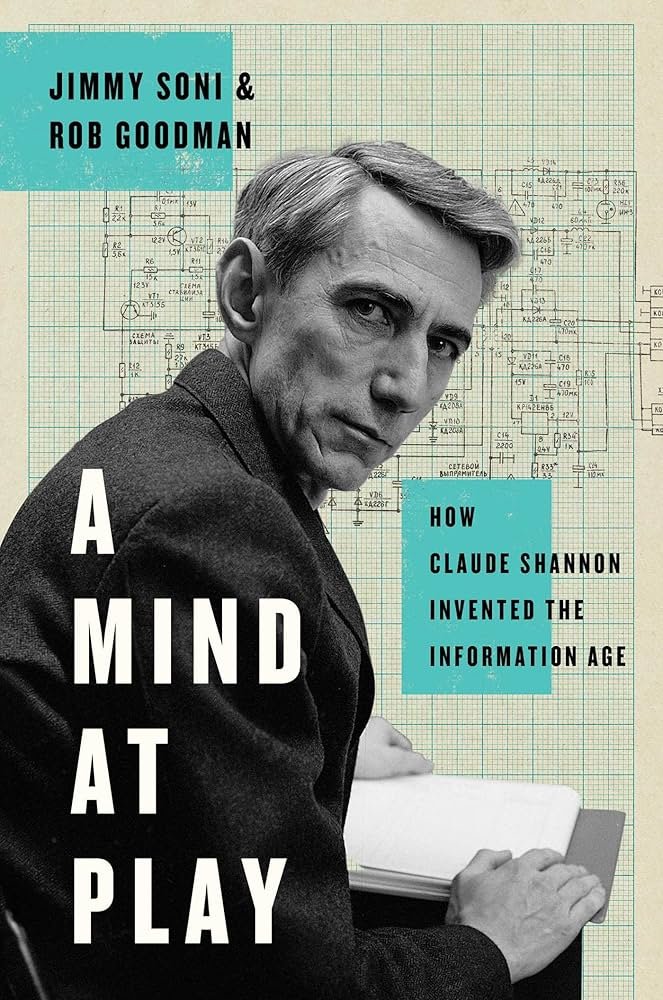
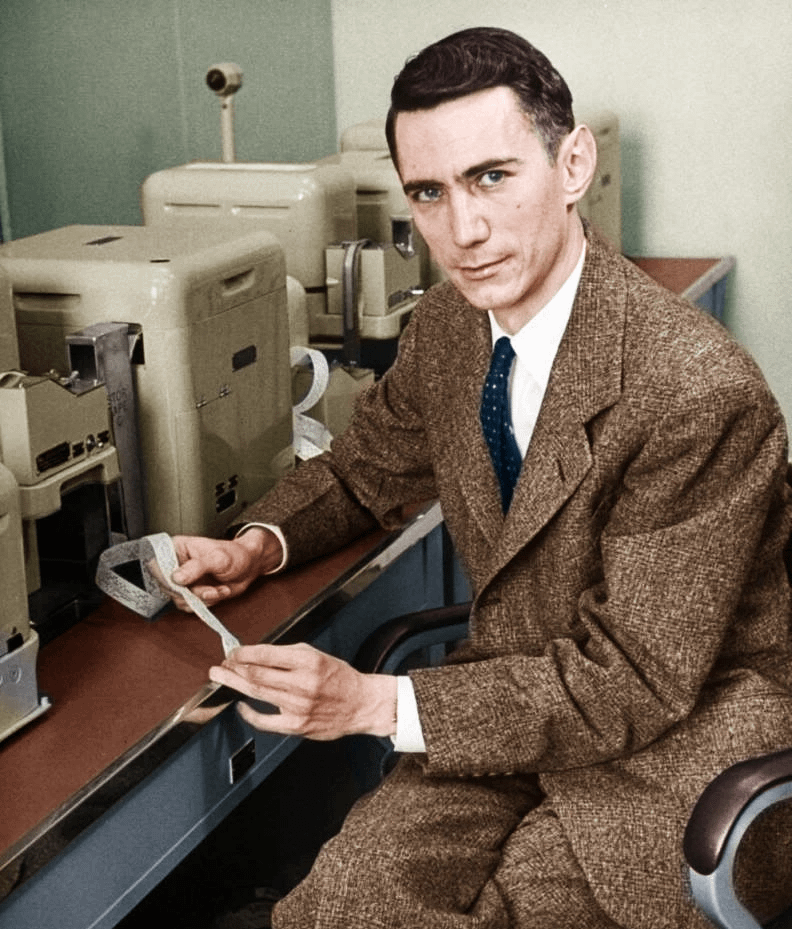
In 1948, a 32-year-old at Bell Labs published a paper nobody fully understood.
Engineers found it too mathematical. Mathematicians found it too engineering-focused. One prominent mathematician reviewed it negatively.
That paper - "A Mathematical Theory of Communication", became the founding document of the digital age.
The man was Claude Shannon. Father of Information Theory.
At 21, he wrote the most important master's thesis of the 20th century.
Working at MIT on an early mechanical computer, Shannon noticed its relay switches had exactly two states - open or closed. He had just taken a philosophy course introducing Boolean algebra, which also operated on two values: true and false.
Nobody had ever connected these two things.
His 1937 thesis proved that Boolean algebra and electrical circuits are mathematically identical, and that any logical operation could be built from simple switches.
Howard Gardner called it "possibly the most important, and also the most famous, master's thesis of the century."
Every digital computer ever built traces back to this insight.
At 29, he proved that perfect encryption exists.
During WWII, Shannon worked on classified cryptography at Bell Labs. His work contributed to SIGSALY, the secure voice system used for confidential communications between Roosevelt and Churchill.
In a classified 1945 memorandum, he mathematically proved the one-time pad provides perfect secrecy, unbreakable not just computationally, but provably, permanently, against an adversary with infinite power.
When declassified in 1949, it transformed cryptography from an art into a science. It laid the foundations for DES, AES, and every modern encryption standard.
At 32, he defined what information is.
His 1948 paper introduced one equation:
H = −Σ p(x) log p(x)
Shannon entropy. The average uncertainty in a probability distribution. The minimum bits required to encode a message.
Three things followed:
> He defined the bit - the fundamental unit of all information. His colleague John Tukey coined the name.
> He proved the channel capacity theorem, every communication channel has a maximum rate of reliable transmission. You can approach it. You can never exceed it.
> He unified telegraph, telephone, and radio into a single mathematical framework for the first time.
Robert Lucky of Bell Labs called it the greatest work "in the annals of technological thought."
Where his equation lives in AI today:
Cross-entropy loss - the function training every classifier and language model, is derived directly from H. Decision tree splits use information gain, which is H applied to data. Perplexity, the standard LLM evaluation metric, is an exponentiation of cross-entropy.
Every time a neural network trains, Shannon's formula runs inside it.
He also built the first AI learning device.
In 1950, Shannon built Theseus, a mechanical mouse that navigated a maze through trial and error, learned the correct path, and repeated it perfectly. Mazin Gilbert of Bell Labs said: "Theseus inspired the whole field of AI."
That same year he published the first paper on programming a computer to play chess. He co-organized the 1956 Dartmouth Workshop, the founding event of AI as a field.
The man:
He rode a unicycle through Bell Labs hallways while juggling. He built a flame-throwing trumpet, a rocket-powered Frisbee, and Styrofoam shoes to walk on the lake behind his house.
He called his home Entropy House.
When asked what motivated him: "I was motivated by curiosity. Never by the desire for financial gain. I just wondered how things were put together."
In 1985, he appeared unexpectedly at a conference in Brighton. The crowd mobbed him for autographs. Persuaded to speak at the banquet, he talked briefly, then pulled three balls from his pockets and juggled instead.
One engineer said: "It was as if Newton had showed up at a physics conference."
He died in 2001 after a decade with Alzheimer's, the cruel irony of information slowly leaving the mind of the man who defined what information was.
Claude, the AI model, is named after Claude Shannon, the mathematician who laid the foundation for the digital world we rely on today.
>be Claude Shannon
>born 1916 in Petoskey, Michigan
>dad is a judge, mom is a language teacher
>age 8, build a telegraph system between your house and your friend's
>half a mile of barbed wire fence as the cable
>you're 8
1930s:
>obsessed with puzzles, codes, machines
>anything that has a system to crack
>go to University of Michigan
>double major: electrical engineering AND mathematics
>graduate 1936
MIT:
>go to work on the differential analyzer
>a giant mechanical computer
>gears, wheels, rods
>the most advanced computing machine on earth
>your job: make it work
>you start thinking about how machines think
1937:
>write your master's thesis
>21 years old
>the thesis: apply Boolean algebra to electrical circuits
>translate logic (true/false) into switches (on/off)
>sounds simple
>it's the most important master's thesis of the 20th century
>this is the foundation of every digital computer ever built
>every chip, every phone, every laptop
>all because a 21-year-old connected two ideas nobody thought to connect
1940:
>PhD in mathematics
>thesis on genetics and algebra
>just for fun
>you're not even a biologist
1941-1945:
>World War II
>work on cryptography and fire-control systems
>classified work at Bell Labs
>meet Alan Turing when he visits from Britain
>two of the greatest minds of the century
>eating lunch together in the cafeteria
>discussing thinking machines
>nobody notices
1948:
>publish "A Mathematical Theory of Communication"
>50 pages that invent the entire field of information theory
>before this: nobody knows how to measure information
>you: invent the "bit" binary digit
>the fundamental unit of all digital information
>explain how to transmit signals without losing them
>error correction, compression, bandwidth
>every text message, every Netflix stream, every WiFi signal
>all running on math you wrote in 1948
>the paper is considered the Magna Carta of the information age
Bell Labs:
>become a legend
>but you don't act like one
>ride a unicycle through the hallways
>juggle while doing it
>build useless machines for fun
>a box that turns itself off when you turn it on
>a calculator that does math in Roman numerals
>you're the smartest guy in the building
>and the weirdest
1950s:
>write a paper on how computers could play chess
>before computers could play chess
>write a paper proving how a mouse could learn a maze
>build the mouse
>call it Theseus
>it learns
>artificial intelligence before the term exists
1956:
>help organize the Dartmouth Conference
>the birthplace of AI as a field
>you're already bored with it
>move on
1960s-70s:
>leave Bell Labs
>become a professor at MIT
>mostly just tinker
>build a wearable computer with Ed Thorp to beat roulette
>it works
>don't tell anyone for decades
the lifestyle:
>juggling obsession write the first mathematical theory of juggling
>unicycles everywhere
>build a flame-throwing trumpet
>build a gasoline-powered pogo stick
>your office is full of toys
>because to you, everything is a toy
>including the universe
1980s-90s:
>Alzheimer's takes hold
>the mind that invented information theory
>slowly loses its own information
>tragic beyond words
2001:
>die at 84
invented the bit.
invented information theory.
laid the foundation for all digital computers.
predicted AI, machine learning, digital communication.
most important scientist nobody knows.
Einstein gave us relativity.
Shannon gave us the digital age.
the man who turned information into math.
Depremde kaybettiğim annemden bana kalan tek yadigarı dün Hatay arsuz Konacık Aslan Hause civarındaki sahilde kaybettim. Bu saate kadar aradık… Belki benim için bir mucize olur diye burada paylaşıyorum. Eger varsa hayatımdaki tek mucizeyi şimdi kullanmak istiyorum nolur Allahım