I'm turning sgclipper-3b-v1 into an API!
- Audio-native clipping model
- Direct M3U8 inputs
- As low as $0.05/hr
Join the waitlist if you're interested ↓
https://t.co/DqLHxshHiY
Introducing sgclipper-3b-v1: an experimental audio-native clipping model that competes with Gemini 3.5 Flash, @OpusClip, @veedstudio and more.
Instead of using transcribed speech, it directly predicts clippable moments from an audio feed.
🤏 Based on @MistralAI Voxtral Mini
🚀 >50x realtime speed
♾️ Infinite audio length
💵 Extremely cheap, lower than $0.007/hr
https://t.co/LlpyB1LepZ
1/2
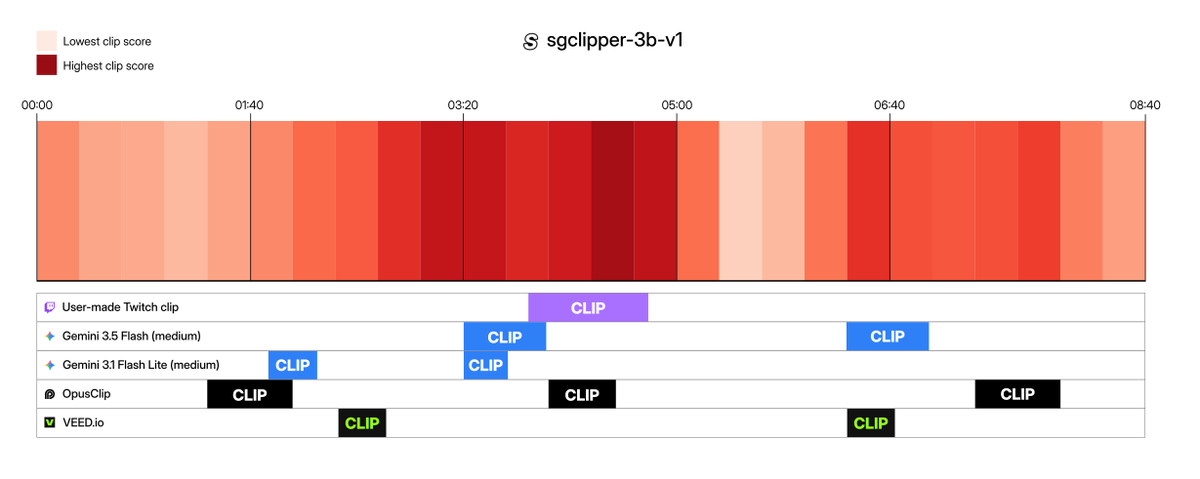
sgclipper-3b-v1 predicts clip scores at audio chunk level.
It's like an embedding model that measures similarity to the "good moment" vector.
This is the predicted clip heatmap of a live audio segment containing an actual clip created by a Twitch user.
Introducing sgclipper-3b-v1: an experimental audio-native clipping model that competes with Gemini 3.5 Flash, @OpusClip, @veedstudio and more.
Instead of using transcribed speech, it directly predicts clippable moments from an audio feed.
🤏 Based on @MistralAI Voxtral Mini
🚀 >50x realtime speed
♾️ Infinite audio length
💵 Extremely cheap, lower than $0.007/hr
https://t.co/LlpyB1LepZ
1/2
Why do people sleep on DSE multimodal retrieval models? 👀
They're just like ColPali, but highly scalable, fast and you can even make them more efficient with binarization or matryoshka with little degradation 🪆
I made a small collection of them (next ➡️)
Introducing vdr-2b-multi-v1 - a fully open-source visual embedding model for your most complex, multilingual documents 🧿🖼️📊
Document search and retrieval is increasingly becoming multimodal, as more and more companies are building agentic document workflows. Most existing RAG, OCR, IDP etc. etc. pipelines depend primarily on text processing. But that inherently causes you to lose information - and a lot of information is locked up in a visual format in unstructured docs.
We’ve invested heavily in tooling and abstractions to automate unstructured data processing, including LlamaParse, LlamaReport, LlamaExtract (upcoming), and more. This is a huge next step in that journey. Vdr-2b-multi-v1 allows you to directly embed image screenshots of different documents so that you can search retrieve image chunks as opposed to text chunks. It outperforms an existing qwen baseline and depends on a 500k query-image dataset we put together.
Huge shoutout to @CimolaiMarco, @disiok, and @LoganMarkewich.
Model: https://t.co/1lh8QD7FUY
Blog: https://t.co/mcPOzrSdbS
We've released a new multilingual, open-source visual embedding model and training set on Huggingface!
vdr-2b-multi-v1 produces single dense vectors for visual document retrieval, enabling efficient large-scale systems. Key features:
➡️ Trained on 5 languages (IT, ES, EN, FR, DE)
➡️ 70% fewer tokens = 3x faster inference for the english-only model
➡️ Matryoshka Representation Learning for flexible dimension reduction
➡️ Full training set is open-source
Learn more:
📝 Blog post: https://t.co/K6N0cqg9Fv
🤗 Model + LlamaIndex integration: https://t.co/eqCie7Bq4r
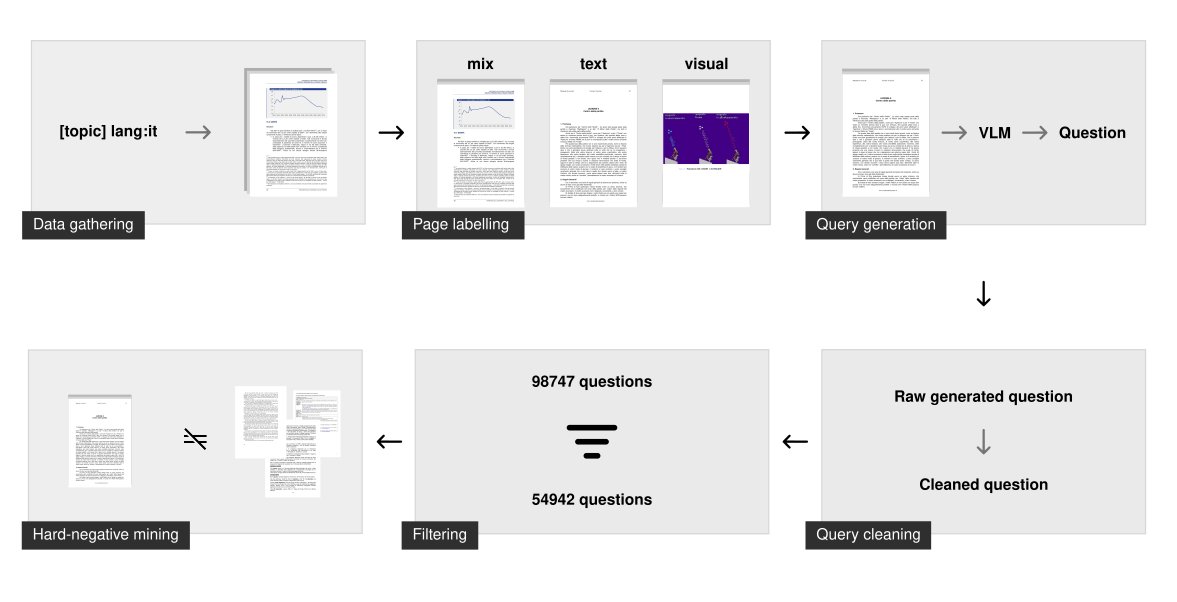
And more! Also releasing the full training dataset! With 500k high-quality samples, it's the largest open-source multilingual (🇮🇹 🇪🇸 🇬🇧 🇫🇷 🇩🇪) synthetic dataset for visual document retrieval.
Apache2, now on Hugging Face.
https://t.co/XHeqwbBHDD
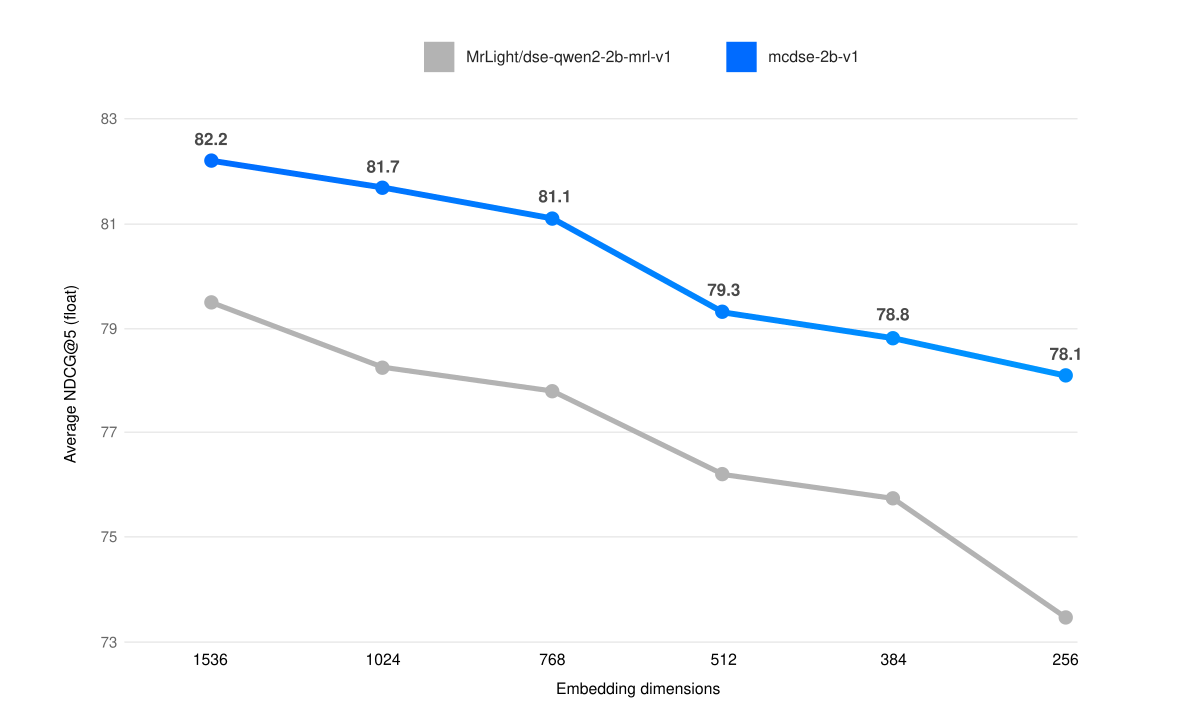
Introducing mcdse-2b-v1: a multilingual (🇮🇹 🇪🇸 🇬🇧 🇫🇷 🇩🇪) embedding model for flexible visual document retrieval.
Trained on MrLight/dse-qwen2-2b-mrl-v1 (Qwen2-VL) using the DSE approach. It's like ColPali but multilingual and single-vector.
- MRL: shrink embeddings from 1536 to 256 dimensions
- Binarization: 768d binary vectors keep 99% retrieval quality of the base 1536d float vectors
- vLLM support
https://t.co/ttQHM3FTJq
@Dorialexander@PetarV_93 Extremely well explained!
I was confused when you said that top_k is the number of tokens we keep in the final selection before sampling, but in the code the next_token is selected from all the probs. I was expecting it to select from the top_k most probable tokens
@xueguang_ma@jobergum 82.9? This is incredible! I wonder if the benchmark datasets are not granular enough to show the advantages of using maxsim over image patches.
Or this shows that there's a lot of room for improvement in colpali, exciting!