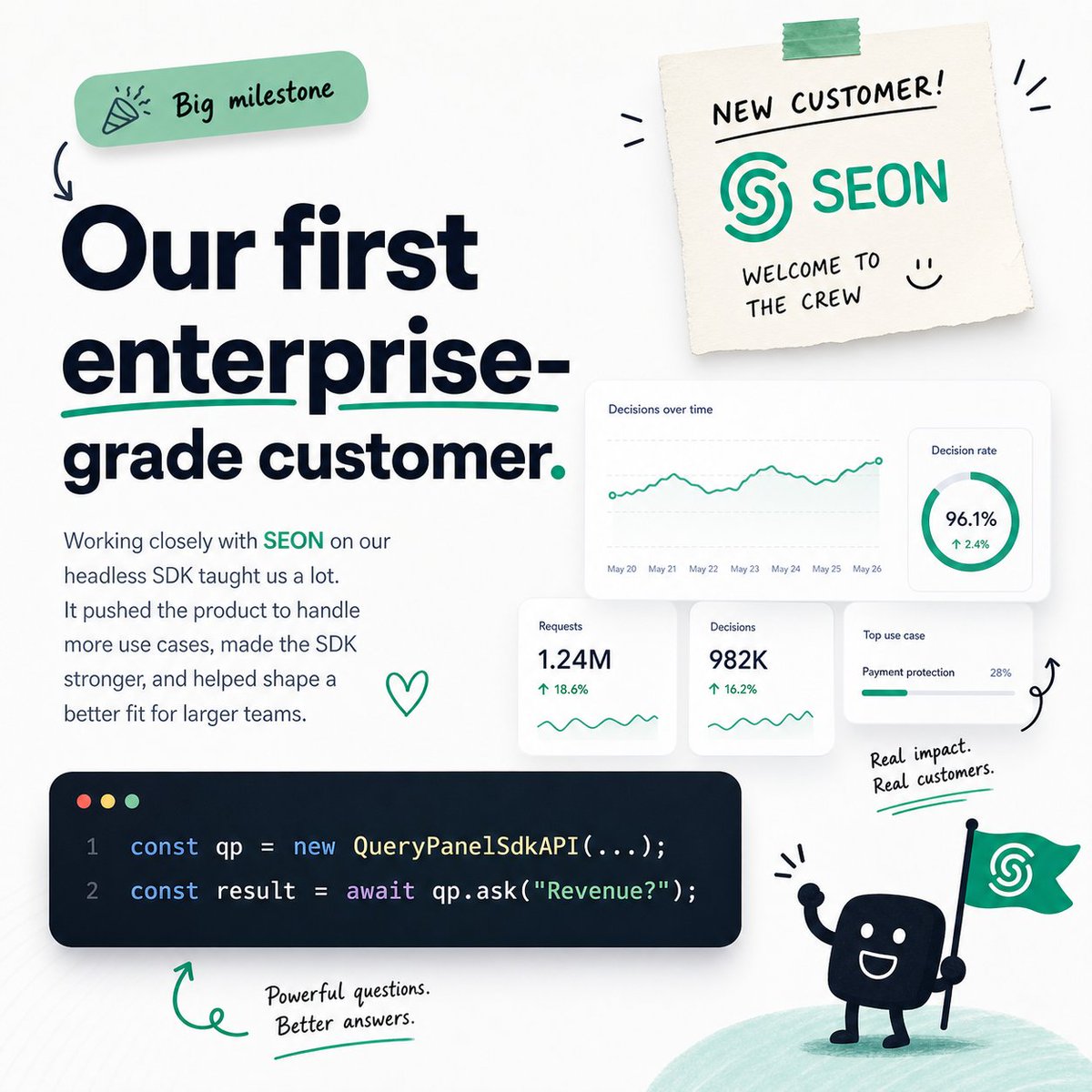
SEON is our first enterprise-grade customer, and this milestone means a lot to us.
Working closely with their team on our headless SDK taught us a lot. It pushed us to support more use cases, think more carefully about flexibility and integration patterns, and improve the SDK in ways that make it a better fit for larger teams.
The collaboration also surfaced edge cases that helped us improve the semantic layer behind our AI, which now produces better and more reliable results.
This is one of the best parts of building: real customers force clarity. They expose edge cases, challenge assumptions, and help shape a stronger product than you would have built in isolation.
Grateful for the trust, and excited for what comes next.
I’d totally missed WebMCPs, so here we go, I did my homework.
Why it matters: computer use isn’t a demo anymore. Browser agents ship inside the tools we use every day: coding assistants, browser sidebars, support bots. More and more, an agent uses your web app before a human does.
And those agents still work by looking at pixels and guessing. Is the spinner gone? Did the route change? Did the chart render the right data?
WebMCP is a draft W3C standard that lets a page register typed tools for agents, like document.modelContext.registerTool(...). The agent stops scraping the page and asks it.
What I found trying it:
❌ Unfortunately, It doesn’t work in Claude’s built-in browser yet
✅ But, It works in Chrome behind a flag: chrome://flags/#enable-webmcp-testing (Chrome 146+, Canary is safest), or launch with --enable-features=WebMCPTesting
UI verification is where it clicked for me:
→ wait_for_idle instead of polling for spinners
→ chart_state that returns the spec, row count and render errors, not a screenshot you squint at
→ page_state with the route, the session and visible errors
But testing is just where you feel it first. If agents are becoming everyday users, the tools your app exposes to them start to matter as much as its UI.
Anyone else playing with it?
I realized I don’t do full code reviews.
I check the critical parts I know, then check out the branch and click through it.
- UI: rendering OK, no extra rerenders or duplicate fetches?
- Backend: logs, performance. Then CI, then merge.
So I made my LLM do the same 🧵
🔹 control-admin: runs the admin app in a real browser, returns screenshots, a11y snapshot, console/network logs
🔹 local-ci: all CI jobs on my laptop in ~2 min
🔹 architecture: our container boundaries as an executable check
🔹 node-sdk-eval: benchmarks our text-to-SQL path on customer-shaped schemas with fake data
🔹 mastra-eval: same for our dashboard agent, with traces
🔹 text-to-sql-common: the shared rules that keep A/B comparisons fair
NVIDIA just open-sourced Auto Ontology, a context layer for text-to-SQL agents. We’ve been solving the same problem at QueryPanel, inside multi-tenant SaaS products. I read the code, compared the two, and improved our system 👇 https://t.co/2cheeWZogG
The good thing, when you have customers and trial users, is that you know what features will bring value to the table. So i added a map 🗺️ chart type to my internal BI tool.
How is my customer using it? He tracks his IoT devices status on the map.
Try it out: https://t.co/cA2cQv9JM2
or
Book a session:
https://t.co/5FlRmelSAW
@Miguel07Code@claudeai Yes, all of my previous videos were made with hyperframes. That was the default to my agents. That’s why i was supprised now that claude were not using that anymore.
@claudeai editor for motion videos are crazy good!!
Previously, it was suggesting me to use hyperframes or remotion, but now it opened the generated motion video in an editor within claude desktop where i can comment on everything and claude reacts on that.
It's super cool!
@deeponailabs@poteto i didnt write these tasks, I got these tasks from customer feedback and i've set up the benchmarking based on that. I aimed for real life scenarios.
Your agents are only as good as the hardest test they see.
Inspired by @poteto
80% → 96% correct answers, ~10 s per answer, about $50 in API costs.
Here’s what I did and what I learned 👇 https://t.co/2mcEPXT2Oe
FOUNDERS‼️: SpaceXAI just opened a startup program. Get up to 6-12 months of FREE Grok credits.
This is @Grok for Startups. One credit balance across Grok, Grok Build, @bot, and the Grok API.
What you get:
- credits sized to 6 to 12 months of real usage
- 20% on approval + 80% after onboarding
- direct line to the startups team
- already got credits from an earlier xAI program? You can still apply.
Who qualifies: the team checks each application for venture backing, a live product, and a company email that matches your website.
Apply 👉 https://t.co/Pgluu5L2Ez
Raising on the back of that AI product? @ThePageform turns your materials into a ready data room in under 5 minutes.
Introducing Gemini 4 Carbon, our latest frontier model.
Carbon delivers improved performance across domains — ranking #1 on v5.0 of the @ArtificialAnlys Intelligence Index and sets a new state-of-the-art in cybersecurity and long-horizon capabilities.
It’s rolling out starting this week to cyber defenders through our Fairwind Program, with expanded access coming soon 🧵