Sitting in India right now, watching the world burn in real time. US & Israel striking Iran. Iran retaliating across the Gulf. Russia-Ukraine still raging. Pakistan-Afghanistan tensions simmering.
Missiles flying over Tehran, Bahrain, Abu Dhabi, Qatar.
And here I am, safe at home on a Saturday evening, in a democratic, peaceful country, worrying about none of this at my doorstep.
We don't say this enough - we are incredibly lucky. Not perfect, not without problems. But at peace. That's not a small thing in 2026.
Today, on National Science Day, we celebrate the spirit of research, innovation and scientific curiosity that drives our nation forward.
This day commemorates the groundbreaking discovery of the Raman Effect by Sir CV Raman. This discovery placed Indian research firmly on the global map.
We reaffirm our resolve to empower our youth, strengthen research ecosystems and harness science and technology for national development and global good.
HEIGHT OF FRAUD
- via social media
You must have read about Galgotia University's fraud act of displaying a Chinese Robot, claiming it to be a product of the University's innovation. And this was displayed and a claim made at the India AI Summit in Delhi.
Online users later identified the machine as the Go2 model made by Chinese firm Unitree Robotics, which is commercially available starting at about 200,000 rupees ($2,200; £1,600).
Reports said that following the backlash, the university was asked to vacate its stall at the summit.
Social media users widely criticised the Galgotia University of dishonesty.
The following writeup exposes Some painful facts about science and innovation in the Indian Universities.
Galgotias University files MORE patents than every IIT in India — combined.
For every patent govt gives Rs 2 - 5 lacs incentive.
Does that tell something ?
If you analyze India's patent data. What you find will shock you.
India's patent grant rate in 2023: 40%
Japan: 70%
South Korea: 57%
United States: 54%
But the real story isn't the grant rate — it's WHO is filing and WHY.
The incentive structure:
→ Govt reimburses up to ₹2 lakh per domestic patent filed
→ Up to ₹5 lakh per international patent filed
→ 80% fee concession for educational institutions (filing cost: ~₹1,600)
→ National Institutiional Ranking Framework (NIRF) rankings factor patent filings in ranking institutions — more patents = higher rank
Some universities figured out the game:
📌 Lovely Professional University — 1,387 filings
📌 Jain (Deemed-to-be University) University — 1,093 filings
📌 Galgotias University — 1,089 filings
📌 Mahaveer University — 1,007 filings
All IITs combined? Just 803.
The math:
Filing cost: ₹1,600 Reimbursement: up to ₹2,00,000
Return: 125x
1,000 filings × ₹2 lakh = ₹20 crore/year — from domestic patents alone.
The catch? These patents are never prosecuted. Never granted. Never commercialized.
File → collect reimbursement → boost NIRF rank → attract students → collect fees → repeat.
India ranks 5th in patent applications. Last among top 6 nations in grant rate.
We're optimizing for the wrong metric.
What should change:
→ Shift reimbursement to GRANT stage, not filing
→ Tie incentives to commercialization
→ Audit universities with abnormal filing-to-grant ratios
→ NIRF should weight grants, not raw filings
→ Cap reimbursements per institution per year
Innovation isn't a form you fill. It's a product you build.
A cow takes grass (inedible to humans) and produces:
- Meat (complete protein + fats)
- Milk (complete nutrition)
- Leather (clothing, tools)
- Tallow (cooking fat, soap, candles)
- Bones (tools, broth, fertilizer)
- Organs (nutrient-dense food)
- Manure (fertilizer)
This is complete resource utilization from a plant humans cannot eat.
You cannot replicate this with any technology. The cow is performing chemical transformations we cannot industrialize.
Grass → complete human nutrition is alchemy.
The cow is worth more than any machine humans have invented.
It runs on rain and grass. Produces multiple products. Builds soil while operating. Sequesters carbon. Reproduces itself.
And we're told to eliminate them for environmental reasons.
While flying in almonds from California and soy from Brazil.
The stupidity is breathtaking.
This is how democracy should work. Fight passionately for your point of view in elections, with no rhetorical holds barred. But once it’s over, & the people have spoken, learn to cooperate with each other in the common interests of the nation you are both pledged to serve. I would love to see more of this in India — and am trying to do my part.
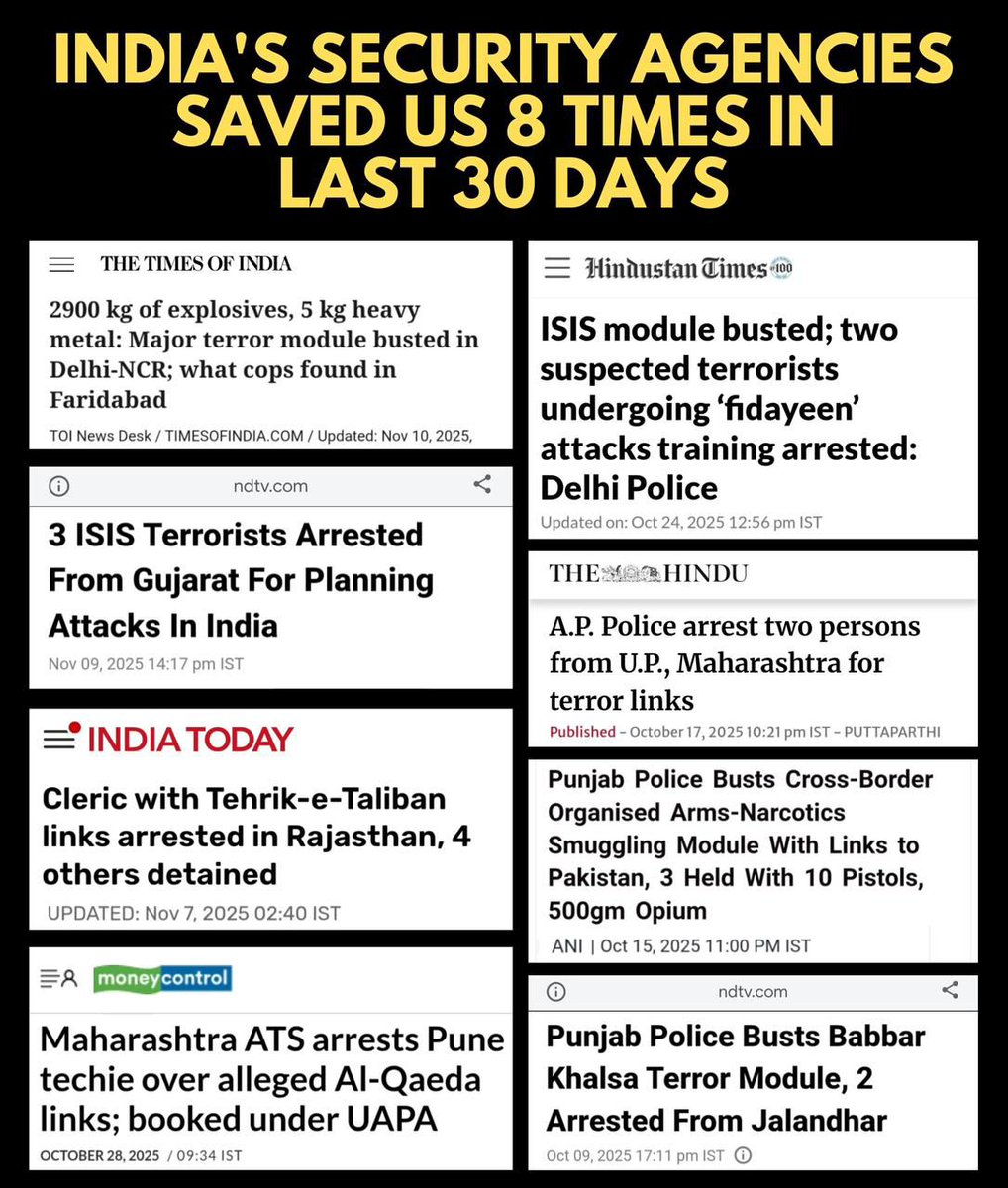
@mehartweets Securing Nation by Security Agencies is a thankless job.
I stand strongly with security forces and agencies.
Jai hind 🇮🇳
BTW this is what our Security Agencies have been doing.
SAMRAT RANA CREATES HISTORY FOLKS! 🤯🤩
HE BECOMES THE FIRST EVER INDIAN WORLD CHAMPION IN THE 10M AIR PISTOL EVENT!
A Gold Medal in an Olympic Event! 🥇
INCREDIBLY WELL DONE SAMRAT! 🇮🇳🔥
Big Win!
@nitin_gadkari ji is implementing my QR scan idea!
On July 12, I posted: If ₹5 biscuit has all details, why not 100 Cr road?
I demanded QR codes for roads. After months of efforts, it’s finally happening!
This is just the start of Accountability & Transparency!
Shri @nitin_gadkari,
You don't give direct answers to direct questions, instead, you deflect with lines like “mere against hitjob hai” or “paid propaganda hai” to media channels.
Again asking a few direct questions. If you can answer these satisfactorily, directly, through media, or even via your influencer campaigns, promise I won’t raise E20 petrol issue again.
1. Why fast-track E20? The original plan was to implement E20 by 2030. That timeline made sense because, by then, most vehicles on Indian roads would be E20-compliant. Accelerating it so quickly is like launching 6G services when no 6G phones exist yet. This is not like polio eradication, where early achievement deserves praise. There was no pressing reason to push it ahead of schedule. Even NITI Aayog had reservations about rushing it.
2. You said there’s no car damage due to ethanol blending “world over.” That’s because other countries match fuels with compatible vehicles. Brazil rolled out E20–30 only after most vehicles became compliant and still offered E0–E10 for older ones. E20 cars on E20 are safe; non-E20 cars, which form the majority in India, are not. India is probably the only country that created this mismatch. If E-20 doesn't damage the non-compliant cars, like you claim, why is there even need for E-20 complaint cars then?
3. Why hasn’t fuel price reduced as you promised? Instead, mileage has gone down, so people are paying more for the same distance.
To summarise, we have no issue with E20 itself, only with how it was implemented. Please answer these questions. And no, saying “we did it for the benefit of farmers” is not an answer. If you want to help farmers, do it through your budget, people are already paying enough taxes for that, don’t cut into ordinary citizens’ pockets or damage their vehicles. "To become self reliant fast" is also not an answer. In that case, non compatible vehicles given E5-10 option would not have stopped you from becoming self-reliant. If you can’t answer, at least don’t call us paid propagandists. You are one of the most powerful ministers; if you truly believe this is a paid hit job, then investigate and prove it. Who’s stopping you?
@dineshwadera Lol...Indians spend half their work hours on social media. Europeans, atleast where I work, hardly get distracted during work hours. I am in the design department, & none touches their phone during work hours. Their 8 hrs work is 8 hrs, our 8 hrs in office is hardly 4 hrs work.
Recently visited @MochaOnline Gandhinagar. Just to get embarrassed in front of my guests. Worst possible service and food was offered. With absolutely zero intention to serve the guests. @foodsafetygov.