« L’explosion de la 'fast-fashion' a conduit à une augmentation massive des volumes mis sur le marché, accompagnée d’une baisse continue de la qualité moyenne des textiles collectés, qui limite les possibilités de réemploi en France. »
https://t.co/fHBmakytnx
« Cette étape leur permet surtout de prénotifier dès maintenant ce rachat auprès des autorités de concurrence, à Paris ou à Bruxelles, qui pourront prendre jusqu’à dix-huit mois pour l’autoriser ou le bloquer. »
https://t.co/5HrBdoDqG1
Apocalyptic bird nest.
A Russian glide bomb knocks down a tree in Donbas. From the shattered branches rolls out a tiny bird’s nest.
Made of drone fiber-optic cable.
Source: Oleg Malchenko
« Il n’existe pour l’heure aucune méthodologie standardisée pour mesurer l’impact carbone de l’IA. "Plein de paramètres peuvent jouer, comme la fréquence d’utilisation de l’outil, le niveau de technologie, le modèle utilisé…" »
https://t.co/SdavEYNNzd
Hard to believe I’m even writing this.
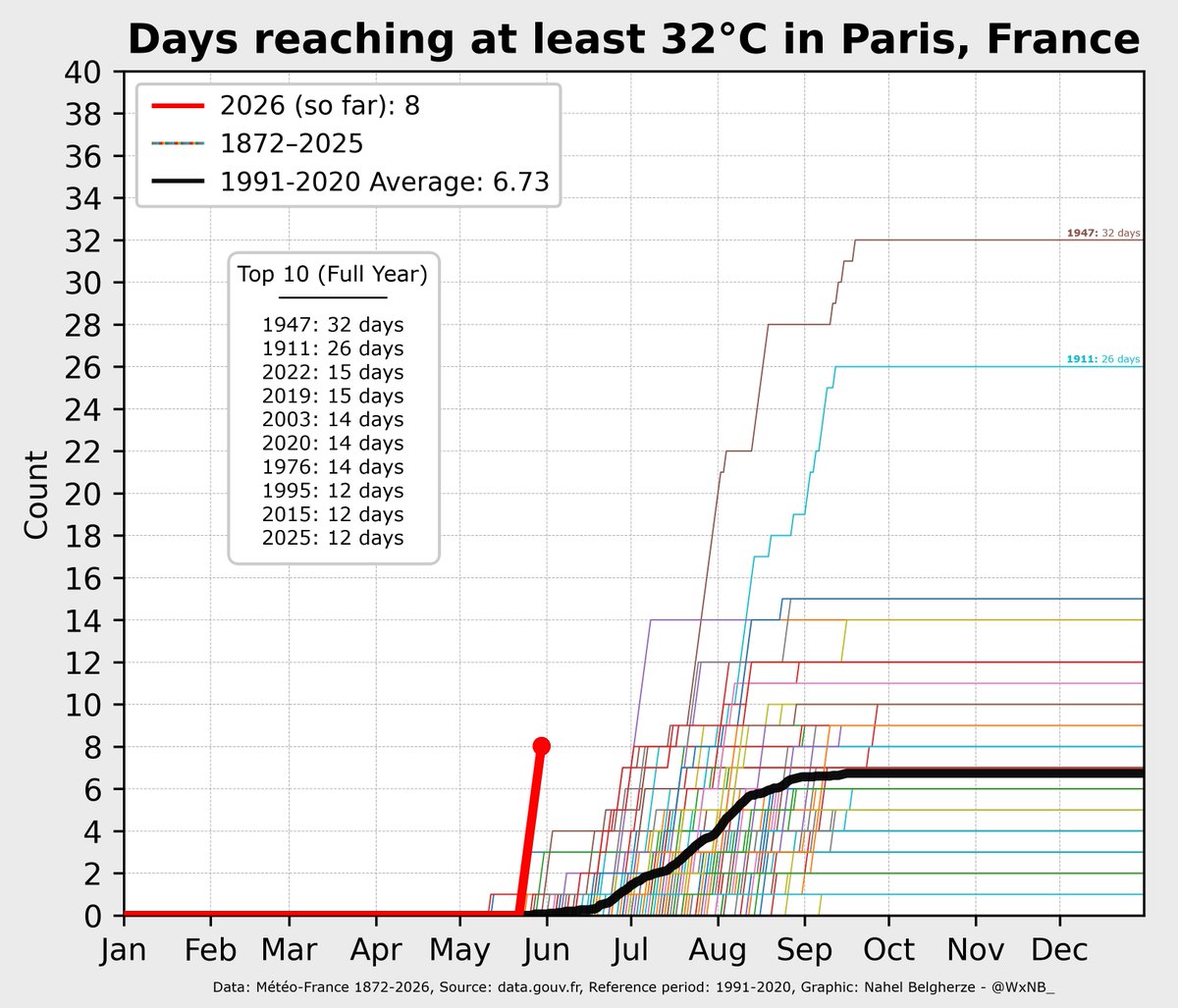
Meteorological summer hasn’t even begun, yet Paris, France has already logged more days above 32°C (89.6°F) than its annual average.
The AI numbers are starting to look very ugly.
Even under "best case" assumptions, FT's own data shows Microsoft AI ROI at -9%, Google at -15%, Meta at -28%, Oracle at -35%. Only Amazon barely comes out positive.
This is exactly why I keep comparing this to the dot-com era. Incredible technology does not automatically mean sustainable economics. The internet survived. Most internet companies didn't.
Right now hyperscalers are spending trillions hoping future demand catches up to present capex. That's not certainty. That's a leveraged bet.
« L’adaptation est très en retard [en France]. Il y a un hiatus entre des plans plutôt clairs et une mise en œuvre défaillante et irréaliste : les objectifs ne sont pas assortis de moyens financiers adéquats. »
https://t.co/OXAAs3STv9
In one of the largest religion surveys ever conducted, perhaps surprisingly, people who are actively religious are the ones who have the highest confidence in AI right now
A burgeoning news website called the South Florida Standard has disappeared off the internet after an investigation uncovered that all of its reporters were AI-generated.
https://t.co/L4K5Q6uPM3
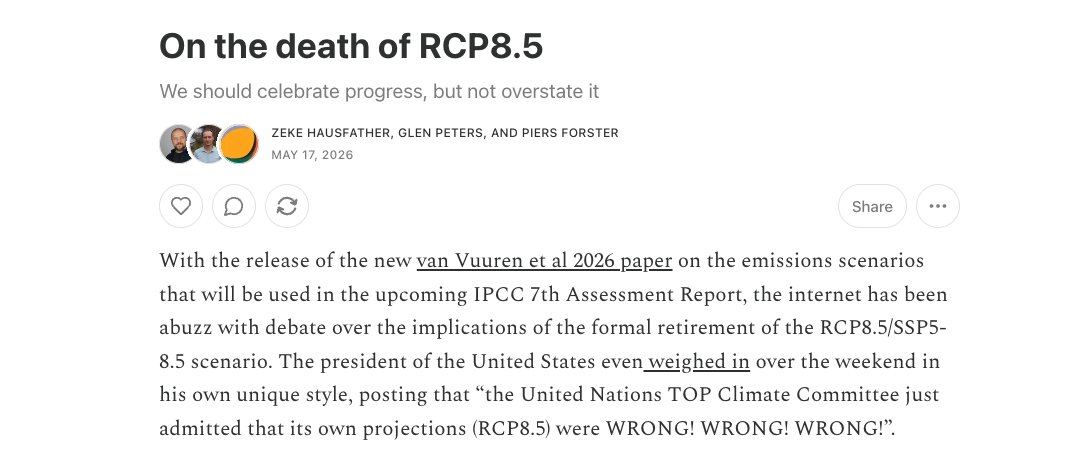
This is exactly what "trust the science" looks like. Scientists updated the worst-case scenario because real-world emissions are tracking below RCP8.5's 2010-era assumptions of runaway coal expansion, primarily because wind and solar got cheap and climate policy started bending the curve. The new CMIP7 HIGH scenario published in Geoscientific Model Development still projects roughly 3°C of warming by 2100, twice the Paris target and a temperature Earth has not seen in roughly 3 million years.
The position being celebrated here amounts to: the climate policies worked well enough to retire the worst-case scenario, therefore we should kill the climate policies. That is hearing the smoke alarm shut off and concluding the fire department was a hoax.
Two things can be true:
• RCP8.5 was never a realistic "business as usual" scenario
• The world has made real progress bending the emissions curve downward
@Peters_Glen, Piers Forster, and I explain in a new article (link below).
1/11
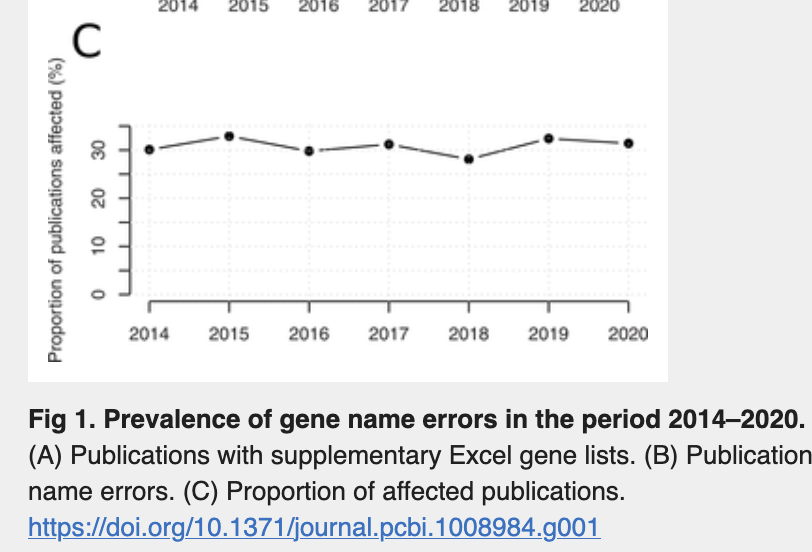
30.9% of genetics papers data are kind of trash because of Excel’s aggressive auto-formatting.
Until 2023, there was no global option to disable data conversion. For example, the human SEPT family (1-14) of genes is directly related to cell division and cancer research.
I’ll give you one guess as to what that auto-formats to. Yup…turns into a date.
Oh, it get’s worse though. Many labs use what are known as RIKEN identifiers. It’s a 10 digit alphanumeric code, kind of like a barcode that identifies a gene sequence. Here’s one:
2310009E13
Uh oh. There’s an “E” in there. Guess what that turns into? A floating point!
Excel has a hard limit of 15 significant digits for floats. So, not only did your RIKEN identifier get formatted wrong, but it’s also rounded off to an unrecoverable state.
12.5% of the RIKEN database (Row E) is a disaster.
If you know anything about Bioinformatics, you should be losing your mind. Remember, a huge amount of scientific research is meta-analysis. Good luck cross-referencing patterns when ~31% of the data has errors!
So basically there’s a giant data hole from 2004-2023, much of which has been standardized into national / official databases, and there’s no good way to fix it.
Microsoft BitLocker-protected drives can now be opened with just some files on a USB stick — YellowKey zero-day exploit demonstrates an apparent backdoor https://t.co/K6FDxeP6YK
Left: the watermark GPT Image 2 embeds into every image it generates.
Right: SynthID, the fingerprint Google bakes into every Nano Banana and Gemini image.
Invisible to the human eye. Applied during generation, not added after. Designed to survive screenshots, crops, and compression.
Most people using these tools daily have no idea their output is fingerprinted at the pixel level. Every major AI image generator now tags what it produces, and the tag travels with the image wherever it ends up.
You can verify this yourself. Content Credentials Verify detects C2PA markers from OpenAI images. Gemini detects SynthID if you upload an image directly to it.
The images will keep getting more realistic. The identification tech is keeping pace.
« On a franchi un cap. Après les emplois manufacturiers, puis les services, ce sont désormais les tâches cognitives qui sont fréquemment délocalisées, celles qui étaient à l’abri de la concurrence des pays à bas salaire et du progrès technique. »
https://t.co/FoStjHePXs
« Le changement de couleur serait dû à un effet mécanique : l’hydratation, en augmentant l’espacement des [structures microscropiques] réfléchissantes, provoque la réflexion de longueurs d’onde plus grandes. »
https://t.co/EJ6CHNJBA5
I knew this was coming. We are so f*cked - fake and real now look the same.
We desperately need tools to show journals and researchers that data is real, not AI-generated.