New paper out :
With Catherine Laffineur we detail the French Occupation Space, assess the occupation-specific potential of professional mobility, and show the benefit of being in a "central" occupation.
https://t.co/eDxMUfudwh
1/6
@cd_land@Nice2030_actu La seule et unique fois que j'ai vu Estrosi sur mon campus universitaire, c'était pour la (fausse) remise des diplômes de "sur les bancs de la fac", le programme payé par la ville et la métropole pour permettre aux retraités de suivre des cours à la fac.
Eigenvectors in Physics and Economics
A few days ago, I made a post explaining the use of eigenvectors to estimate economic complexity. That post sparked a discussion about the use of eigenvectors in economics and physics that I think is worth expanding on.
The post received many positive reactions, primarily from economists and scholars around the world, but also a few negative comments from “Econ influencers.” So, let’s address some of those.
First, I will discuss the use of eigenvectors in economics, and then, I would give some examples of their use in physics to explain the differences.
First, a few people objected to the idea that eigenvectors are less commonly used in economics as they are in other fields, such as physics. As evidence, they pointed to two relatively recent papers using eigenvectors in the context of networks: a 2014 AER paper on financial network contagion and a 2012 paper on the network origins of fluctuations.
Unfortunately, both of these papers are more recent and less cited than my own 2009 paper defining the Economic Complexity Index—an eigenvector that represents the steady-state mapping of a bipartite network. So, if this is the best evidence out there, it seems like too little and too late. The work is very recent, and it applies to networks—a field that was hot in physics in the late 1990s, not the 2010s.
There are, however, a few other places where eigenvectors are used in economics. One is econometrics, where they are employed as a data-analysis technique (not in the deeper theoretical sense I will explain later). Here, eigenvectors are used to reduce dimensionality, test for cointegration, and decompose data.
They are also used in finance, but again as a data analysis technique.
The use that I like the most in econ is input–output matrices. This is an older application that emphasizes the importance of taking a structural view of economic systems. But again, eigenvectors and eigenvalues appear mainly in the context of stability or long-run dynamics. These are valid applications—but still far from the theoretical level in which they are used in physics.
So, how are eigenvectors and eigenvalues used in physics? And is this use comparable to the ones I just described in economics?
Let’s start with a simple question:
Why is the ground state of a hydrogen atom (the energy level of its “deepest” orbital) –13.6 electron volts?
This sounds like a weird and arbitrary number, but you can derive it analytically as it is the first eigenvalue (n = 1) of the time-independent Schrödinger equation in a Coulomb potential.
Notice the gap. Here, the eigenvalue is not a data-analysis tool or a dynamical system convergence criterion—it is a way to estimate a deep and measurable physical reality (the energy you need to kick out an electron from the deepest orbital in a hydrogen atom). The associated eigenvector is the wave function of the electron in that orbital.
Now, let’s consider another theoretical question with an even better illustration of this gap.
Why do some orbitals in an atom allow more than one electron? The first orbital allows 2, the second 6, the next 10, the fourth 14, and so on. These numbers also look weird, but they are crucial to explain the periodic table of elements and their chemical behavior.
So where do these numbers come from? The answer lies in the degeneracy of eigenvalues.
An eigenvalue is not always associated with a single eigenvector (or eigenfunction), it can instead correspond to a subspace (e.g. two or more eigenvectors sharing the same eigenvalue). These degeneracies explain the number of electrons in a shell. Energy levels are degenerate, and these degeneracies are filled with multiple electrons that differ in other quantum numbers (e.g., angular momentum l or spin s).
Of course, the discreteness of angular momentum itself also comes from an eigenvector and eigenvalue problem.
The thing is that this is physics from 100 years ago (not last decade) based on physics of more than 200 years ago (e.g. Laplace equation is of a similar vintage than Adam Smith’s Wealth of Nations).
So, while I am happy that some subfields of economics use eigenvectors for data analysis, and that their use has grown in the last decade, that use is conceptually very far from the theoretical depth with which these concepts have been employed for over a century in physics.
In physics, eigenvectors are not a “PCA” data analysis tool, but a core theoretical object explaining something as deep as the structure of the periodic table (among other things, such as music theory). Even particles can be seen as eigenstates in QFT.
I also know from experience that these concepts are not widely familiar in economics.
How? Because for the better part of the last 20 years, I have been invited to present my work all over the world, in rooms big and small, filled with economists working in academia, government, and the private sector. The vast majority of them are extremely nice, friendly, and welcoming. I made an enormous number of friends and colleagues in the global economics community through these interactions. And through this window into the world, I got plenty of hands-on experience on how people trained in economics react to an indicator built on the eigenvector of a specialization matrix (the Economic Complexity Index). For many, this is an unusual method. And that’s fine—that’s why they invited me to present it and explain it.
So, for the handful of economists full of hubris and self-righteousness who enjoy trolling on X, my message is simple: chill.
If you want to be an EJMR-style troll, go ahead, make X even more toxic.
But if you want to be a scientist, you must first accept that science is bigger than economics and that maybe other fields blazed trails you have not yet learned.
Stay curious. Stay humble. Stay respectful.
Now that everyone is talking about the impact of AI on labor, here is a quick thread with some key findings from the broader literature.
TLDR; there is some evidence of both, AI enhancing and reducing gaps among low- and high-performers.
Pull the thread to learn more 🧵👇
@BVLorient Bonjour, par tout hasard, auriez-vous sauvegardé quelque part cette base de données? La version actuelle en ligne est sur un autre découpage qui ne m'arrange pas. Merci
@InseeFr
Je cherche les series annuelles de chômage par zone d'emploi, mais découpage 2010.
Le fichier en ligne "chomage-zone-2003-2024.xls" ( https://t.co/Oh8xrRHYdn) est désormais sur le découpage 2020
Où peut on retrouver les fichiers antérieurs ? (Jusqu'en 2019 si possible)
Shipments of small packages from China have skyrocketed, but the ‘de minimis’ policy excluding them from tariffs may end. This week, we explore the history of this quirky bit of US tariff policy plus the economic implications of Trump shutting it down.
https://t.co/w3dol6A7Xi
It's kind of sad to see the anti-immigration wing of MAGA waiting for clarification from Trump when Trump doesn't even know the difference between an H-1B and H-2B visa.
@pascaloupfm @EmmanuelRMartin Ça va, tranquille la conscience d'afficher en public les profs avec qui on est pas d'accord?
Planqué derrière un pseudo ?
Pauvre type.
@sc_cath Et cacher les véritables efforts/priorités:
Le budget du ministère de l'ESR sert ainsi en partie non pas à former ni innover, mais payer des retraites.
Offre de stage @CEPII_Paris : je recherche un.e stagiaire (fin de M1/M2) pour travailler sur la répartition de l'activité et de l'emploi manufacturier en Europe et dans le monde.
A partir de début mars 2025 (selon disponibilité du/de la candidat.e).
Plus de détail 👇
L'ordre de grandeur des économies envisageables est sans commune mesure avec l'effort nécessaire pour seulement stabiliser la dette publique à son niveau actuel et ces économies porteraient surtout sur les universités et centres de recherche (pour épargner les retraités ???)
Évidemment on a un super vivier d’universitaires et d’étudiants qui ne demande qu’à être siphonné avec l’aide de l’ambassade de France aux US qui fait la promotion du Crédit Impôt Recherche (sans rire). On est les rois du offshoring R&D, et ne vous en réjouissez pas trop vite.
Good evening! At request we will not close the submission system until the end of the weekend. There is still time to make final adjustments to your submissions!
Ale Cuñat, Harald Fadinger, Kalina Manova and I are organizing the 8th Workshop on International Economic Networks (WIEN) to take place in beautiful Vienna on June 26-7, 2024. Send us a paper for consideration! We're particularly keen on receiving submissions from young scholars.
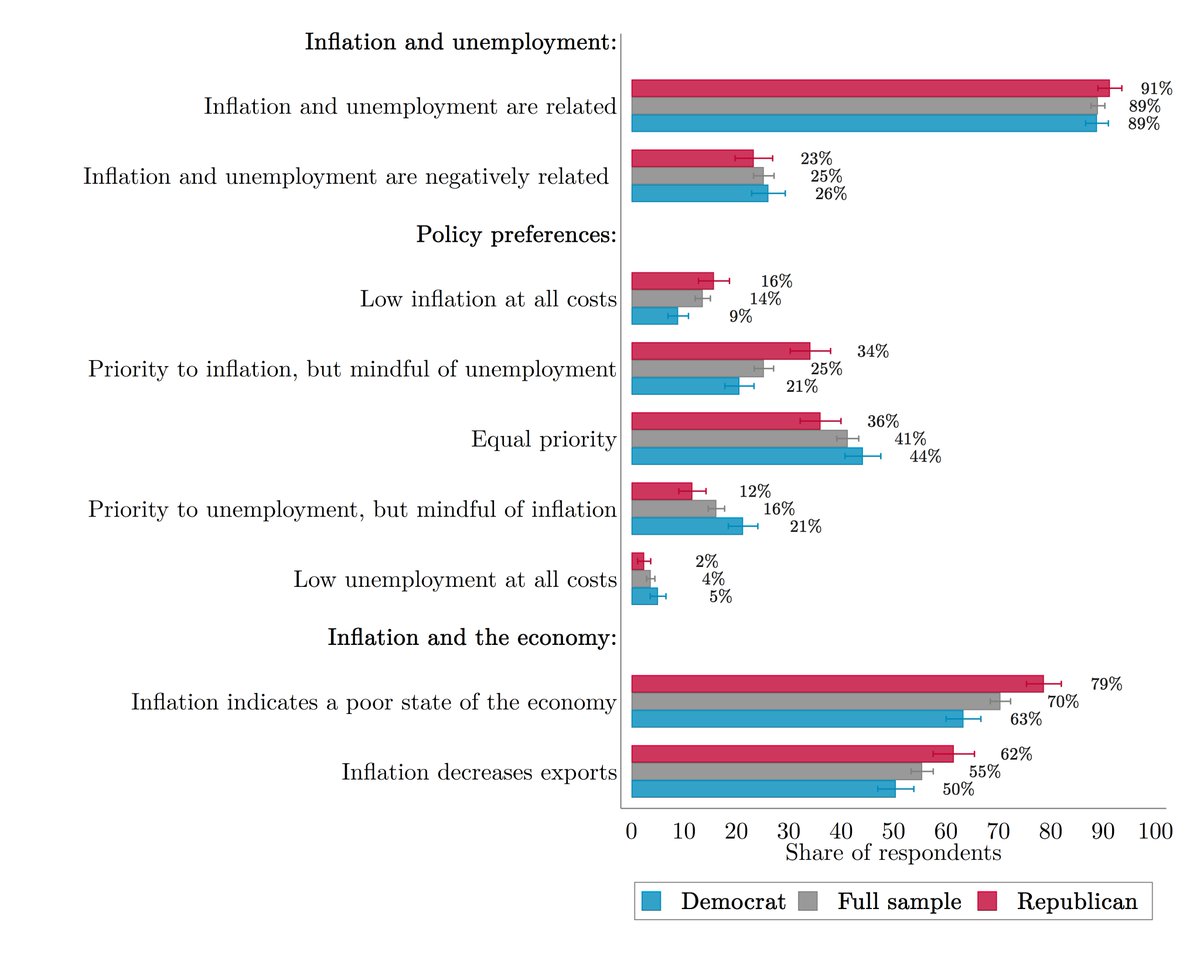
The tradeoffs economists think about between lower unemployment/higher inflation (in certain circumstances) are not perceived by people at all. Instead, people hold a view more consistent with stagflation situations: Inflation is linked to a "bad economy" and high unemployment. 9
@S_Stantcheva Was this always the case ?
I'm thinking about the mid 1960s to mid 90s inflation.
Or did we just got used to low inflation since the 2000s?