My friend and colleague Don (E.D.) Hirsch asked me to spread this open access version of his book "The Schools We Need and Why We Don't Have Them" far and wide. Please do the same!
https://t.co/n1SMSW9QmX
@RealMarkLatham And the implication therefore is the other 7 are lying. If they change their tune that becomes another story.
He’s paying a heavy price for loyalty to Warner
“What Bishop Barron objects to is the condition that …Pope Paul VI placed on that work: the Church brings people to Christ by becoming the kind of community in which Christ can be seen. The condition falls on Catholics first, before it falls on anyone Catholics hope to convert.”
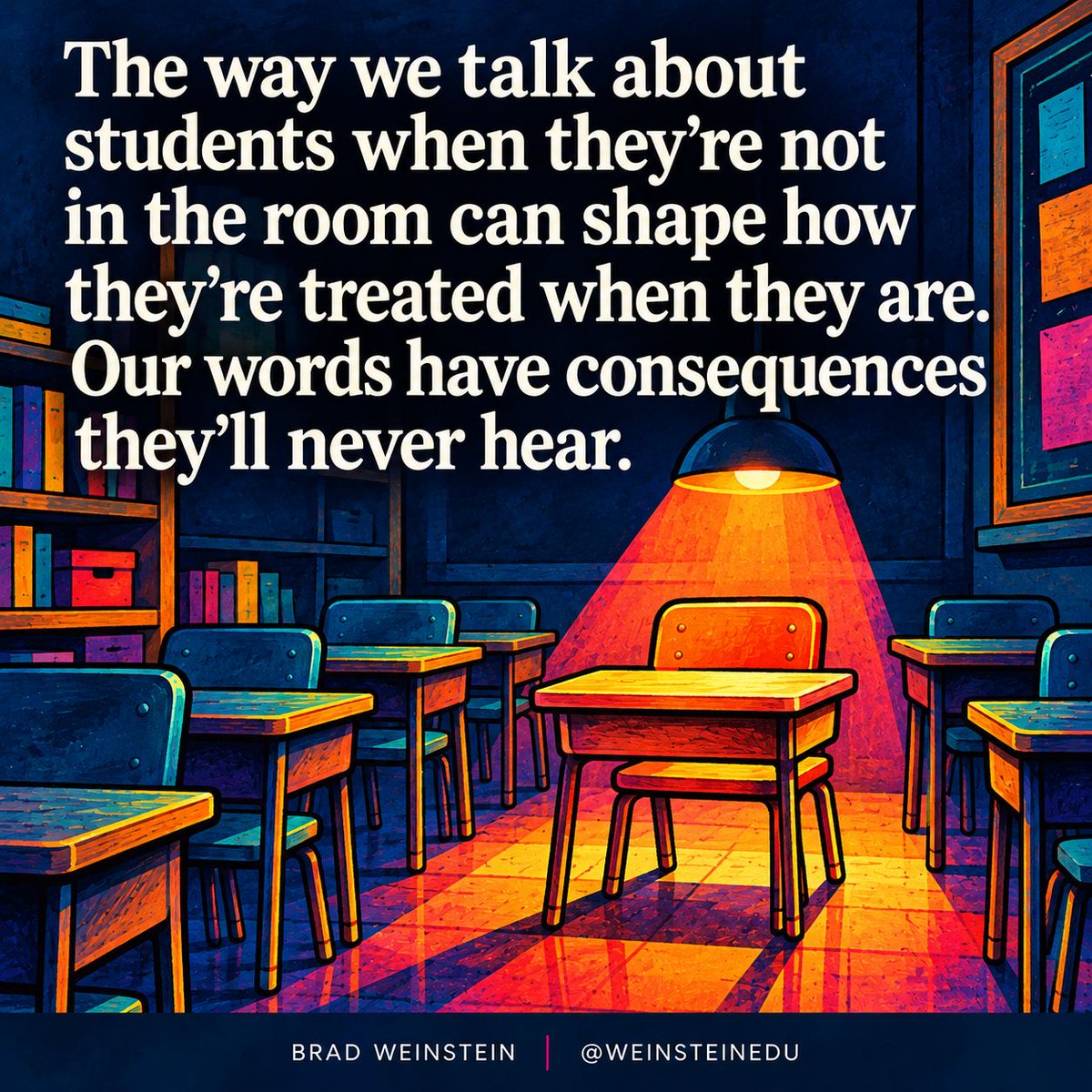
Think about how often students arrive in a new classroom with a reputation they had no part in creating.
"Just wait until you have him."
"She never does her work."
"He's going to give you a hard time."
Sometimes those comments come from genuine frustration. But they can also shape what the next teacher expects before that student has even walked through the door.
Of course, educators need to share important information. Knowing what a student struggles with, what supports have worked, and what patterns to watch for can make a real difference.
But there's a big difference between sharing information that helps a teacher support a student and passing along a judgment about who that student is.
A student who struggled last year might thrive this year. A student who had a difficult morning might be ready to turn things around by afternoon.
We should leave room for that possibility.
Before describing a student to another educator, consider whether you're helping them understand that student or simply telling them what to expect.
Every student deserves the opportunity to be known for more than their most difficult moments.
Ten million people have watched a comedian accidentally destroy the entire TED talk industry.
He filmed the talk once at TEDxNewYork in 2014 and openly admitted he had nothing to say.
Speaking coaches charge $5,000 to teach the exact tricks he used in 6 minutes to say nothing at all.
His name is Will Stephen. He is a comedian from Late Night with Seth Meyers who was invited to give a real TED talk and used it to prove the format is a costume anyone can wear.
Every TED speaker opens with a question, tells a personal story, cites a scientist, and shows a chart. Stephen did all four in six minutes with zero content.
His entire formula fits on a napkin.
Gesture with both hands. Ask the audience a question anyone can answer. Tell a mildly embarrassing story so they say aww. Point to a stranger on a slide and call them important. Flash a chart of random numbers. Wear glasses with no lenses. The audience will think you are brilliant.
That last trick alone has probably cost the public speaking coaching industry a hundred million dollars in sessions clients should have skipped.
"If you watched me on YouTube with the sound off, you would think I was a genius."
That is Will Stephen on the TED stage, three minutes into the talk he was paid to give. He wasn't lying.
Executives pay $15,000 for a keynote coach and still open with a joke the room never laughs at. Founders rehearse their pitch for weeks and still sound like Stephen at minute four, saying "wagga wah, gabba gabba" with authority.
The talk is free on YouTube. The method is written across every TED speaker's playbook for ten years.
Stephen still writes for Seth Meyers. Almost none of the ten million viewers have stopped nodding at empty slides since.
The formula is free. The willingness to actually say something before your next keynote, pitch, or townhall is the entire edge.
‘One Nation is in a crisis of credibility. It wants to be taken seriously and appeal for real responsibility, yet it’s led by a longtime racist and infused with the persona of a sniggering, smutty, antisocial 14-year-old delinquent.’ Consider it nailed.
https://t.co/DH6U3hsv10