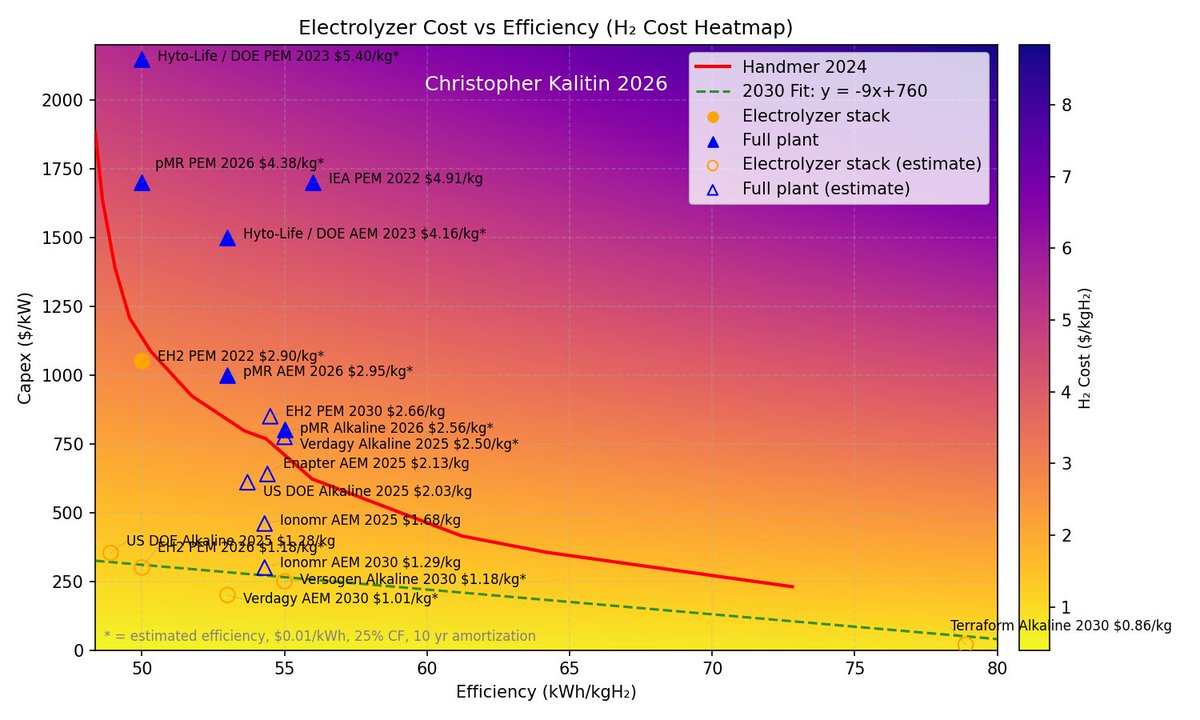
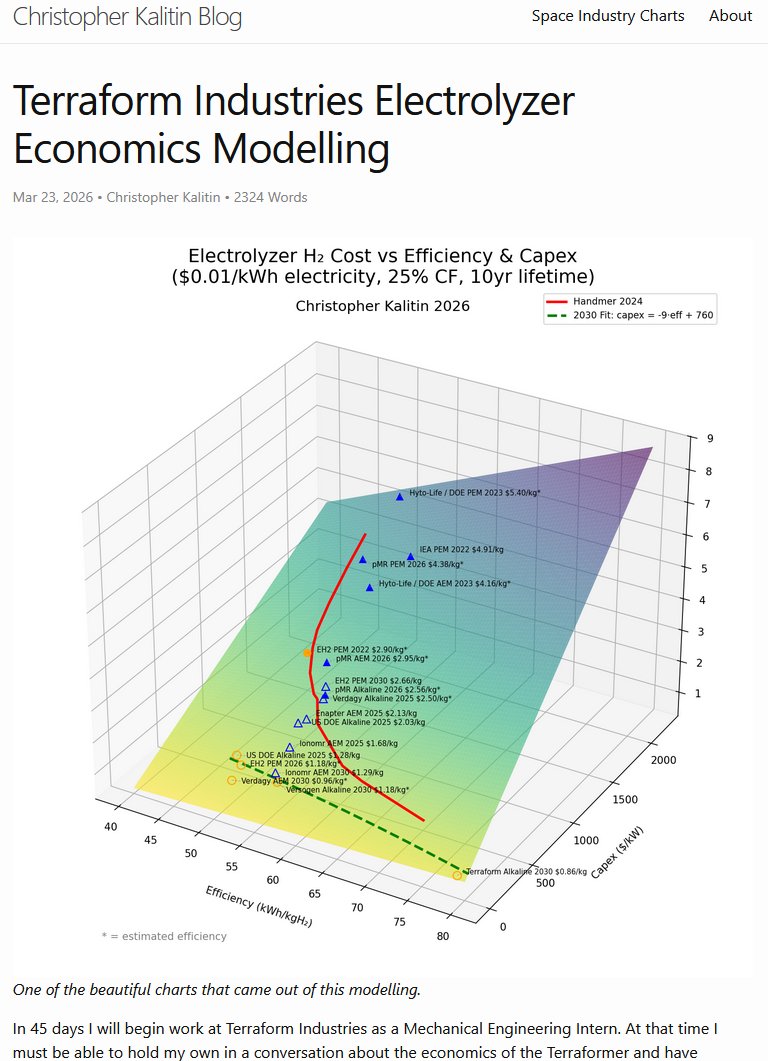
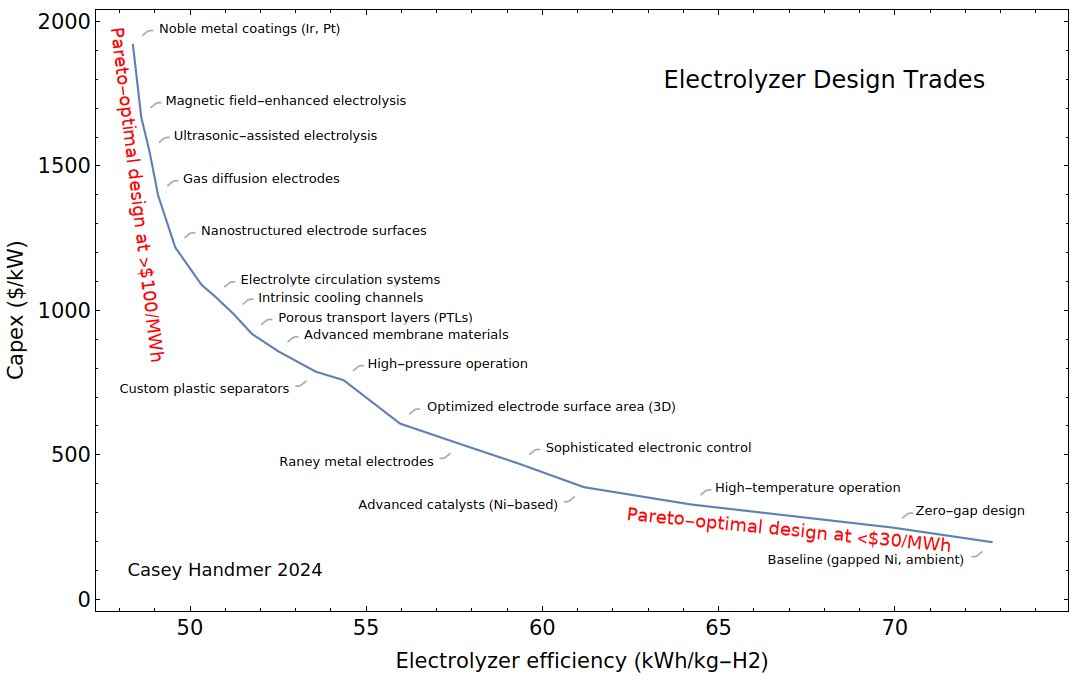
This summer I'll be working at @TerraformIndies, so aside from the usual technical preparation to not feel like a total idiot when I start, I've done an analysis of their electrolyzer economics.
I read Klaasnotfound's criticism of Terraform's strategy 53 hours and 23 minutes ago and decided to do the due dilligence for myself with all the time since then, and came to the same conclusion wrt electrolyzer architecture that @CJHandmer did.
Many particularly fun charts in this one!
https://t.co/AJYpwRt6hS
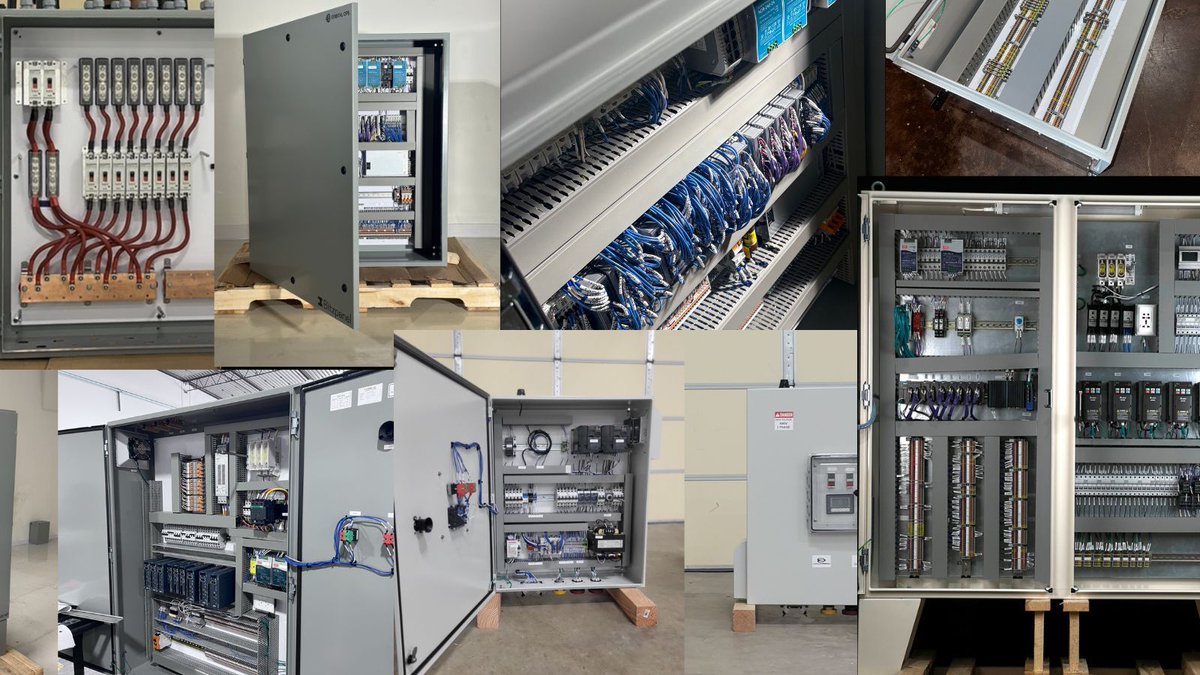
Having spent far too much of my time at Terraform putting together electrical panels (I thought we were here to make CH4 not electrical panels?) excited to see what comes of this
Alright, I see where you’re coming from
This chart is all I’ve seen on Raney electrodes at Terraform, it may be fairly cheap but it’s also directionally inconsistent with the strategy.
Why do you put high pressure as a prerequisite for high temperature operation?
BPRs are cheap but in a few decades Terraformers will have to cost tens of thousands of dollars, which makes them look far less cheap.
Going in the opposite direction and figuring out what trades you have to make to have a completely pumpless electrolyzer (I have a fun idea here that I’m sure others have derived) is far more consistent with the strategy.
Sorry for the imprecise phrasing, 2.5 V is just higher than I expected.
The setup is even cooler in person!
For shunt currents we deal with it the obvious way, just have long thin channels whenever you can, tolerate it when you can’t.
This is one of the most exciting things I've ever done in my life, on par with seeing my hardware run a solar car. Deploying your hardware to the desert is always an amazing test.
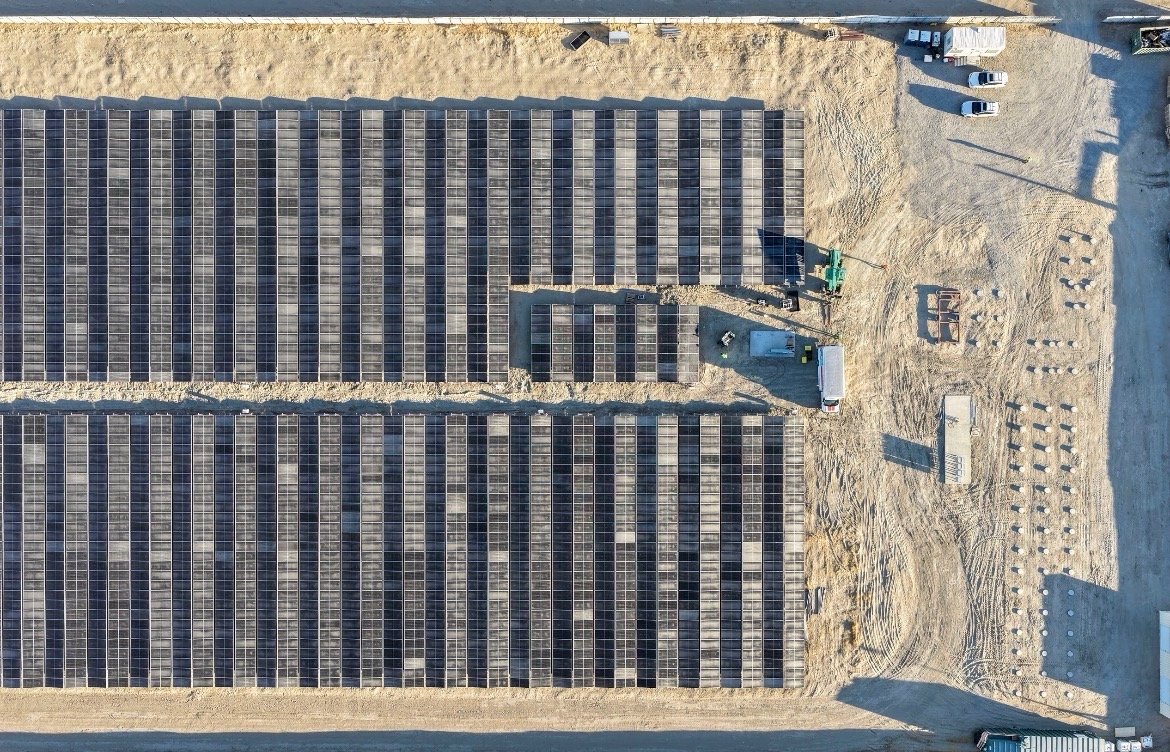
The most striking thing is the ease of setup. Our test rig only has two external connections, the PV solar array and a couple of batteries powering the instrumentation.
We can literally wheel a wagon over to any solar array (of suitale amperage), plug in, and immediately be producing Hydrogen.
There is only one control system on the rig, a contactor. Either you're directly coupled to the array making hydrogen or your not.
This bodes extremely well for building terawatts of electrolyzers and conquering the primary energy layer of civilization!
We will win!
Last week the hydrogen electrolyzer team @terraformindies pulled off yet another first, the sustained production of >99.9% pure H2 from our vertically integrated, California-manufactured electrolyzer stack while it was coupled directly to a solar array at our Muroc desert test site.
WTAF?
Most commercial electrolyzers need carefully conditioned power from expensive battery-meditated backup systems. Ours runs directly off the sun. Clouds pass, the day turns to night, and we maintain purity from a stack whose Bill of Materials cost is well below $100/kW.
Terraform's single-minded focus on capex reduction has allowed us to convert sunlight to hydrogen in an unprecedented demo at a cost below $2/kg. If that wasn't enough, we have a crystal clear plan of steady execution to push that cost below $1/kg in the coming years.
Rather than linger on this point in response to experts-with-spreadsheets who said this was not only beyond my team, it was forbidden by known laws of physics, let me tell you a bit about how we actually pulled this off.
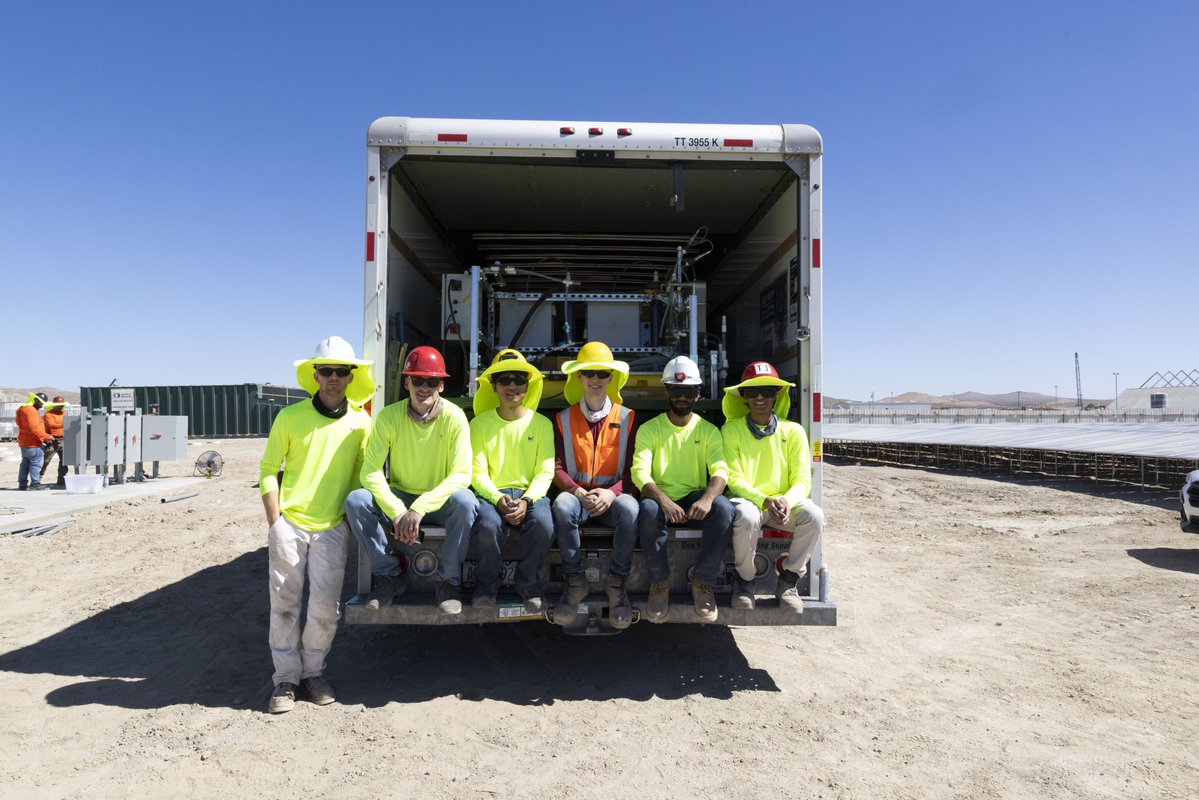
We started building this test site in March. Once the panels and electrics were in place the CO2 team were the first to demonstrate production on site. Close behind them the electrolyzer team planned the logistics necessary to project substantial operational ability into a hostile test site in the middle of nowhere. It's no good to find you're missing a wrench half way through the day!
Much of the test prep was completed before dawn, when the panels go live. The sun came up and the stack immediately started splitting water into hydrogen and oxygen. The team carefully monitored purity and flammability as the sun climbed through the sky. As designed, the stack warmed up and conducted even more power, maintaining solid production until late afternoon when the setting sun shaded the panels.
Terraform's synthetic fuel system is uniquely designed to follow the sun and extract the maximum possible value from cheap solar panels.
Hydrogen is a pernicious molecule. It leaks through and embrittles metals, burns almost invisibly at a wide range of mixtures in air, burns hot and fast and can easily undergo detonation transition, and has about half a dozen other spookily dangerous properties. My advice is to never work with it unless you absolutely have to. The Terraformer produces and consumes H2 in one compact discrete area with a minimum of complexity and fuss, and as expected this demo was completed in accordance with our rigorous safety standards and no unscheduled excitement!
This successful demonstration was also a profound milestone for the team after a testing anomaly last December compelled us to finally rip off the bandaid and move decisively towards the "future design" with half the parts but considerable complexity in assembly. No-one else makes electrolyzers this way and we, more than anyone, know exactly why. And also how to do it anyway, translating directly into a unique cost advantage.
A huge congratulation to Ken, Sherman, @ckalitin, Nikhil, Abdullah, and Aaron for their successful test campaign.
Terraform's hydrogen and CO2 are the chemical precursors for synthetic methane and methanol, which we make in our own synthetic fuel reactor.
Combined, we make oil and gas out of sunlight and air. We are breaking the geological and geographical monopolies on oil production.
In the limit, Terraform will deploy these electrolyzers by the millions and they will all be plug-and-play with solar PV arrays.
The Muroc smoke test campaign is far from over.
We will win!
Well my boss is watching so I can’t give away all the secrets, but:
The premise of Terraform is to delete every single system possible to minimise capex. This lowers efficiency but direct coupling to a solar array makes up for it in electricity costs.
Now, applying this:
Raney Ni catalyst? Sounds like a part we can delete to save capex
Is the 190 psi to minimize evaporation / boiling? We’re atmospheric, delete the BPRs, save capex
Given the size of the array and electrolyzer in the images you could get to a rough current density number, it’s not 4A/cm2
Our ~50% efficiency target gets us to a similar voltage, why is yours so high? Why so high on the IV curve?
@miaoubete@CJHandmer@TerraformIndies Read this blog post closely enough and stare at the graphs for long enough and you can see the implicit initial state assumptions:
https://t.co/bc8lpbfklF
It’s a supplier (let’s see if he likes this post too!), here’s is a pretty nice analysis we did a while ago:
https://t.co/8A8LMnAIod
East-West facing arrays minimises total system LCOE with a smooth power curve. Because peak power is slightly lower and slightly more spread out through the day, your Terraformer can be smaller. Even though south facing arrays have similar mounting requirements and higher power, EW wins on net.
There are plenty of solar companies with similar mounting mechanisms if you want to read up on it, maybe even figure out who did ours if Casey gave a little too much away in some post.
For solar to really get cheap you have to delete everything that isn’t the solar module itself, since the cost of the silicon decreases 20% YoY but the cost of the steel holding it in the ground does not
Here’s my analysis:
https://t.co/0koMqTJEEk
@CJHandmer@TerraformIndies The most interesting part of all of these posts is the images of the very thin EW-mounted PV-system. Is it in-house or verified from a supplier?
@oscilllator We take the water with us
In the limit it’s not a requirement since there’s far more water in the air than co2, so you condense far more than is stoichiometrically required.
@algern0n79@CJHandmer@TerraformIndies With the magic of on demand software you can vibe code your own calculator!
It would take ~900k Terraformers, we plan 100-400M total.
https://t.co/gqaJZDrze9