Often I find myself in a (European) airport with between 5 & 10 books in my carry-on, yet feel compelled to buy a book at the poorly stocked bookstore and only read the one I just bought.
Twenty years ago, I would have called myself nerd for the love of books.
Now, I can confirm that reading has made me literally and metaphorically rich over the time span of the last twenty years.
And it’s a life-long process.
"Buffet has won in a way no one ever has if victory is measured as the product of three things: fortune, time on earth and an almost unblemished reputation for decency" - Bloomberg
My conversation with @DanielSLoeb1, his first ever podcast and one I've been wanting to do for years.
Dan started Third Point in 1995 with $3 million. Today the firm manages over $24 billion across equities, credit, venture, and insurance.
Along the way he wrote some of the most iconic activist letters.
We discuss:
- Why deep value stopped working
- The power of writing
- The Twitter and XAI credit trades
- Lessons from FTX and Danaher
- The Sony and Sotheby's stories
- What makes a great analyst today
- The importance of kindness
I feel lucky we all get to learn from one of the greats.
Enjoy!
Timestamps:
0:00 Intro
2:48 Macro Views and Tech Trends
5:13 The Roots of Third Point
10:30 Evolving to Quality and Thematic Investing
19:07 Market Psychology and Inefficiencies
24:10 Good and Bad Corporate Governance
29:19 Activism
31:23 Sotheby's
41:37 AI
44:28 Sony
52:50 Danaher's Operating System
56:31 Building an Insurance Business
59:25 FTX
1:05:17 What Makes a Great Analyst Today
1:07:24 The Next Decade
1:10:00 Kindest Thing
SPACEX will be the biggest and most expensive IPO I have seen.
Retail, Pension funds and alike will be forced to buy it via the ETF inclusion which was only possible by fully changing multiple rules to create exit liquidity for an overpriced IPO.
Very sad to see this type of rule changing at the expense of all investors.
This is one of the craziest stories ever.
And it's full of insights you can apply in life and work.
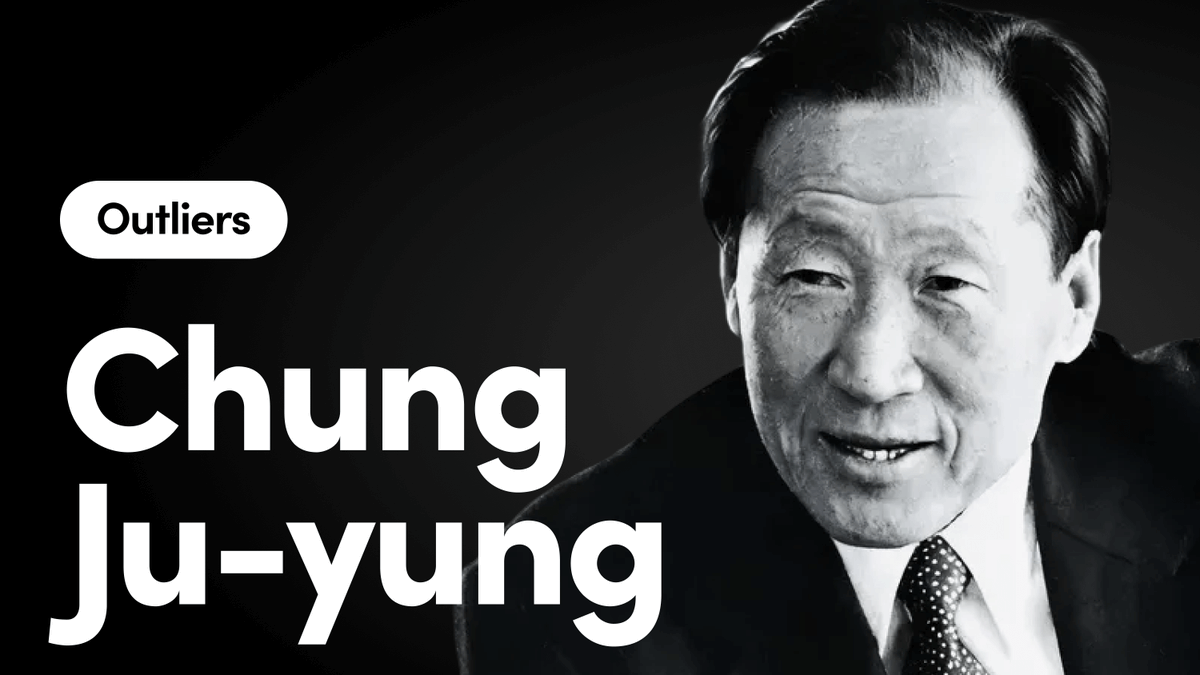
Chung Ju-yung started so poor that he ate tree bark as a kid to survive. Before he passed away, he was one of the ten richest people in the world.
His autobiography describes how he escaped poverty, developed the mindset to succeed, founded Hyundai (one of the world's largest conglomerates), and lifted an entire country out of poverty.
Every time I read this book, I'm inspired to go faster and further.
Listen to his story here:
• Spotify: https://t.co/X3aBx6T761
• Apple: https://t.co/KdPBXhRD1x
Having read an early copy I can tell you this book by my friend, co-author, and former colleague Aaron Brown is fabulous. You should order it.
https://t.co/HPfjMoKc0N
I have finished my in-depth look at the causes of Australia's productivity slump, including:
* housing/planning distort capital allocation
* migration lowers the incentive for capital substitution
* energy costs weaken industrial competitiveness
* manufacturing erosion reduces process innovation capacity
* measured business dynamism is misleading
* R&D and intangible investment are weak
* non-market employment composition drags aggregate productivity
* AI encounters the same institutional constraints
https://t.co/y2Ner7sKEA
#auspol #ausbiz #ausecon
The federal budget unintentionally sparked the debate we need to have as a country and has given voice to a large number of people who have never expressed themselves publicly before.
The debate is about the sort of country we want to be and the role of ambition, incentives, aspiration and wealth creation.
As much as some of us might hate some of the policy Initatives in the budget, we should be thrilled that we are finally having the debate we need to have.
So, Google redesigned the search by making the AI mode default. Now the question is: who and why would still produce new high-quality content if no one will leave Google to visit the web pages?
If no one is visiting your website, you cannot earn from ads and you cannot earn from subscriptions either.
Is Google planning to produce this content using AI? This is hardly imaginable. Or an army of low-pay workers? Again, hard to imagine.
Did anyone ask this question? I mean sure, someone did. What was the answer?
https://t.co/TwhkTmLKak
Its funny how much the whole "strawberry" thing, which turned out to be o1-preview, was dismissed as overhyped at launch when it is clear in retrospect that it was way underhyped.
A direct line from models unable to do basic math to solving unresolved math problems in 18 months.
Another step on my journey looking at Australia's productivity slump. This time electricity costs.
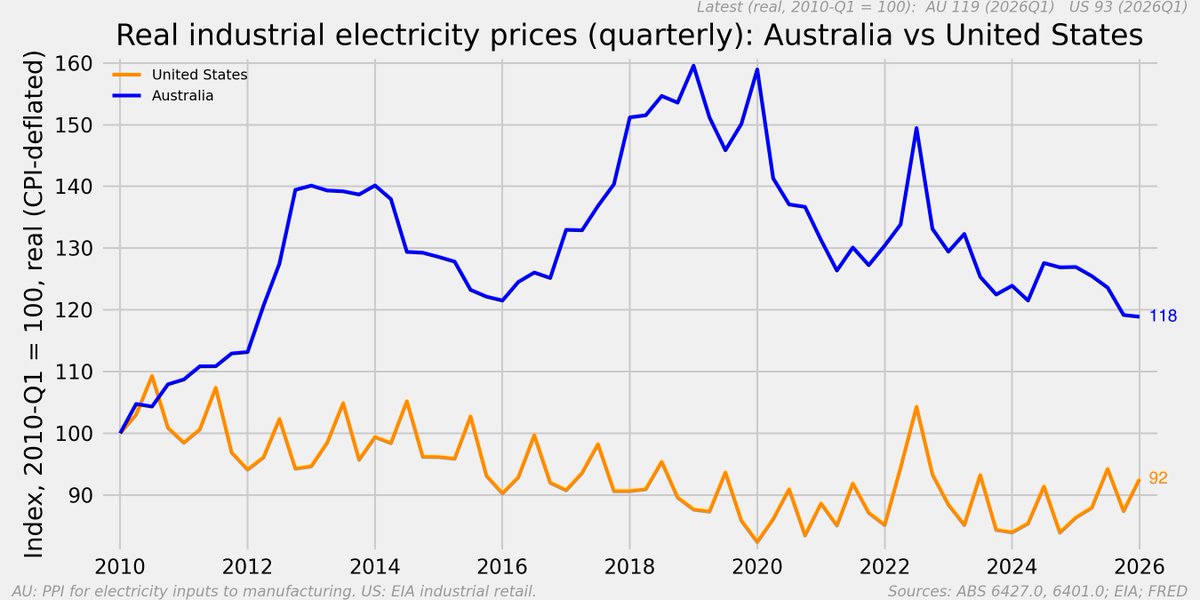
Australian industrial electricity prices are up 18 per cent in real terms since 2010. US industrial electricity prices are down 8 per cent. That's a 26-point relative divergence over fifteen years.
The US went the other way on shale and LNG. Abundant cheap gas pulled industrial electricity prices down and gave US manufacturing a meaningful cost advantage. Australia, sitting on world-scale gas reserves, exported the gas, lost the domestic price advantage, and added grid transition costs on top. Energy-intensive manufacturing has contracted or moved offshore. Cheap industrial energy is a direct productivity dividend for the US. Expensive industrial energy is a direct productivity drag for Australia. Process improvements that depend on energy-intensive capital don't get made when energy costs eat the returns.
The chart shows indices not levels, so it doesn't tell you which country had cheaper power in 2010. It tells you Australia made industrial electricity more expensive while the US made it cheaper.