I don't mean to blow my own trumpet, but happy to report that I rank #29 at LJMU based on the composite indicator (c-score, self-citations excluded); and # 238 in the world in the sub-field of 'Logistics and Transportation' (out of 19,216 researchers).
🟢What can scientists do to avert the climate crisis?
Prof. @KevinClimate visited @ICTA_UAB to give a lecture addressing the deliberate failure of national leaders, whether in politics, business or indeed journalism, to address climate emergency & what science can do about it.
@LISCOtweets LISCO is organising a high-profile event, The Maritime Contribution to Net Zero, bringing together research, business and government communities.
Date: Thursday 14th November 9.00am-1.00pm followed by a networking lunch.
Register for free at https://t.co/AIhjnmGmpd
@TankerTrackers@mercoglianos Greece has the right to extend territorial waters to 12nm but hasn't done it (yet) in the Aegean. Extension to 12 nm might mean that Turkey (hasn't ratified UNCLOS) will declare war to Greece (casus beli). (2/2)
https://t.co/ZDB0lrqnda
@TankerTrackers@mercoglianos map is inaccurate. Greek Law No. 4767 (Jan. 2021) extended waters to 12nm, primarily in the Ionian Sea to Cape Tainaro (peninsula in the left in your map); therefore still 6nm in the Laconian Gulf. (1/2)
@hausfath Zeke, thanks. It seems that the avoided cooling might not be important then. SOx emissions were cut down by 70%+ almost instantly. These were mainly released over the oceans (around ports were already regulated). What is the consensus among climate scientists on this?
@LeonSimons8 CAMS is probably more accurate. CEDS modelling for shipping is very questionable; it is too complicated to explain but see here.
https://t.co/kXM9NMW5w7
Next year probably the IMO will publish the 5th IMO GHG study which will include 2019 and 2020 SOx estimates.
@hausfath@Peters_Glen @piersforster re. the questionable assumptions in CEDS: shipping fuel consumption is overestimated (see 4th IMO GHG study vessel-based int. shipping), residual to total percentage too low, sulphur content (Resid S%=0.78) too high and rather strange way of modelling it too.
@hausfath@Peters_Glen @piersforster re. the questionable assumptions in CEDS: shipping fuel consumption is overestimated (see 4th IMO GHG study vessel-based int. shipping), residual to total percentage too low, sulphur content (Resid S%=0.78) too high and rather strange way of modelling it too.
@hausfath@Peters_Glen @piersforster 8.5Tg SO2 reduction between 2019 and 2020 for shipping alone (Forster,2023) is probably correct by then it gets total SO2 in 2020 (CEDS) to 68.063 Tg. I hope that SO2 emissions for 1A1a_Electricity-public are correct otherwise the total emissions are way lower :)
@iain_staffell Do you agree with the comments though? or do you find them abstract and nonsensical? Many non-native english speakers use ChatGPT for rephrasing.
@LeonSimons8@ClimateOfGavin I did my own calculations based on ACTUAL fuel consumption data; 2020 went below 2 Tg for sure. There is huge uncertainty though because fuels have different sulphur content, all estimates use an average!
Also there are now many vessels (more than 3,000 large) that use scrubbers.
@LeonSimons8@ClimateOfGavin no idea. I checked CEDS today and some of their assumptions are wrong. Could be the definition of international shipping. Both models are based on AIS data and they overestimate the fuel consumption; see https://t.co/b7zfZOwC4X
@LeonSimons8@ClimateOfGavin SOx estimates definatelly wrong. Across the 2010s it was around 9-10 Tg SOx (IMO 2020 Study gives an estimate of 9.25 Tg for 2017). We went from around that in 2019 to around 1.5 Tg in 2020 (around 3 according to CEDS 2024).
@Peters_Glen I feel the shipping SOx (total) estimates are not correct. CEDS projects a reduction from 10,434.68258 ktSO2 in 2020 to 3,012.939263 in 2019. I would argue that the 2019 figure should be approximately half of that, around 1.5 Tg. Not easy to estimate SOx though.
@jukkapekka_j True. Most individuals involved in IMO decisions don't know much about climate science. The push towards alternative fuels incl. H2, methanol, and ammonia, might have unintended consequences. I was surprise to learn that even H2 has a GWP100 of 11.6 ± 2.8 (Sand et al. 2023).
@DrTGBell@SOLAS_IPO New in Boundary Shift: Perspectives on shipping emissions and their impacts on the surface ocean and lower atmosphere: An environmental-social-economic dimension https://t.co/uEsFNhkeJ8
@IMOHQ policies - including the 2023 Revised IMO GHG strategy- do not consider the impact on Climate of SOx reductions, and the potential slippages from the use of, even, clean fuels such as Hydrogen or ammonia. My opinion, this is a very myopic view to address Climate Change!
https://t.co/B4HC1wzCeo
Are SO2 emissions reductions contributing to global warming?
"Scientists conclude that it is too early to attribute the recent exceptional warming to a reduction in shipping emissions undertaken since 2020." #shipping#aerosols#cooling
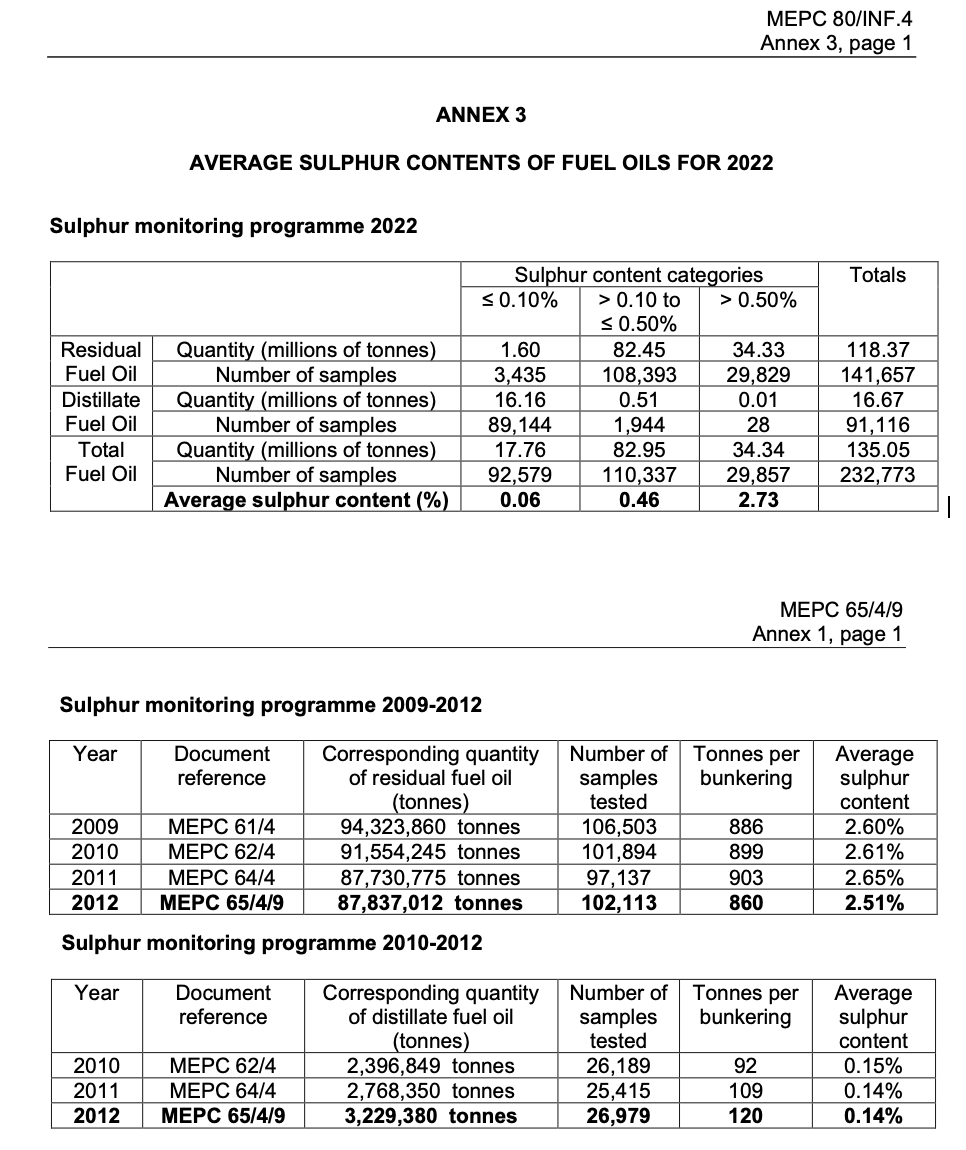
the average sulphur content of residual fuels was 2.51% in 2012 and it went down to 0.51% (2022 data for vessels not using scrubbers). #SOx#emissions are directly related to the sulfur content! Can you connect the dots?