Great callout by @jakedewitte:
Nuclear "waste" in America has roughly as much energy potential as ALL known oil reserves. Globally.
Nuclear waste is not waste.
Video here:
Making it easier to get more geothermal built faster is a huge win. More good-paying jobs, lower energy costs, and greater energy security - that’s what we’re unlocking with today’s reforms.
It prohibits agencies now and in the future from construing this particular EO as authority for a licensing regime. That was where my “ban” framing came from, which is a bit clunky. But you’re correct. It doesn’t bind Congress and a successor (who could strike it with a pen-stroke). It closes one path and leaves every other open.
Overall, Trump’s latest AI EO is fine. It explicitly bans licensing models and never touches the Defense Production Act. But here’s what nobody’s saying: “voluntary” only covers half of it.
Being labeled a “covered frontier model” isn’t voluntary at all. The NSA makes that call through a classified benchmark you can’t see or contest. Only the second step, when you hand over access, is the part you opt into. You can decline the program. You can’t decline the label.
And the no-mandate promise in §3(c)? The same order says, in §5(c), that nothing in it is enforceable in court. So the guarantee protecting you can’t actually be invoked by you.
Voluntary is a policy choice being made today but not a hard limit. We’re one administration away from “shall.”
SITUATION EXPLAINED: Trump just signed his long-awaited AI executive order.
• The government is directed to facilitate access to Mythos for federal agencies, state and local authorities, and critical infrastructure operators
• An "AI cyber clearinghouse" will coordinate vulnerability scanning and patching across government
• Voluntary 30-day pre-release framework: AI developers can share frontier models with the federal government before releasing to other trusted partners
• No mandatory licensing, pre-clearance, or permitting requirement for developing or releasing AI models
@theojaffee: "The government has been directed to facilitate access to covered frontier models including Mythos for government institutions. And the benchmarking only covers cyber capabilities. That seems a little too narrowly scoped."
1/ Proud to announce that, as of last Friday, we (alongside @ckoopman, many thanks) filed an amicus brief in the Supreme Court in Department of the Air Force v. Prutehi Guahan (No. 25-579).
In our brief, we encourage the Court to embrace and expound upon the functional equivalence doctrine: the rule that when Congress assigns a specific environmental decision to a dedicated statutory process (here, RCRA permitting), NEPA’s general environmental procedures should not also have to be fulfilled.
⚡️ NRC Chairman Ho Nieh, interviewed by Utah Governor Cox at the Gigawatt Summit today:
“We are not going to be an impediment to nuclear in the U.S.”
“Over the past 20 years, China has built 60 nuclear power reactors. The U.S. built three. This is a strategic deficit.”
“International buyers want power plants not PowerPoint’s. They won’t buy a reactor that has not been built and deployed by the providing country. This is a problem for us.”
Is the nuclear renaissance real now?
“Yes. I have been at the NRC for 24 years. It is very different now. Many of the rules and regulations are from 50 years ago, and we knew less then. We have retained unneeded regulatory burdens from more uncertain times long ago.”
“We are a solution-oriented regulator. Instead of no, how do we get to yes? Everyone at the NRC is working with a sense of purpose.”
“Germany shut down their nuclear plants after Fukushima, and now they regret it as they seek energy security.”
I’ll be speaking on critical materials for energy dominance this afternoon: https://t.co/MRiGUi1XvK
Latest from @neil_chilson in @WSJ on the AI Overwatch Act. It would replace a presidential scalpel for a congressional sledgehammer and risk doing to American AI what the Jones Act did to American shipbuilding.
This is an abomination. What are we even doing here?
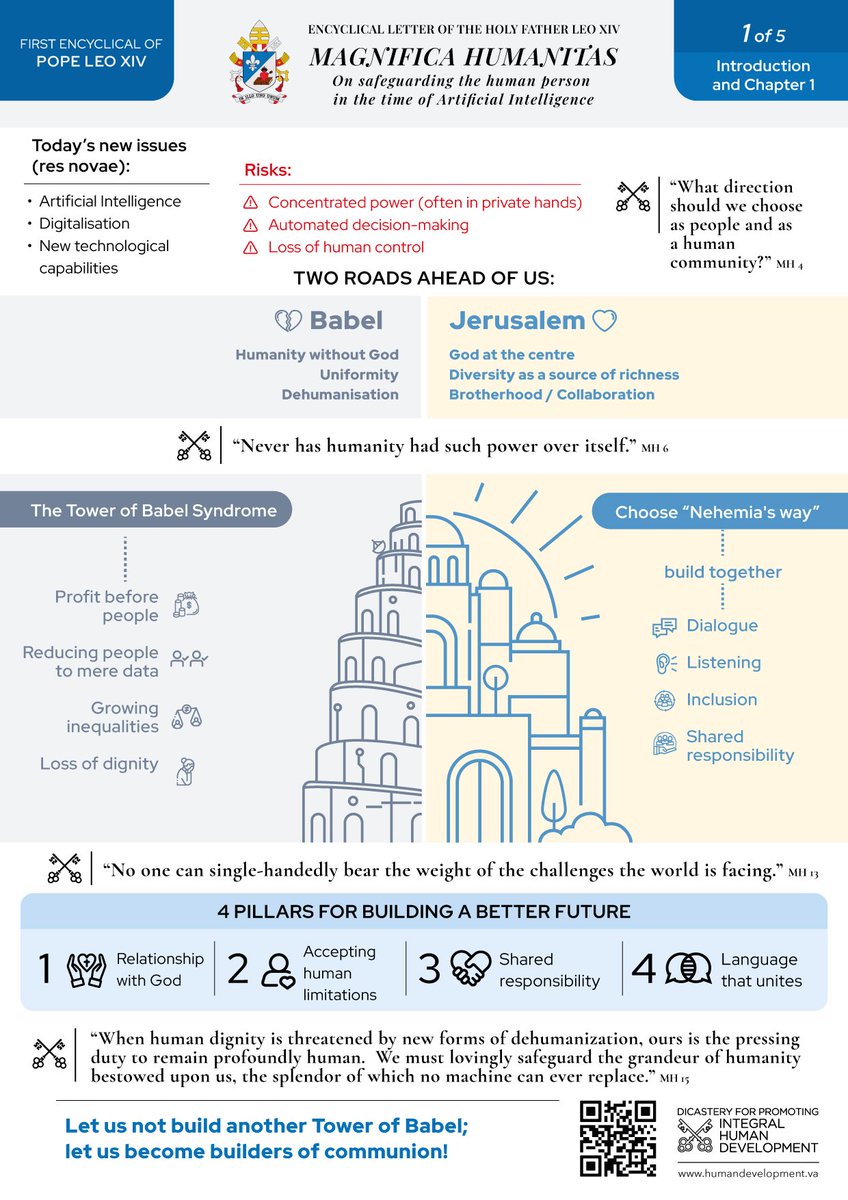
My evaluation of the encyclical has taken a sharp downward turn in the past 36 hours, as we can’t really separate the text from the circumstances and events that gave rise to it, and which follow it.
You just said you don’t trust the Trump administration with this technology. Nationalizing it hands it to whichever administration is in power. Private, distributed, competitive AI is the structural check against the exact scenario you’re worried about. Concentration is the risk. Public or private.
If my posts keep showing up and you don’t want them to, tap the three dots on any of my posts and hit ‘Not interested in this post’ or mute me. Algorithm should adjust pretty quickly. No hard feelings
Latest from @neil_chilson in @WSJ on the AI Overwatch Act. It would replace a presidential scalpel for a congressional sledgehammer and risk doing to American AI what the Jones Act did to American shipbuilding.
If Congress wants American AI dominance, the lever isn't export licenses but maximum deployment. Power plant permitting. Pentagon acquisition. These are the places where China's advantages are becoming hard to reverse. And that's the fight worth having!
And, as Neil explains so succinctly, the empirical case for controls is weakening. Huawei's Ascend 950 is now 3x as powerful as H20 and comparable to the H200 in aggregate system performance. Earlier rounds of controls didn't stop China's progress. Instead what we did was push China to build the stack itself, faster. The CPU market is the control case: Intel and AMD stayed in China, and domestic alternatives never materialized. Pull U.S. firms out, and you get a stronger Huawei.