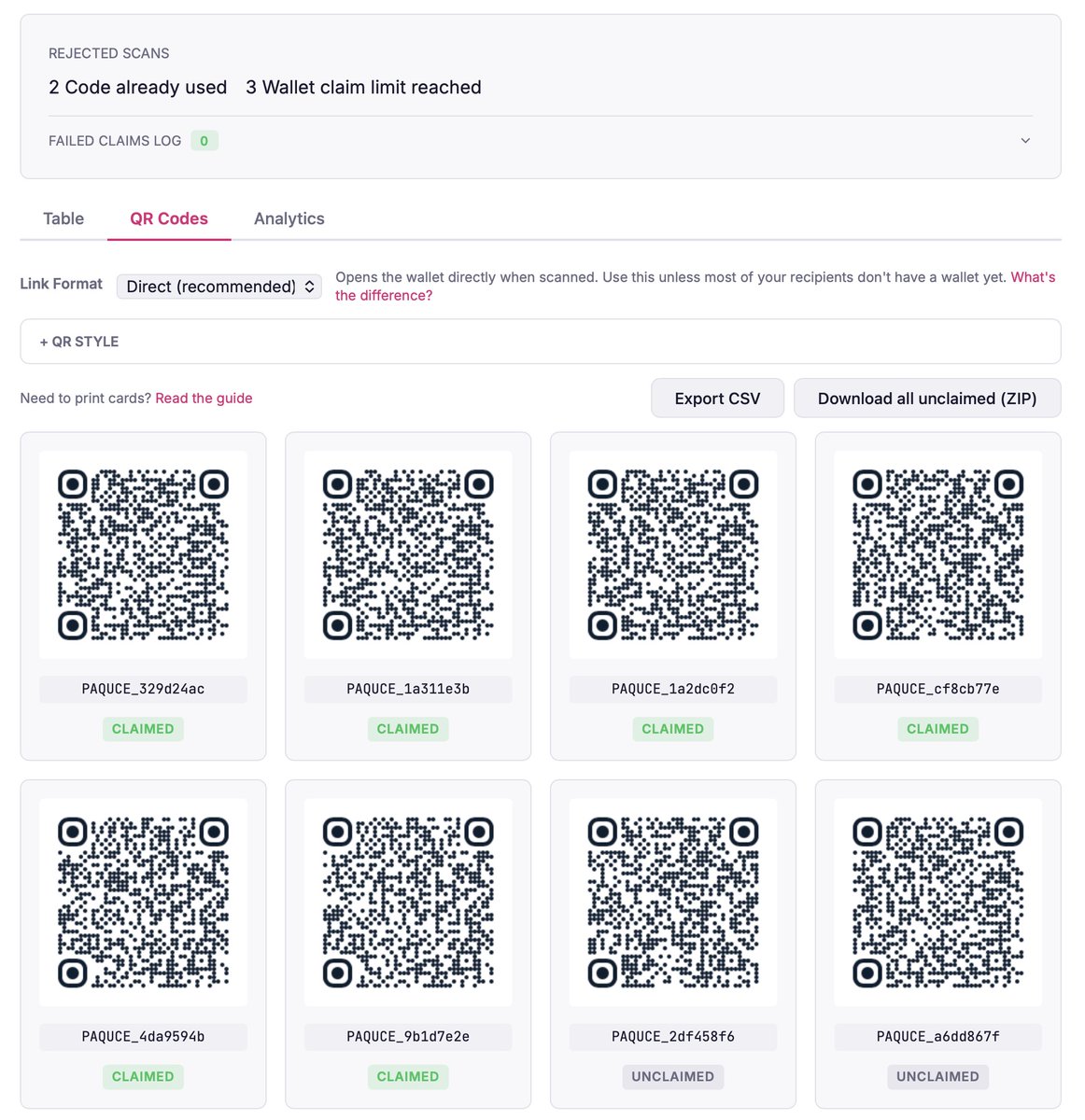
Event next week, badges at the printer, and you are exporting claim QR codes one at a time.
All unclaimed codes now come down as one ZIP. Hand the folder to whoever does the printing and get back to the parts of event prep that need a human. ⤵️
https://t.co/GAbIQSjNQp
This is the best use of a blockchain I have seen in a few weeks.
If any educator needs $ada distribution for a class like this, please reach out and I will move your @claimpaign request/feature need/what not to the front.
In my “Blockchain & Society” class, I love using real examples to help students understand how decentralized ledgers works. This semester, I was able to take things up a notch by using Claude Code to build a custom Cardano Blockchain Explorer as part of our class activity.
My course is generally taken by students who have little to no experience with blockchains or crypto. Many are preparing for careers in technology and information consulting, where they will analyze different systems, assess their organizational value and limitations, and communicate recommendations to clients and decision-makers.
In past years, I have done an exercise where I put a blockchain explorer up on the screen and walk students through how transactions move through the chain. But this time, I wanted them to learn about blockchain transactions by sending real assets over the Cardano network themselves.
For that I had planned out a worksheet and a workflow where each student would receive some ADA, send transactions to each other, and then send some to a common address that I could use as a tracking point for the whole class.
My intention was to use the Claimpaign platform to distribute the ADA, but I didn’t get it set up in time for students to use it in class. As I was getting ready to teach, I realized I would need a different way to get ADA into their wallets. Luckily, I knew that the VESPR wallet lets me use Face ID on my iPhone in place of the signing password, which means I can send a transaction about as fast as I can look at my phone.
So when class began, I explained the activity, passed out the worksheet, and had students install either VESPR or Eternl on their phone or computer. Then I went down each row and manually sent every student 4 ADA to seed their wallet. Thanks to the Face ID option, this did not take me very long to accomplish. As students got set up with their ADA, they started working with a partner on the worksheet, and once everybody had traded with each other, they sent their ADA on to the classroom wallet.
I had originally intended to look at all of this in an ordinary Cardano blockchain explorer, but I was having fun designing the activity, so I asked Claude to build me a custom explorer that would show the transactions and let me reveal the transaction flows my students had engaged in, step by step. (Hat tip to @SmaugPool for the UX inspiration from @pool_pm.)
The whole class worked out fantastically. After students had traded with each other and sent ADA to the classroom wallet, I used the custom explorer to collect the on-chain data via Koios and display it in a way that showed the transactions lined up one next to another. We had a discussion on how the transactions worked and how their structure showed the inputs and outputs we had been discussing in class, not just for Cardano but for Bitcoin as well.
We also talked about how their wallet software was their way of controlling their private keys for the blockchain network, just like the activity from the first week of class where I had them set up PGP key pairs so they could send secure email and get a feel for key-pair cryptography. We discussed the security implications of a mobile software wallet like VESPR compared with cold-storage methods, as well as situations where convenience might be prioritized over stronger safeguards.
Overall, I am extremely happy with how the activity went, and I am thoroughly impressed with the way Claude was able to extend my ability to teach this lesson. While I didn’t strictly need a custom blockchain explorer to show my students the activity they had engaged in on chain, it let me show what was happening exactly the way I wanted so that I could reinforce the lessons I had been teaching in class.
There is a lot of discussion right now about how AI tools are being used by instructors and students. While there are certainly real downsides to becoming over-reliant on AI to build new products and do analysis, there are also ways it makes things better. It is undeniable that most of my students will be graduating into jobs where they will be using AI systems every day. I am actively working to shift my teaching to help them learn how to manage their interactions with these systems. Rather than requiring as many written assignments that could simply be produced by AI, I am doing a lot more hands-on in-class activities like this and asking students to give oral presentations. I have found that the preparation required to explain a concept to your peers is what makes you understand it fully.
I have put the activity in a GitHub repository so that anyone who teaches a blockchain course can use these materials and modify them for their own needs. I hope you find it useful!
https://t.co/1B0T7ZQau6
Someone scans your claim QR with the phone camera. No wallet installed. The link dead-ends, they shrug, they walk on.
That is where event onboarding quietly dies. A claim code has to survive the moment where the visitor has nothing installed yet.
SPOs, Charles needs your vote: the constitutional committee action is past the DRep threshold but still ~7% short, and the Leios hard fork can't be approved without a seated committee.
https://t.co/2y7ur2Uaic
Onboarding at a crypto event used to mean paper wallets: someone else generates your seed phrase, preloads it, and hopes you migrate later. Fine for a demo. Terrible as a habit.
It's an open standard, not a product feature. Any wallet can implement it, any project can run a campaign on it. We're one implementation, not the gatekeeper, and that's the point.
Your ada is not just money. It is a vote.
The moment an attendee claims their first token at your event is the moment to tell them.
New guide on turning holders into participants:
https://t.co/G8wiPeyetU
The Cardano event ends, the onboarding doesn't.
Follow up with the people who claimed: what to do next, where the community lives, what the token unlocks. A claim is a beginning, not a receipt.
Tracking down where the Cardano community meets used to mean three tabs and a group chat you muted months ago.
https://t.co/7aakWWxIu4 just got rebuilt. conferences, hackathons and meetups, online or in person, with filters and a calendar view.
hosting one? add it 👇