Tuesday Tango with @jonahkoch@BeRewt and @Cerkoryn about an Explorer, a X post, a flowchart, Leios, phalanx, zkHEROs, and the positive outcome of asking a question.
https://t.co/MJ6GrhXyfz
Frozen Raptor. Situated at Eglin AFB, Florida, the 46th TW’s McKinley Climatic Laboratory is the largest environmental testing facility on the planet. Often referred to as "the world’s largest refrigerator," this massive hangar serves as a high-stakes torture chamber for the most advanced aircraft in the world.
@CashAnvil Bro this is another example of…
Shelley before Goguen
Voltaire before Basho
These only make sense in Cardano 🏝️
Node diversity before DeFi
We are spending like ~20M ADA to fund <10 individuals to diversify block production…blocks are empty folks 🫠
@CashAnvil Bro this is another example of…
Shelley before Goguen
Voltaire before Basho
These only make sense in Cardano 🏝️
Node diversity before DeFi
We are spending like ~20M ADA to fund <10 individuals to diversify block production…blocks are empty folks 🫠
Why do we keep bailing out companies lol?
You remove catalyst
You remove CB Dao
You remove intersect grants
Companies start failing, you see the pattern. This is what happens when you pick winners and losers based on loyalty.
Why do we keep bailing out companies lol?
You remove catalyst
You remove CB Dao
You remove intersect grants
Companies start failing, you see the pattern. This is what happens when you pick winners and losers based on loyalty.
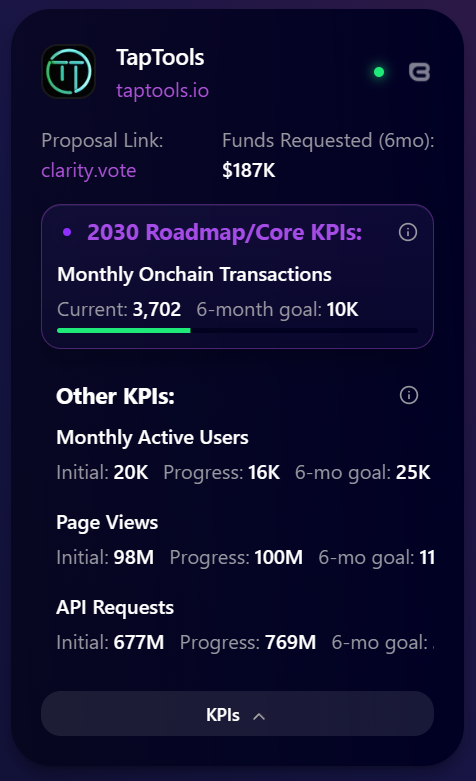
@TapTools Hey @TapTools I understand your running costs are prohibitive is there anywhere where I can learn more about the platform? Do you have an architectural diagram?
I'm a SPO, DevOps/Engineer at @Cardano_CF and I would love to support/take over whatever.
TapTools just can't die.
@CashAnvil The Cardano community needs to start paying attention to what people **DO**, not what they **SAY**.
As in any democracy where political interests exist, some people will say things to please certain groups, but these are just empty words without actions to back them up.
"If all you have done is recreate what already exists, what will you have achieved? Something new that does the same things as the current systems will, without exception, be worse."
The oldest and most significant permissioned blockchain firm, owned by the who's who of banking, has gone all in on @solana
"Permissionless innovation drives growth, including for the incumbents… if only they can get out of their own way."
Really happy to see more founders, startups, and young builders in Vietnam becoming interested in Cardano, governance, and sustainable Web3 development 🇻🇳
The Saigon Founders Meetup & Startup Fair 2026 was more than just a meetup — it was a meaningful space where founders, investors, builders, and communities could openly discuss fundraising, governance, Blockchain, AI, and long-term startup growth.
Thank you to everyone who joined, shared ideas, asked questions, and contributed to the discussions.
Special thanks to:
@Cardano_CF@Cardano@Catalyst_onX@HUBNetworkVN
for supporting community growth and ecosystem development in Vietnam.
📖 Full recap:
https://t.co/qEngt1hxJK
CC: @IOGroupNews@c3eth@mietran0407@Hahero7@VnmeseMarkbui@IlumNguyen@YaoHuynh@HarisNguye80637@HUBNetworkVN@AsiaAfrica_AACC@AsiaCnft
#Cardano #Web3 #Blockchain #CardanoCommunity
Builder tip:
Think about your next work session before ending the current one.
Perhaps, leave yourself a note:
• What's next?
• What's blocked?
• What's the first thing you'll do?
Future-you will thank you.
Momentum loves a clear starting point.
#PieceOfPie#hackathon #gimbalabs
📌 Surfacing Innovation & Growth DAO Feedback and Misconceptions
Chapter 2: Why another funding mechanism?
🔹 Misconception #1
"Why create the Innovation & Growth DAO if Treasury Withdrawals and the Intersect Budget Process already exist?"
This is a fair question.
But I believe it starts from a flawed premise.
The existence of a funding tool does not automatically make it the right tool for every funding need.
The Innovation & Growth DAO is not being proposed because Treasury Withdrawals and Budget Proposals are useless.
It is being proposed because they solve different problems.
If the only funding tool we allow ourselves to use is a hammer labeled "TWGA", every problem starts to look like a nail.
So let’s examine this misconception through four points:
🔹 1. Not every funding decision requires the same governance machinery
Treasury Withdrawals are an important governance mechanism.
They make sense for large, high-impact, ecosystem-level decisions that justify extensive scrutiny from DReps, the Constitutional Committee, SPOs, and the wider community.
But that level of scrutiny comes with a cost.
A Treasury Withdrawal requires proposal review, community discussion, rationale writing, constitutional assessment, voting, and potentially ongoing milestone or quality assurance oversight.
That machinery is not free.
Even when much of the work is voluntary, Cardano still pays for it through time, attention, coordination, and opportunity cost.
Every hour DReps, CC members, SPOs, and community contributors spend reviewing funding requests is an hour not spent building, researching, operating, educating, or contributing in other ways.
That cost may be fully justified for a multi-million ADA initiative.
But it does not scale well when applied to every funding request, regardless of size.
A ₳50k grant and a ₳10M Treasury Withdrawal do not create the same level of risk, complexity, or treasury exposure.
They should not require the same governance machinery either.
Not because small grants are irrelevant.
They are not.
But because the decision process should be proportional to the size, risk, and complexity of the funding request.
Otherwise, the collective cost of reviewing, evaluating, coordinating, and later performing quality assurance on smaller grants can become too large relative to the grant itself.
That is not treasury protection.
It is governance inefficiency.
Different funding needs require different levels of governance overhead.
Treasury Withdrawals are excellent tools for large strategic decisions.
That does not automatically make them the best tool for every funding decision.
If the only funding tool we allow ourselves to use is a hammer labeled “TWGA,” every problem starts to look like a nail.
You do not use a hammer to turn a screw, and you do not need a bazooka to kill a mosquito.
You should not need to mobilize the full governance machinery of DReps, CC members, SPOs, rationales, debates, votes, and oversight to evaluate a ₳50k grant.
🔹 2. Long funding cycles create treasury rush incentives
Treasury Withdrawals and long-cycle budget proposals are valuable governance tools.
But they also create a predictable incentive problem.
When funding demand exceeds available treasury capacity, proposers are encouraged to move early.
The logic is simple:
🔹If I submit now, I may get funded.
🔹If I wait several months, the available treasury capacity will likely have been largely exhausted by proposals submitted earlier in the cycle.
This becomes even stronger when the NCL is defined over a long period, such as one year, 500 days, or more.
The longer the funding horizon, the stronger the incentive to secure resources early.
The result is a treasury rush.
Funding activity becomes concentrated into relatively short periods of intense competition for treasury resources.
Projects compete to secure funding before available capacity is consumed.
That may work reasonably well for large organizations with long planning horizons and dedicated governance resources.
It works much less well for emerging opportunities, unexpected needs, new builders, or projects that appear later in the funding cycle.
A healthy ecosystem should not require contributors to predict every funding need many months in advance.
Nor should it depend exclusively on periodic races for treasury access.
It should also have mechanisms capable of distributing funding more gradually throughout the cycle.
That is another gap a dedicated innovation fund can help address.
🔹 3. Catalyst is paused, leaving a gap in early-stage funding
Catalyst was far from perfect.
But it provided an entry point for:
🔹 New builders
🔹 MVPs
🔹 Local initiatives
🔹 Research experiments
🔹 Grassroots contributors
It provided a place where ideas could be be tested before becoming mature organizations, large products, or ecosystem-wide initiatives.
Today, Catalyst is officially paused. Only operations related to managing proposals already in progress remain active.
No new Catalyst Funds have been announced, and there is currently no confirmed information regarding the launch of a future Fund. In addition, it has been publicly communicated that the budget previously allocated for Funds 15 and 16 will be returned to the treasury.
With Catalyst paused, funding discussions have naturally shifted toward other governance mechanisms. The Intersect Budget Process plays an important role in ecosystem planning and resource allocation, but it is not designed to function as a continuous small-grants mechanism for early-stage experimentation.
Treasury Withdrawals are important, but they are generally better suited for initiatives that already have defined scopes, established teams, clear deliverables, and the organizational capacity to navigate complex governance processes.
As a result, there is currently no active Catalyst funding round serving as an accessible entry point for early-stage experimentation.
And that gap matters.
Innovation rarely emerges on a predictable schedule.
New opportunities, local initiatives, research ideas, MVPs, and promising experiments can appear at any point during a funding cycle.
Without an accessible top-of-funnel funding layer, many of those ideas may never get the opportunity to prove themselves.
So the real question is not whether Treasury Withdrawals and budget proposals exist.
They do.
The real question is how Cardano intends to support early-stage builders and experimentation while Catalyst remains paused.
🔹 4. Resilience should apply to funding, not only infrastructure
Over the past months, Cardano has had serious debates about infrastructure resilience and node diversity.
The Amaru and Dingo Treasury Withdrawals made that discussion very concrete.
Many reasonable arguments were made in favor of strategic redundancy.
Cardano should not depend on a single node implementation, a single client, or a narrow set of infrastructure providers.
I agree with that principle.
But if redundancy matters for the technical stack, why does it matter less for the contributor stack?
Why do we defend decentralization for nodes, clients, and infrastructure while accepting increasing concentration in who can realistically access treasury funding?
Treasury Withdrawals require a 100,000 ADA deposit, governance expertise, stakeholder outreach, community engagement, and the ability to coordinate support from DReps.
Large organizations typically have more resources, visibility, relationships, governance experience, and organizational capacity to navigate that process.
Smaller builders often do not.
Funding systems shape ecosystems.
If Treasury Withdrawals and long-cycle budget processes become the dominant funding pathways, they will naturally favor actors with existing capital, existing networks, and existing organizational capacity.
Over time, this creates a self-reinforcing cycle.
The actors most capable of securing funding become even more capable of securing future funding.
Meanwhile, smaller teams and emerging contributors face increasingly higher barriers to participation.
The result is not only concentration of funding.
It is concentration of development capacity, institutional knowledge, and ecosystem influence within a smaller subset of actors. Gatekeeping.
Infrastructure resilience protects the network we have today.
Funding resilience helps ensure that the ecosystem continues to attract, develop, and retain a diverse set of contributors tomorrow.
👉So the real question is not whether TWGAs and Budget Proposals should exist.
They should.
The real question is what funding layer is still missing between large treasury decisions and early-stage ecosystem experimentation.
That is where the Innovation & Growth DAO enters the discussion.
#Cardano #Governance #Treasury #DRep